Tuesday, June 28, 2016

All the Way

Lyndon Baines Johnson was one of the most consequential presidents in U.S. history--by far--and yet this HBO adaptation of a Broadway play is the first that really tries to paint a picture of this legendary figure. Rob Reiner's film LBJ, due out later this year, will star Woody Harrelson as a younger Johnson, but here with All the Way, the focus is on the first four tumultuous years of a very tumultuous presidency, and so it starts with the sounds of a parade, followed by gunshots. It does not require an MA in History to infer that we are starting in November of 1963, when John F. Kennedy was shot and killed in Dallas, Texas. Someone comes to whisper in Johnson's ear: "He's gone." The "he" is Kennedy, and Johnson is now an "accidental president."

Bryan Cranston, the actor as talented as Kevin Spacey but with less overacting, looks remarkably similar to LBJ. He squints and he glares, he smiles a thousand smiles. His face is wrinkled and his ears are enormous. I haven't read any of the four (soon to be five) biographies of Johnson by renowned historian Robert Caro, but one anecdote from Caro I remember hearing on TV was how Caro went to a rural area of Texas similar to where Johnson grew up in during a pitch-black evening to get a better sense of what life was like in the pre-electrification of rural Texas. Johnson certainly had a tougher upbringing than his predecessor (who is more and more becoming known as an overrated president) and just about all of his successors. It did things to him, and that is visualized through Cranston's performance. Cranston originated the role on Broadway in the play written by Robert Schenkkan that won Best Play at the 2014 Tony Awards. Cranston and Schenkkan are working with probably the most qualified man to direct the televised adaptation: Jay Roach. Roach's most famous films are hilarious comedies: Austin Powers: International Man of Mystery, Meet the Parents, and The Campaign are just a few of them. But he's also worked for HBO in Recount, the story of the stolen 2000 presidential election, and Game Change, which adapted the tell-all tale of the 2008 election and focused on the Sarah Palin episode.

The first major scene in All the Way is Johnson's first address to Congress, and here we see the major players of this story and the impressive actors behind them: Martin Luther King (Anthony Mackie), Hubert Humphrey (Bradley Whitford), Richard Russell (Frank Langella), and J. Edgar Hoover (Stephen Root). LBJ pressures Congress to pass the civil rights legislation that Kennedy had proposed (but dragged his feat on because he really wasn't all that interested). This is the McGuffin of the film: civil rights, and the delicate balance in ensuring its success. Not the remaining parts of the Great Society or Vietnam, but civil rights. And MLK is LBJ's great agitator, supporter, and partner. If this all sounds quite similar to Selma from two years ago, it's because it is. But All the Way is told more from the prospective of Johnson and less of King. So in essence, these two films can be paired together nicely.  

Johnson walks a thin rope. He has to keep the conservative element of the Democratic Party--the Southern wing that has stuck with the Democrats since before the Civil War--from revolting and switching sides. This, as we all know, was a failure. The conservative shift towards the Republican Party accelerated after Johnson's 1964 election victory. He has to satisfy Humphrey and the Senate liberals and the civil rights movement who distrust him and believe he will water down any bill. And he has to do all of this while Vietnam is deteriorating.

This may not be a birth-to-death narrative of Johnson, and rightly so, but all those anecdotes you might recall for history class are sprinkled throughout: him pulling his ears dogs, defecating with the door open as he strategies with his aides, and giving members of Congress the "Johnson treatment," charming and even threatening his opponents. And yes, he did refer to that part of his body as his "bunghole". As was the case with last year's Trumbo (also directed by Roach), Cranston has a tendency to overdo things from time to time. But the one who overacts the most is Root. Most of the time, Root, in his best roles (Office Space, Finding Nemo, The West Wing) gets the notes just right. Here, as FBI Director Hoover, however, he's just as snaky as American mythology apparently dictates he has to be, but this is television, not Broadway. Other than Cranston, it is Whitford who provides the most interesting performance to watch, and it's his best since his days on The West Wing. But it's disappointing that we don't get to see more of Melissa Leo as Lady Bird Johnson. Lady Bird is right behind her husband, where she's "always been," and it reinforces the view most Americans have that the First Ladies are simply there to support their husbands and nothing else. Amanda Taub, the best writer at Vox, wrote an interesting article last September after that awkward GOP debate in which the candidates were asked which women they thought should be placed on American currency. Mike Huckabee showed how serious he was as a presidential candidate by claiming it should be his wife, while Jeb Bush offered Margaret Thatcher (seriously). Chris Christie made a somewhat serious effort by telling the audience that it should be Abigail Adams, but his reasoning was simply that without her we wouldn't be here today because John Adams wouldn't have had the support he needed. First Ladies support and care, nothing else. That's the view this film takes as well.

The first act of All the Way is certainly superior to the second, which drags. It becomes practically Shakespearean as Johnson feels he's being backed into a corner by everyone, and that people aren't being grateful for all he's doing. He succumbs to the worst angels of his nature, growing arrogant, paranoid, and mean, barking orders at Vice President Humphrey. It becomes almost predictable, checking boxes required for most biographical movies. Ultimately, though, this is a very apt film for our times. After all, we currently have a Republican nominee for president who really seems to despise people of color. We are in an era where voting rights are under siege, and apparently it is deeply offensive to many people to say that black lives do in fact matter. A film like All the Way is necessary to remind us of where our country has come from and how we still have not reached the promised land.

Tuesday, May 31, 2016

Captain America: Civil War

Captain America: Civil War, the thirteenth Marvel Cinematic Universe film, is borderline cinematic refuse, an epic movie that may have a consistent mood but nevertheless distrusts its audience to debate the bigger picture. There are working parts that surprisingly do not add up to anything worthwhile. This is not to say that it doesn't have good company, as its predecessor (The Winter Soldier) was only slightly worse. But given that these two film's banality is only dwarfed by other "Cap" movies like The Avengers and The Avengers: Age of Ultron, I'm close to pledging to never watching future Avengers movies. True, Marvel Studios can make good movies. Last year's Ant-Man is an example of that, as well as the near-exceptional Guardians of the Galaxy. But the nicest thing I can say about this part of the Marvel Cinematic Universe is that they just aren't my cup of tea. But there are so many harsher things I can say, and so I shall.

Before my tirade begins, I should at least start by writing that there are some (but very few) enjoyable aspects of this film. Civil War is not as painfully boring as say X-Men: Apocalypse, another dreadfully dull comic book film this summer that lacks as much heart as it does brain. Whereas Apocalypse vomits out some gobbledygook about ancient Egyptian deities (or something), there is an actual allegory in Civil War, a real debate about the role of regulation and oversight, of liberties versus strong offense against the enemy, freedom versus security (which, as we all know, are binary). A successful mission early in the film results (yet again) in high amounts of collateral damage. The Avengers are warned by the Secretary of State (William Holden) that their destruction in the name of peace has cost too many lives. The UN has mandated accords for regulation of the group and their weapons. Tony Stark/Iron Man (Robert Downey, Jr.), an industrialist who surprisingly sides with more government regulation, opposes Cap's attitude and approach. There will be blood.  

I hate to give it to them, but the thought behind the movie deserves some recognition. Critics have rightfully criticized the injudicious destruction and carnage of The Avengers and Man of Steel in a post-9/11 world. Civil War tries to convince its audiences that it's better than that, that it recognizes that when those buildings go down, there are people inside them. But this interesting story is quickly gutted for boom! action!, because why should we expect an audience to pay attention for longer than five minutes? The allegories are disemboweled so quickly, and so they are not the best part of this movie. That honor goes to the return of Spider-Man, who's back after several bad movies. Here, Tom Holland is the young hero from Queens, and he is convinced by Stark to join his side against Steve Rogers/Captain America (Chris Evans). I haven't figured out how to articulate why Spider-Man is such an appealing character, but he very much is, and it is a treat to see him again. In the original Civil War comics, other characters were included, like those from Fantastic Four and X-Men. We should, though, be reminded that Marvel Studios doesn't own all the film rights to every Marvel character. 20th Century Fox owns X-Men, and Sony has owned Spider-Man since the late 1990s. But the deal Sony and Marvel struck very much should benefit both parties involved. While it would have been far more interesting this time, I think, to have Miles Morales, a Black Hispanic, appear instead of Peter Parker again, Holland still does a pretty good job, though his awkward teenager shtick is a bit over the top. He's charming nonetheless.

Spider-Man isn't the only one recruited to join Stark in preventing Rogers from protecting Rogers' friend Bucky Barns/Winter Soldier, who Rogers believes has been framed for the murder of a Wakandan king at a UN meeting. Because of this murder, Stark is able to persuade the heir to that throne, Black Panther (terrifically played by Chadwick Boseman, and whose standalone film will be directed by Ryan Coogler) to join as well. Also joining Stark is Black Widow (Scarlett Johansson), War Machine (Don Cheadle), and Vision (Paul Bettany). Opposed to them are Captain America, Winter Soldier, Falcon (Anthony Mackie), Hawkeye (Jeremy Renner), Scarlet Witch (Elizabeth Olsen), and Ant-Man (Paul Rudd). Just as he did last year, Rudd provides comic relief effortlessly, especially as he causes malfunctions in Iron Man's armor. Most of this fighting, like most of the fighting in the real world, is not necessary. Most, if not all, of it is because of the actions of Helmut Zero, enticingly played by Daniel Bruhl. Love or hate MCU movies, I think the consensus is that most of the villains are dull. Not so with Zero. He may not be as powerful as the Avengers are, but he is just as clever, if not more so. It's easy to accept his decisions when compared to a cinematic world of malicious maniacs.

As I write, I realize that perhaps this movie isn't as bad as I had initially thought. Maybe a second viewing is necessary. But probably not. There's a lot to complain about this movie: Elizabeth Olsen's "accent", a sleep-inducing tunnel chase scene, the superfluous presence of many of these characters. Martin Freeman shows up and does nothing. Seriously--they misused Martin Freeman. I don't know what exactly I'm missing with these movies, and nobody has ever been able to explain why they like them other than they like mindless entertainment, but I suppose I feel happy that so many others seem entertained by them. In the meantime, there are approximately 5,479 MCU movies in the works, so I'm sure I'll like at least a few of them.

Monday, May 30, 2016

The Jungle Book

This version of The Jungle Book feels less like Disney and more like Life of Pi for kids. Or at the very least, it's an adaptation of the very famous story that strives to embrace both Disney and Kipling, without alienating either camp. Shere Khan, the malicious tiger, is here of course, but he's not quite George Sanders. In the 1967 animated film, Shere Khan was debonair. In Disney's first live-action adaptation in 1994, he was more sympathetic, more of a protector of the wild. In this one, directed by Jon Faveau, the former has more weight than the latter, but it is understandable to see why he hates Mowgli so much. The result is something far scarier than anything you saw in the cartoon.

For the very few who have no idea what the story is about, Mowgli (Neel Sethi) is a young boy who has been raised by wolves. But the jungle has become too dangerous for him, for Shere Khan (Idris Elba) possesses a fierce hatred toward man for the scars they gave him, and wishes to annihilate the young boy. "Man is forbidden!" he yells to other animals of the jungle. Bagheera (Ben Kingsley), the black panther who rescued Mowgli, sets out to return Mowgli to the man village, where he will need to be raised as a man. But while it does take a village of animals to raise a man-cub, it takes another to destroy him. It's not simply Shere Khan who tries to kill Mowgli on his odyssey, but also Kaa the snake (Scarlett Johansson) and King Louie the ape (Christopher Walken).

There is a ton of talent in this cast, an eclectic array of some of the best performers around. And yet, the one with unquestionably the toughest task is young Sethi. His Mowgli is just as inquisitive and brave as he needs to, but unlike the title character in the 2005 movie Charlie and the Chocolate Factory, Mowgli doesn't have a solution to every conundrum. He is helpful and courteous, even selfless, but he also gets angry and makes mistakes. That is about Mowgli, so what makes Sethi's portrayal of the character so interesting? The most obvious is how imaginative he must have been during the filming. This is a film shot basically all on a sound stage surrounded by green screens. Other than Jim Henson puppets that were supplied to him, Sethi was acting in make-believe land.

I had mixed feelings about the use of some of the classic songs from the animated version. Bill Murray as Baloo, the bear who befriends Mowgli, does a surprisingly decent job belting out "Bare Necessities," but Walken's solo of "I Wanna Be Like You" is very...Walken. It doesn't feel like a big jazzy showstopper but instead an arbitrary act of look-at-me showmanship. Mowgli's mouth seems to hang open more due to shock at how random the scene is in relation to the rest of the movie than to how scared it must make him. Everyone knows Walken is an entertaining dancer, but in regards to singing, he's no Louis Prima. For the rest of the scene, though, Walken is terrific. He plays King Louie, an invented character from the animated film, not Kipling's stories. In the animated film, Louie is an orangutan, a creature not native to India. Here, Favreau and his crew changed the character to a Gigantopithecus, an extinct ape, and he rules his ape kingdom akin to Malon Brando in Apocalypse Now. It's the film's best scene.  


Overall, this is quite a fun movie to watch. The technology would have been unthinkable ten years ago. The animals, in my mind, still look too obviously unreal, but maybe that's how it should be. Just think of what this technology will make the movies of next decade look like. But technology only goes so far. Story is important, and not just a story we've known for over a century. The story coupled with the visual effects make The Jungle Book feel fresh. The movies Favreau directs are not perfect, but this one is quite good. It's the kind of movie you will be thinking about for a while.

Monday, April 4, 2016

Frank Underwood Would Definitely Lose the Election

Obviously, there are spoilers below.

At the end of the fourth season of the Netflix series House of Cards, President Frank Underwood, the most Machiavellian, murderous politician of our time, is in a serious mess. Journalists are starting to take seriously the allegations that he was involved in the overthrow of his predecessor. His Republican opponent is far ahead of him in polls. Terrorists have just executed an American captive. He has no way out.

It probably goes without saying that in the real world, Underwood would almost certainly lose the upcoming election, even with one of his two-steps-ahead methods up his sleeves. House of Cards is (hopefully) far, far from the real world, but assuming there actually was a President Underwood up for election in 2016, here's an analytical look at his actual chances.

The biggest myth about American elections is that they are a race between two candidates. They are not. They instead are a referendum on the party in power. The winner wins essentially based on how satisfied or disappointed the American electorate is in the incumbent administration. Underwood's short amount of time in office is certainly tumultuous, but he still has elements that favor him. The simplest factor in his favor is that incumbents are really hard to defeat. In the past 11 presidential cycles, only Jimmy Carter and George H.W. Bush lost their re-election bids. Underwood would join them.

Let's consider what "The Keys to the White House" would say about his chances. The Keys system was developed by American historian Allan Lichtman and Russian scientist Vladimir Keilis-Borok in 1981 to predict the popular vote winner of presidential elections using 13 true/false statements (or "keys") based on factors from every presidential race from 1860-1980. If six or more statements are false, the incumbent loses. If you're skeptical of this system, let me mention that it's been quite accurate: the model has accurately predicted every U.S. presidential election from 1984-2012.

Let's use the Keys to predict Underwood's chances of survival:

1. Party Mandate After the midterms, the incumbent party holds more seats in the U.S. House of Representatives than after the previous midterm elections.

The timeline of the fictitious universe of House of Cards starts in 2013 during the Walker Administration. The Speaker of the House of Representatives at the time is Bob Birch (Larry Pine). In an early episode of season four, Underwood is addressing Congress during the State of the Union, and the Speaker is now a Republican. We can assume that the Democrats have lost control of the House of Representatives in 2014.

Verdict: False 

2. Contest There is no serious contest for the incumbent party nomination.

The contested convention, something that almost always dooms the incumbent party, at least in recent history, is one of Underwood's biggest obstacles. A house divided often does not survive election. (Think when then-Governor Ronald Reagan challenged President Gerald Ford, or in 1980 when Senator Ted Kennedy challenged President Jimmy Carter.) Underwood loses a host of states to his opponent, Heather Dunbar (Elizabeth Marvel), a former Solicitor General. Then he is actually challenged by his own Secretary of State Kathy Durant (Kayne Atkinson) at the convention when she learns that Frank has been politicking to get his wife, Claire (Robin Wright) the nomination for vice president and not Durant, as originally promised. This alone should drive a nail in his re-election bid's coffin.

Verdict: False  

3. Incumbency The incumbent candidate is the sitting president.

Despite an assassination attempt, Underwood survives and lives on to be his party's candidate for the general election, helping his party's chances.

Verdict: True

4. Third Party There is no significant third party or independent campaign.

This would have to be a significant third party challenge akin to Theodore Roosevelt in 1912 or Ross Perot in 1992. (Both President Howard Taft and President George H.W. Bush lost those elections.) As of season four of the show, there is no evidence that Underwood would face a third party challenger, and we have no reason to believe he will.

Verdict: True

5. Short Term Economy The economy is not in recession during the election campaign.

We know from season three that the economy is in a slump. Underwood proposes a controversial solution called America Works, a plan with the aim of adding 10 million new jobs, essentially (and unrealistically) doing in 18 months what President Obama did in six years, and bringing about full employment. Aside from the fact that zero employment is impossible, Underwood marches on.

But he has other economic problems. The shortage in gas produces long lines at stations, likely increasing anger at Underwood and increasing the chance of a recession. (The 1979 oil shock resulted in a U.S. recession.)

While the show doesn't explicitly state so, the House of Cards universe is probably going through a recession or recession-like conditions.

Verdict: False

6. Long Term Economy Real per capita economic growth during the term equals or exceeds mean growth during the previous two terms.

This is the most challenging to predict, as, outside of the economic conditions previously mentioned, the show has not revealed what the economic growth is like. For the heck of it, let's just cut Frank some slack and say that despite all his other troubles there is good enough economic growth.

Verdict: True

7. Policy Change The incumbent administration effects major changes in national policy.

It doesn't appear that the Underwood administration is actually able to pass any kind of change in national policy. They make a go for it with gun control reform but likely will come up short.

Verdict: False

8. Social Unrest There is no sustained social unrest during the term. 

There don't appear to be any protests or unrest similar to those of the late 1960s.

Verdict: True

9. Scandal The incumbent administration is untainted by major scandal.

This is by far the biggest obstacle to Underwood's success in 2016. During the final episode of season four, reporter Tom Hammerschmidt (Boris McGiver) and the Washington Herald publish a chronicle of the revolting ways Underwood made his way to the top, including orchestrating the overthrow of his predecessor. While the revelation that he also murdered two people are not included, these charges are serious enough to provide a political maelstrom similar to Watergate.

Verdict: False

10. Foreign/Military Failure The incumbent party suffers no major failure in foreign or military affairs.

In season two, the U.S. (under then-incumbent president Garret Walker, played by Michael Gill) experiences a major trade war with China. In season three, the Underwoods (with Claire as Ambassador to the UN) are dealt a setback with Russia; it's such a serious blow that it serves as the impetus for their marriage troubles we see at the start of season four.

These may be setback, but they do not constitute a foreign or military affair failure akin to "losing China" in 1949 or 9/11.

Verdict: True

11. Foreign/Military Success The incumbent party achieves a major success in foreign of military affairs.

If you need examples of this one, think of the Bin Laden raid in 2011 or the peace treaty between Egypt and Israel in 1979 (even though Carter still lost in 1980). If anything, the Underwoods experience tense situations in foreign policy, especially with regards to Russia. Claire does score a victory by negotiating with Russia while Frank is fighting for his life in the hospital, but nevertheless it's not a major foreign policy victory.

Verdict: False 

12. Incumbent charisma The incumbent party candidate is charismatic or a national hero.

As his rivals for the presidency point out, Underwood has never served in the military. And despite his Southern charm (and reminding ourselves that his fellow citizens are not aware that he actually threw a woman in front of a moving train), Underwood is not a charismatic candidate like Franklin Roosevelt, John Kennedy, Ronald Reagan, or Barack Obama.

Verdict: False

13. Challenger charisma The challenging part candidate is not charismatic or a national hero.

Kinnaman plays Conway as a tough (almost macho), youthful candidate opposite the ailing Underwood. His Kennedy-esque photogenic qualities put him on magazine cover after magazine cover, and his military record stands in contrast to the lack of service from Underwood.

But like Underwood, he may have charm, but he doesn't have charisma, and his military service in Afghanistan does not make him an almost mythical national hero in the eyes of the public similar to Ulysses S. Grant or Dwight Eisenhower.

Verdict: True


Frank Underwood probably has at least seven false keys, absolutely assuring us that he would lose to Conway. But that wouldn't make for a very entertaining fifth season, would it? This is House of Cards, after all, the only show that succeeded in making The West Wing look like neo-realism. Frank and Claire will find a way out, just as they always do.

Friday, April 1, 2016

Road House

"Pain don't hurt."
-Dalton

There are few action films of the past quarter century as riveting as Road House, the 1989 adrenaline-filled thriller starring Patrick Swayze. Swayze may be better remembered for his roles in The Outsiders, Dirty Dancing, and Ghost, but they all, frankly, are inferior to Road House, a tour de force demonstration of effective film-making, and just about the most fun you could have watching a movie.

Swayze is Dalton, the number-two professional cooler in the country. He's hired to pack his bags and head to Missouri to work at a bar called the Double Deuce (which is just about the coolest name ever). There, he delivers a powerful set of instructions to his team: "All you have to do is follow three simple rules. One, never underestimate your opponent. Expect the unexpected. Two, take it outside. Never start anything inside the bar unless it's absolutely necessary. And three, be nice." This succinct yet brilliant knowledge is one that could be used in virtually any type of workplace.

Co-starring as one hell of a villain is Ben Gazzara, who finally was able to find a role that suited him. Gazzara was terribly misused in sleep-inducing atrocities like Anatomy of a Murder and The Big Lebowski. Here, he was finally handed material worthy of him, and away he went. He holds no punches, so to speak, when slithering about; if anything, he should have chewed up the scenery even more and not held back. Gazzara is Brad Wesley, a business magnate terrorizing the Missouri town where the Double Deuce is located. Wesley is sort of the John Gotti of the South, and only Dalton can stop him. Of course, he'll need help, and help he gets in the form of his very own Obi-Wan Kenobi: the number-one cooler in the country, Wade Garrett, played by legendary Sam Elliott.

In a weaker film, Dalton would be considered a deranged maniac, but here he is a protagonist with a heart, a happy warrior warmly embracing vigilantism, taking the law in his own hands to protect his adopted home. But is this, as philosopher Aeon J. Skolbe (who has written about the ethics of vigilantism in Taxi Driver) might ask, defensive vigilantism or adventuresome vigilantism? One is defensible, the other isn't. I would argue that Dalton embraces more of the former. Of those he defends from the cruel Wesley and his gang is his girlfriend (a doctor played by Kelly Lynch), a local store owner, the man whose pristine farm Dalton stays and meditates at, and many others. Even the Double Deuce starts to prosper thanks to Dalton's protection.

There is a certain degree of seriousness that is present here missing in other motion pictures of the past quarter century. And given that it faced serious competition with a host of 1989 blockbusters (among them The Little Mermaid, Indiana Jones and the Last Crusade, Batman, and License to Kill), it's not surprising why this hidden gem has never received its deserved acclaim. But it's not simply its action scenes and political allegories that make this movie impressive; it's its screenplay. Some of its lines ("I used to fuck guys like you in prison!") are not for everyone, but I truly think that this screenplay could make this movie the Citizen Kane of action flicks.

Forget about Spotlight, last year's Best Picture winner. Forget about the new blockbuster Batman vs. Superman: Dawn of Justice. Forget about classics like 12 Angry Men. Forget about any other movie. Watch Road House, this forgotten treasure, as soon as possible.


HAFD

Tuesday, March 22, 2016

Chi-raq

Spike Lee, whose Do the Right Thing and Malcolm X are among the best films of the past quarter century, and are certainly among the best that have ever dealt with racial issues, has returned to societal themes in his most interesting movie in twenty years. Centering on the gun violence epidemic in Chicago, Chi-raq contains a message we desperately need. If it isn't self-evident, the title is a juxtaposition of Chicago with Iraq; essentially, Lee is arguing what many have for years: that perhaps the U.S. should focus on its own violence problems before making new ones overseas. The film is not perfect, but its frankness is admirable.

At first, like probably most viewers, I was perplexed by the particular vernacular of the characters. As the plot unfolded, however, it suddenly dawned on me: Lee has adapted Lysistrata, the ancient Greek comedy about Athenian women withholding sex from their partners in an attempt to bring peace, for his anti-gun violence story, and what a genius move it was on his part. In case there is any doubt of the connection to the ancient Greek play, Lee naming the protagonist after the character should put any question to rest. (I was in a production of Lystrata in university, so this only further fanned my appreciation.) More evidence of the use of archaic plot devises is having an actor provide the voice of a chorus, or an on-screen narrator. In this role, Lee has cast his frequent collaborator Samuel L. Jackson in a role named Dolomedes. I could not find anything to verify that this was a character in ancient Greece. However, I found that this name comes from the Greek "dolomed," or wily. Jackson must have known this, for his performance is among the most sharp-witted of all the characters here.

In other roles, Lee has put together perhaps the best cast of 2015, with Nick Cannon, Angela Bassett, Jennifer Hudson, Wesley Snipes, and John Cusack among the film's members. But the best of them is Teyonah Parris in the lead role as Lystrata, who early in the film decides that enough is enough. Her boyfriend, a rapper played by Cannon who also takes Chi-raq as his nickname, has nearly been assassinated by a rival gang. Around the same time, she witnesses a mother (Hudson) mourn the death of her young child who was killed in the streets during a gunfight, and eventually leads a group of women (in both rival gangs) to join together and abstain from intercourse to force their male lovers to the peace table. Some of the actors aren't as interesting to watch as the others. It seems pretty clear that Cusack is meant to be Father Michael Pfleger, the Chicago Catholic priest and activist. Pfleger's sermons are enormously over the top (or "passionate," his supporters might say), so it's understandable why Cusack and Lee would take this route, but it seems distracting and out of place.    
It's obvious why Lee has chosen this topic for these times. We are an outlier nation with a serious gun problem. In recent times, there have been more than 30,000 gun deaths each year. Since 1968, more Americans have died from gun violence than from all the American wars combined, and black Americans are twice as likely to die from gun violence than white Americans. Year after year, our representatives in Washington do nothing. They either have a fetish for this kind of thing, or they are completely beholden to their masters at the NRA (or both). Either way, our country is seriously, pathetically messed up, with guns being its primary disease. But while this is a necessary film for these troubling times, it will not do much to change anything. If young children being massacred within the span of a few minutes at their elementary school in addition to the tens of thousands of Americans who have died each year from gun violence has not sparked a reaction among this country to really tackle this crisis, then a Spike Lee Joint won't either. Maybe preventing our male-dominated government from having sex will.

Thursday, March 3, 2016

The Trouble With Harry

There is a man dead, lying in the grass peacefully. A variety of characters all seem quite morbidly calm about the whole thing as they pass him by. The first to see him, an older retired navy captain named Albert Wiles (Edmund Gwenn, best known by today's audiences for his Academy Award-winning role as Kris Kringle in Miracle on 34th Street), is constantly red-faced and by far the most fun to watch. He's on a hunting trip and believes he killed the man, who we come to know is named Harry, Harry Worp. He doesn't seem to be all that concerned. Even Harry's ex-wife, played by Shirley MacLaine in her debut movie, shows up and finds the whole thing humorously ordinary, telling her young boy that they will be lucky if Mr. Harry doesn't wake up from his deep sleep.

Wiles decides it's time to start flirting with a local lady named Ivy Gravely (Mildred Natwick) over blueberry muffins and elderberry wine; there surely must be something satirical about this situation. There's rarely been an eclectic array of such peculiar characters juxtaposed with beautiful autumn Vista Vision colors in a movie directed by Alfred Hitchcock. Fall trees, a one-room market, colorful paintings, and a dead man; most of the time, we just see his feet. It's a fairly far-fetched start.

There's a lot of 1950s overacting in the film that needs to be seen through the lens of hindsight, but most of the leads do a fine enough job. Even the young kid (played by Jerry Mathers, immortal to American audiences for the television show Leave It to Beaver) provides some proficient acting. Of all Hitchcock's female leads, MacLaine would go on to be the most successful; she's a living legend. As previously mentioned, Gwenn is the most interesting to watch and is certainly given the best dialogue. Another man shows up and steals Harry's shoes. Another decides to stop and do a painting of Harry. "Next thing you know," Wiles complains to himself, "they'll be televising the whole thing."

Despite all the autumn leaves and sweet lemonade, this New England town seems to exist in a world far darker than anything in Psycho or Rebecca. But soon the characters at least care about what kind of burial and funeral Harry is to have--a spot facing West, perhaps, so he can watch the sunset. They won't report his death to the authorities, but they'll make sure he has pretty views in the afterlife. In the meantime, however, the characters become convinced that they are not convinced how how he actually died, and the whole thing becomes sort of like a whodunnit Clue-esque caper story, a series of unfortunate, anomalous events.

The Trouble With Harry is not the most intriguing or exciting film Alfred Hitchcock directed, and it's filled with moments where some of the characters make decisions so outrageously stupid that they're hard to buy. It certainly has its moments though. Bernard Hermann's theme is just as interesting, though not as memorable, as his other scores for Hitchcock, though it was their first collaboration. There's a door that periodically opens in a rather eerie manner. If Ernst Lubitsch could do more with a closed door than other directors could with an open zipper, as Billy Wilder said, then perhaps Hitchcock could do more to inspire thrills with the opening of a door than lesser directors could with loud bumps in the night.


Sunday, February 21, 2016

Oscar Predictions

Having more or less hit it out of the park two years ago but having egg on my face last year, I've become a bit more cautious in my approach to predicting the winners of next week's Oscars. Perhaps I don't need to, for this looks like a fairly easy year to predict, especially awards like Best Actor and Best Director. Some (like the top award) are far more challenging. For my take on who will win, who should win, and who should have been nominated for awards at next week's Academy Awards, read on.

But before I begin, a word on #OscarsSoWhite: They are. They always have been, and at least for the near future, they always will be. We've known this since 1996, when the media first started reporting on it (in People magazine of all places), and so it shouldn't be surprising, given that the vast majority of its members are male and virtually all of them are white. But their excuse is often to say that they are not the disease but the symptom. This is partially true. The Oscars reward movies made mostly by Hollywood, an industry that does not make movies by, of, or for people of color.

But the Academy has less of a case in the past two years. Last year, Selma, a kind of movie that the Academy usually salivates over, only earned two nominations, and this year, despite a considerable number of potential candidates (like Michael B. Jordan, Corey Hawkins, Ryan Coogler, Idris Elba, Oshea Jackson Jr., Jason Mitchell, Benicio Del Toro, and Samuel L. Jackson, among others), the Oscars nominated mediocre performances from actors like (with all due respect to them) Matt Damon, Mark Ruffalo, and Christian Bale. People, especially people of color, have more than enough reasons to be frustrated. I don't know if the Academy's recent measures will help solve the issue. We'll simply have to wait and see.

But given the lack of diversity in the nominations (and considering just how friggan boring the show in recent years has become), I might not watch them this year.

Beyond that, here are some predictions:

Best Picture
What will win: The Revenant
What should win: Room
What should have been nominated: Inside Out

The Revenant has successfully squeezed by as the front-runner for the top prize, as Spotlight, despite some early buzz and impressive wins, fell behind. Make no mistake about it: this is still very much a horse race, and don't be too surprised if a dark horse movie like Mad Max: Fury Road pulls off an upset. The Revenant is not much better of a movie than Spotlight or some of the other nominees, but the Academy will likely be impressed by just how epic a movie The Revenent is, and it might be able to win by riding Leonardo DiCaprio's coattails, as he's guaranteed a win for his acting in the film.

Best Director
Who will win: Alejandro Gonzalez Innaritu (The Revenant)
Who should win: George Miller (Mad Max: Fury Road)
Who should have been nominated: Ridley Scott (The Martian)

I remain a moviegoer who still is not the biggest fan of Innaritu, but this is his best movie and best work as a director. The Academy might be uninterested in giving it to him again this year (he won last year for Birdman), and it would make him the first since the 1950s.

I'm rooting for George Miller, whose Mad Max: Fury Road is one of the most active movies I've ever seen. That being said, both Innaritu and Miller (along with a host of other directors in the past several years) have succeeded in making movies look authentic again, and so both should be applauded.

Best Actress
Who will win: Brie Larson (Room)
Who should win: Brie Larson (Room)

Brie Larson is simply astonishing in Room, the best film of the year and perhaps the decade. She plays a kidnapped mother who has been forced to raise her young son (played by Jacob Tremblay) in a shed they've been held hostage in for years. This is the most emotionally intense performance of the year, and yet Larson makes it look incredibly easy. She also deserves praise for working so well with a young actor like Tremblay, and it's a real shame that he was not nominated. Tremblay not receiving a nomination is the rob of the year.

Best Actor
Who will win: Leonardo DiCaprio (The Revenant)
Who should win: Leonardo DiCaprio (The Revenant)
Who should have been nominated: Michael B. Jordan (Creed)

Like Larson, DiCaprio also gives a rather messianic and committed performance. It's not a very vocal performance, as he's often alone in the wilderness and his throat has been damaged by a bear attack, so more is required of him. As many have pointed out, it's as if he's doing his very best to scream loudly and clearly at the Academy that if surviving filming in the harsh winter of North America won't win him an Oscar, nothing will.

Best Supporting Actress
Who will win: Alicia Vikander (The Danish Girl)
Who should win: Alicia Vikander (The Danish Girl)

Vikander had an amazing 2015, and in The Danish Girl as artist Gerda Wegener (the wife of artist Lill Elbe, who became one of the first to receive sex reassignment surgery), she shows a variety of different qualities: smart, funny, vulnerable, angry, sexy, sympathetic. If Vikander has shown us just how tremendous she can be in the movies, particularly with The Danish Girl and Ex Machina, just think of what a wonder she will be to watch in the future. I can't wait to see what she'll show us next.

Note: You may have noticed that there are no "who should have been nominated" for both female acting categories. Hollywood has a problem with racial diversity; they also have a problem with gender diversity. Year after year, there are enormous amounts of great male roles and fewer female ones.

Best Supporting Actor
Who will win: Sylvester Stallone (Creed)
Who should win: Sylvester Stallone (Creed)
Who should have been nominated: Idris Elba (Beasts of No Nation)

Stallone in some respects is lucky in that Idris Elba for Beasts of No Nation was not nominated and Mark Rylance for Bridge of Spies never seemed to catch momentum. After winning the Golden Globe and Critics Choice Award, Stallone is in a strong position. Momentum or no momentum, he deserves it. In Creed, the seventh installment of a franchise he helped create in 1976 (he wrote and starred in the first six and was the director of four of them), he may not get beat up like he used to, as he's now the mentor to the son of his former adversary-turned-ally, but his appearance as Rocky Balboa here is a remarkably subtle one, with enormous weight behind it.


Best Original Score
Who will win: Ennio Morricone (The Hateful Eight)
Who should win: Ennio Morricone (The Hateful Eight)
Who should have been nominated: Michael Giacchio (Inside Out)

Ennio Morricone is 87 years old, a legend not only of Italian cinema, but cinema as a whole. His score for The Mission is spiritual, hypnotic, and empowering. Similar adjectives could be used to describe his score for The Untouchables. Morricone's music for The Mission lost to Herbie Hancock for Round Midnight. It was one of five loses out of over 500 scores. His music for The Untouchables wasn't even nominated.

Morricone might be most recognizable for his western films music, even though, as he has pointed out in the past, westerns only account for eight percent of his music. Still, you'd be hard-pressed to find someone who hasn't heard his music for Sergio Leone's Dollars trilogy--A Fistful of Dollars, For a Few Dollars More, and The Good, the Bad, and the Ugly. Like the films of the trilogy, Morricone's music gets better with each one.

Morricone may not like being recognized as a composer for music for westerns, but indeed he is nominated for this year's Academy Awards for The Hateful Eight. But a win for Morricone shouldn't been seen as a career prize. It is, in fact, the best score of the year. It's haunting and appropriately so for such a horrifyingly violent movie.


Other predictions:

Best Visual Effects: Star Wars--The Force Awakens
Best Adapted Screenplay: The Big Short
Best Original Screenplay: Spotlight
Best Documentary: Amy
Best Makeup: Mad Max: Fury Road


Sunday, February 14, 2016

The Revenant

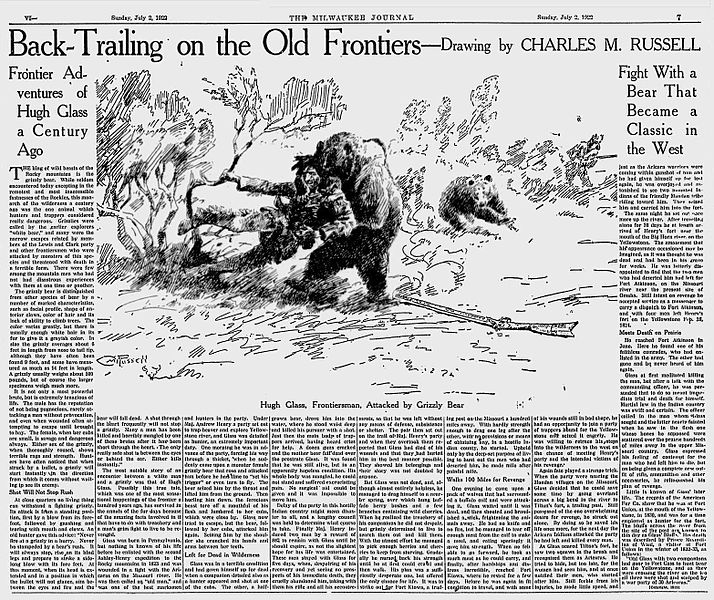
File:Hugh Glass News Article.jpg“Pain is temporary, film is forever.” That quote is from Leonardo DiCaprio in a recent interview. The viewer witnesses in the new film The Revannt just how much DiCaprio apparently believes in this. You could argue that after more than 20 years, he truly wants that Oscar, a prize that has shockingly been denied from him over and over again. DiCaprio earns it here—there's no question about that. In The Revenant, directed by Aalejandro Gonzalez Inarritu, who won three Oscars for Birdman, he plays real-life figure Hugh Glass, who, in 1823, was attached by a bear and left for dead yet crawled back and survived.

This movie is simultaneously a story of survival and a story of revenge. The revenge elements are unfortunately fairly uninspiring. The survival scenes, however, are unlike just about any other you've ever seen. Film critic Patrick Bromley mentioned on his podcast how he sometimes wakes up with neck pain if he sleeps incorrectly on his Swedish mattress. His point was that compared to most people of the mid-19th century, most of us from the present would be long gone if we had to survive in the wilderness of what was then the Dakota Territory. Everyone back then appeared to be horribly malicious, at least from what occurs in this film, and Glass' colleague John Fitzgerald, who was scalped by Indians and therefore deeply hates Glass partly because of his half-Indian son (Forrest Goodluck), particularly so. Fitzgerald is played by Tom Hardy, who had quite a year, having also appeared in the acclaimed Mad Max: Fury Road. Watching Hardy throughout his career, I usually am annoyed by his accents, regardless of what it is; whatever role he plays, it tends to require subtitles. Here, however, he's quite good. It's an intimidating performance; with one single, slow turn of his head, he says more than he needs to throughout the rest of the film.

File:Wpdms nasa topo hugh glass route.jpg
I'm a product of American culture and history, so I know next to nothing about the American Indian tribes depicted here. I can't say how accurate its depictions are, but the days of Anthony Quinn are long gone; there are American Indians cast here, like Melaw Nakehk'o as a young Arikara woman captured by French fur trappers, and Arthur Redcloud as a Pawnee man who assists Glass in his journey home. The other actors are pretty good, too. Domhnall Gleeson (who may be the actor of the year, having also starred in Star Wars--The Force Awakens, Ex Machina, and Brooklyn) is the captain of the party. Will Poulter is also here as a young member of the trappers. who is conflicted about his complacency in what the crew (particularly Fitzgerald) has done to Glass.
 
But DiCaprio is the one everyone is talking about. DiCaprio, it should be noted, does overdo it in a scene or two, but find me a movie in which he doesn't. He almost never relies on his voice for this performance; it's like something from a silent film. Having serious damage to his larynx from the bear attack, he's mostly left to communicate in a tactile manner. This helps DiCaprio, because accents are not his thing. Watch Gangs of New York, The Aviator, The Departed, and Blood Diamond and tell me those are good accents.

Inarritu is not my favorite director, but this is eons better than Birdman. He has taken his cast and crew into the deep, dangerous (and cold) wilderness of the U.S. and Canada to film some absolutely gorgeous locations. There hasn't really been a movie like this in a while, and not since The Grey in 2012 has there been a shoot that has looked so painful. Indeed, the production has come under criticism for the dangerous filming, with one member calling it a "living hell." That being said, Glass escapes death so many times that it's hard not to role one's eyes. He's clinging to death when I think most of us (well, at least me) would easily give up, but why doesn't he? Revenge. When we are pricked, do we not bleed? And when we're left for dead after a bear nearly kills us, do we not really, really want to hurt the jerks who left us?


Thursday, February 11, 2016

The Best Films of 2015 (And the Most Overrated)

Movie Theater
Hey there, cats and kittens.

The year 2015 was not as dismal as 2014 in terms of movies, but it was still not a phenomenal year. There were lots of good movies--movies as varied as Ant-Man, Slow West, Listen to Me Marlon, and others--and there weren't as many overrated movies. Some of the best of the year were truly phenomenal and should be seen by everyone; some of them include the following:

Paddington
It's disappointing that 2015 featured the return of puppetry with Star Wars and a bear that nearly ate Leonardo DiCaprio in The Revanant, but we still have a CG protagonist in Paddington. Still, this is a great family film, and even though the title character doesn't have an iota of realism in how he looks, he's still a terrific character in a family film championing the role of family. The cast, which includes Ben Winshaw, Sally Hawkins, Julie Walters, and Peter Capaldi, is spot on, and Nicole Kidman does a fine job in her first role (to my knowledge) as the villain. In one particular moment, she's far too nefarious, but that scene is the only blight in this otherwise fine film.

Trainwreck
I was very much prepared to hate this movie. From the few clips I've seen of Amy Schumer's hit Comedy Central show, Inside Amy Schumer, I wasn't impressed. And Trainwreck is a fairly standard rom-com in many respects, mostly poking fun at the genre but then suddenly embracing it. But I quickly loved this hysterical comedy. Schumer plays a woman whose rule is to never spend the night post-sex with a man. She's a "modern chick who does what she wants" and sleeps with whomever she wants, even though she's seeing someone, an incredibly muscular bro who actually is kind of sweet but a little dumb. That character is played by professional wrestler John Cena in one of the film's funniest roles, particularly as he uses sports lingo to talk dirty in the bedroom. Another sports figure who appears (as himself) is the surprisingly hysterical LeBron James, who according to the film, appears to be quite the fan of Downton Abbey. "Listen," he says, "I'm watching it tonight, because I'm not going to practice and all the guys are talking about it and I'm left out." Why exactly did this lose Best Comedy to The Martian (apparently a rip-roaring laugh fest) at the Golden Globes?

Brooklyn
Brooklyn is a simple movie, perhaps the simplest on the list, and yet it is one of the best of the year. It feels like a story we've seen over and over again, and yet it feels so fresh. Its supporting cast is charming, particularly Emory Cohen, Jim Broadbent, Julie Walters, and Domhnall Gleeson. But the real star is of course the lead, Saoirse Ronan, who plays Eilis, a young lady who emigrates from Ireland to the United States in the 1960s. Her performance is one of the very best of the year. In the hands of a weaker writer and director, the choices her character has to make would be much easier from the audience's perspective. Not so with director John Crowley and writer Nick Hornby, adapting Colm Toibin's novel of the same name, who really make just about all the right moves.

Inside Out
Inside Out is a movie that tells children (and adults) that sadness is a necessary, even helpful, emotion. This is the most emotionally powerful Pixar film since WALL-E and Up, and while it's not as unforgettable as those films, it deserves to be in their rank. Few animated films look anywhere near this incredible, and what a cast to back it all up, including Amy Poehler, Phyllis Smith, Richard Kind, Bill Hader, Lewis Black, Mindy Kaling, and others. Many were disappointed with Pixar's follow-up later in the year, The Good Dinosaur, and many are nervous about the upcoming sequel to Finding Nemo, but let's hope Pixar still has a plethora of other fantastic tales to tell.

Room
Room is just about as perfect as a movie can be, a movie that had water in my eyes and a lump in my throat for practically its entirety. There are few films this powerful, this well written, this well acted, this well directed, this exceptional in virtually every way. The entire cast is great, but of course the best accolades should go to its two leads, Brie Larson and Jacob Tremblay, who are truly exceptional. Larson (who also played Amy Schumer's sister in Trainwreck) hands-down deserves the Oscar. This might be the best movie of the decade.

Note: The trailer for Room is the reason why there should be no movie trailers at all. I was stunned to watch it (fortunately, after I had seen the film) and to see that a pivotal moment in the movie is completely revealed in the trailer. Don't watch the trailer before seeing the movie!

Honorable Mentions

Ex Machina
Ex Machina is the best science fiction film of the year, giving us a terrific directorial debut from screenwriter Alex Garland and three great performances from Alicia Vikander, Domhnall Gleeson, and Oscar Isaac. All three of these stars had a phenomenal 2015, with Vikander the front-runner for an Academy Award for The Danish Girl, and Isaac and Gleeson appearing in the biggest film of the year: Star Wars--The Force Awakens. Gleeson may have overdone it in Star Wars, but he was charming in Brooklyn and vulnerable here in Ex Machina. Vikander's role, particularly during the climax, is haunting, and Isaac definitely performs the dance of the year in the film's lone offbeat comedic scene.

What We Do In the Shadows
What We Do In the Shadows has a much funnier first half than second. Upon second thought, I realize that I watched the first half in the hospital right before my tonsillectomy, and the second half right after, so that probably had something to do with my reaction. Still, this mockumentary from New Zealand about vampires is one of the funniest of the year.

I Am Big Bird: The Carol Spinney Story
This documentary about Carol Spinney, the man behind Oscar the Grouch and Big Bird, starts off the same sort of bland way that dominated much of the 2011 documentary Being Elmo. The second half, however, really elevates the story, as the viewer truly gets a sense of just how enormous a presence someone like Spinney has remained for the past several decades.

Mission Impossible--Rogue Nation
I never thought there would be a year in which a Mission: Impossible movie would be better than a Bond movie, but in 2015 that was definitely the case. This is the best in the franchise since the first in 1996, and probably justifies its continuing.

The Walk
Sure, Man on Wire won the Oscar for Best Documentary about Philippe Petit, the man who walked on a wire from both towers of the World Trade Center in 1974, but you really cannot understand that feat without having a visual effects powerhouse like what director Robert Zemeckis and his team deliver in The Walk. True, most of the film is good, not great, and Joseph Gordon-Levitt's accent is, well, as a vast majority of respondents in one poll put it: "Sacreblue! He might as well wire walk with a French accordion and a croissant." Still, the final third of the film--the walk--is a tremendous work of special effects.

The Hunting Ground
This is the kind of documentary that will leave your blood boiling. If your friend tries to tell you there is no such thing as rape culture, show them this film.


Best Trailers

Forget my above criticism of trailers for just a moment to appreciate three trailers that I did watch in 2015 and enjoy. If you're going to do a trailer, these film makers show you how to do it right:

3. Creed


2. Suicide Squad (click here to watch the even better second trailer, released this past January)


1. Star Wars--The Force Awakens


Actress of the Year
Alicia Vikander (The Danish Girl, Burnt, The Man From U.N.C.L.E., Ex Machina)

Actor of the Year
Domhnall Gleeson (The Revenant, Star Wars--The Force Awakens, Brooklyn, Ex Machina)

Comebacks of the Year

Jennifer Jason Leigh (Anomalisa, The Hateful Eight)

Kurt Russell (Furious 7, Bone Tomahawk, The Hateful Eight)


But a negative note must end this post. Movies still "aren't what they used to be," at least in terms of quantity. For every great film the critics told us to go out and see, there were twice as many piles of feces they sold us. Some of these films we have ourselves to blame; perhaps if Jurassic World didn't make nearly two billion dollars (and had over seventy percent of critics not liked it), we wouldn't have to suffer through anymore of these. Some of them (Timbuktu) were missed opportunities, others (The Duke of Burgundy) were dreadfully boring, and some were just pure garbage, like the number one pick for the most overrated movies of 2015:

Honorable Mention: White God

10. Girlhood
9. Jurassic World
8. Cinderella
7. Predestination
6. Timbuktu
5. The Duke of Burgundy
4. Testament of Youth
3. The Avengers: Age of Ultron
2. Shaun the Sheep
1. Me and Earl and the Dying Girl

2015 was better than 2014, but let's hope 2016 is better than 2015.