Showing posts with label Barack Obama. Show all posts

Friday, July 29, 2016

The 2016 Election

When Donald Trump admitted way back in July 2015 that he thought John McCain was only "a war hero because he was captured," I thought that was it for him. Mind you, this was after his serious (and false) comments about Mexicans being "rapists," but I figured conservatives didn't really care about that. They did, after all, ignore the 2013 report that bluntly declared that Latinos feel that the GOP "couldn't care less about them."

But then he said Megyn Kelley, a conservative reporter who asked him a fair question about his sexist comments toward women, had "blood coming out of her wherever" when she questioned him. And I thought, "Okay, now they'll ditch him." But the absurdity just kept coming. I mean, I've never seen a presidential candidate brag about his genitals on stage at a debate, have you? I'll admit: I've loved much of it. I mean, this guy is a world-class clown, and clowns are supposed to be funny. But then I remind myself of his calls to ban an entire religious group from entering the country, and his sexism, racism, and apparently even anti-Semitism. (Seriously, Trump voters, you cannot deny that Trump is vehemently racist. What other presidential nominee--or person since the mid-19th century--has ever said out loud "Look at my African-America"?) Then there's his narcissism, his arrogance. And the violence. Oh, the violence. It's terrifying, and he actually encourages it. Trump is the closest thing to Mussolini I think this country has ever seen. (And apparently, Trump likes to tweet Mussolini quotes, but no big deal.) There are numerous stories history has given us of what charismatic autocrats can do once they instill and/or fuel a significant amount of fear in the public. We should heed history's warnings.


Let me say that policy wise, Trump is the least bad of the 17 Republican candidates who ran for the nomination. He is a rare somewhat moderate Republican whose coalition includes independents, less religious voters, and what we used to call Reagan Democrats. He is nowhere near as ideologically far-right as Ted Cruz, who would have been an absolute nightmare as president. Trump's hesitance to embrace interventionism is in stark contrast to Marco Rubio's hawkish neoconservatism. He was right to criticize George W. Bush over 9/11 and the Iraq War (and brave to do it in South Carolina, Bush Country). His views on the welfare state are shockingly reasonable compared to the conservative establishment. I actually agree with him that we need to re-think NATO and pull back a bit from the world stage.  

But he would still be a terrible pick for president, and all Americans should renounce him and his ugly rhetoric. That includes conservatives in this country. To my conservative friends: If you're a conservative, do you really want to vote for Trump? Do you really think a billionaire like him, a man who is rich because his rich father gave him a "small loan of a million dollars," truly cares about the plight of working-class citizens? Do you really think that a man who is illiterate in the Bible really believes in evangelical principles? Do you want to support a serial liar unlike any we've ever seen before? A man who flip-flops on everything? (He supported action against Libya, then opposed it. He favored the Iraq War, then was against it. Was pro-choice, now is pro-life. Just look at what he used to say about Barack Obama and Hillary Clinton!) His authoritarianism is at odds with Tea Party ideals about a limited government for the people. Do you think it's a bit odd that he offered the VP to John Kasich, and that Kasich would be in charge of foreign and domestic policy entirely? Does his remarkable inexperience concern you? Do his connections to the mob bother you? Does his previous use of undocumented Polish workers to build his giant tower diminish the fervor you have for him regarding immigration? A guy who seems to have incestuous feelings for his daughter? His bullying attitude towards people with disabilities? His lies about Muslims on 9/11? The endorsement from North Korea? The KKK? Seriously, what is it going to have to take for you to vote against this monster? Many conservative leaders are opposed to him, and you should be, too. The two living former Republican presidents do not support him, and the Republican party's 2012 presidential nominee Mitt Romney fiercely opposes him. Even Ted Cruz doesn't support him. Supporting him because he "speaks his mind" is not a sufficient reason to support him. His mind is filthy.


How could any of us possibly be at ease with this guy at the helm? When asked on Morning Joe whom he was consulting with regarding foreign policy issues, Trump's response was "himself" because "I've said a lot of things." Seriously. Trump, who assures us he will be tough on ISIS, primarily consults himself. A real estate tycoon with literally zero experience in foreign policy will have his hands on the nuclear codes, and his primary consultant on these matters is himself. If you think I'm being hyperbolic, let me tell you that a Trump presidency now ranks as the third-biggest global threat due to his militaristic tendencies and indifference to nuclear proliferation, among other things. That's how disastrous a President Trump could be. I'm totally at a loss as to why all of this needs to be emphasized and repeated, but apparently it's going to be a very close election.

Many Americans will vote in this election simply because they do not want Trump in the White House. They will hold their noses and vote for Hillary Clinton, the only nominee in U.S. presidential election history who has negative ratings near his. I am not one of these voters. I think Clinton is a tremendous candidate, by far the best the Democrats offered in the primaries. As a child, Clinton dealt with bullies by punching them and proudly telling her mother, "Mommy, I can play with the boys now." Hillary has been playing with the boys for decades now, and she plays the game better than most of them. And that kind of toughness is exactly what we need against the tyrannical bully that is Trump.

A woman who holds the record for the Gallup's most admired woman in America, we know much of her time as First Lady, U.S. Senator, and Secretary of State. Let's not forget about her early roles, whether it was her work on the Watergate Senate committee, her helping to launch Arkansas' first rape crisis center, or her awesome declaration in China in 1995 that women's rights are human rights. But we've also forgotten her more recent accomplishments. While people like Rudy Giuliani reassured the world that the air quality in Ground Zero was safe (which was wrong, resulting in the illness of many recovery workers), there were actual leaders like New York's junior senator, Hillary Clinton, who was instrumental in helping secure over $21 billion in relief for the World Trade Center. As Secretary of State, she prioritized climate change, by far the most pressing issue facing the world. So far, she has shown pretty good judgment in choosing people who will surround her in the White House should she win, first and foremost with her pick of Senator Tim Kaine, a "Pope Francis Catholic" who has been fighting for social justice his entire career. Kaine is respected by his Republican colleagues in the Senate, where he became the first senator to give a speech on the Senate floor entirely in Spanish, and is a fierce opponent of the NRA.


Clinton talks about building bridges, not walls. Instead of allowing a thin skin to inspire her to shout at everyone, she is a listener. I would be lying if I said that the excitement of finally having a female president is one of the reasons why I will be voting for her in November. The U.S. has a rather pathetic record when it comes to electing female politicians, and it's time to end that.

Clinton is not perfect, and I don't agree with her on everything. I worry that unlike President Obama, she has learned the wrong lessons from the mess in Libya. As the New York Times put it, she has "displayed instincts on foreign policy that are more aggressive" than most other Democrats. She probably won't be tough enough with Israel. I disagree with her stance on the death penalty. I tend to lean in the opposite direction of the pro-choice crowd, which obviously puts me in contrast to her and most other liberals. Unlike Sanders, she seems to be hesitant to embrace a more Scandinavia model. But she has earned my vote. Her opposition to guns, embrace of the queer community, and her record of service all have made my decision easy.

And to those thinking of voting for Jill Stein, the Green Party nominee, or Gary Johnson, the Libertarian Party nominee, because you didn't get Bernie Sanders as your Democratic Party nominee, I implore you to reconsider. Yes, it would be nice to have four parties really go at it and let the American people have a real debate. But love it or hate it, we currently have a two-party system and will for some time. Clinton and Sanders actually have a minuscule amount of differences; they certainly rarely disagreed when they in the Senate. Sanders strongly endorses Clinton, and you ought to vote for her. We cannot afford a Trump presidency.


Is this the most important election of our lifetime? Well, that's what they said last time. They said it in 2004, in 1924, and in 1860, and practically all the others. Saying this is the most important election ever is getting a bit dull. But electing Trump over Clinton would have enormous consequences. Just think of what kind of a pariah the U.S. will become with Trump as our leader. We must defeat him, and we must elect Hillary Clinton.

Sunday, June 29, 2014

The Legacy of Barack Obama (Pssst--He's Not the Worst!)

By now you've probably heard about the poll that says Obama is the worst president since the end of World War II. We've still got several years to go, but it seems voters have made up their minds about the man who was to bring us hope, change, and a post-racial America.

The worst president ever?

You can debate whether or not you agree with President Obama's policies, but you can't argue that he hasn't achieved a majority of them. According to Politifact, Obama has basically achieved 69 percent of what he said he would do. Among some of the most significant "promises kept" include bringing troops out of Iraq, seeking verifiable reductions in nuclear warhead stockpiles, and creating new financial regulations, which include the creation of a new Consumer Financial Protection Bureau (created by now-Senator Elizabeth Warren), a financial stability oversight council, an audit of the Federal Reserve, credit card rules, and regulation of over-the-counter derivatives.

Admittedly, there are many "promises broken," and it seems that just about all his policies are controversial. But I'd like to focus on several and argue that now only has President Obama been one of our most consequential presidents ever, but he has also been one of the best.

Is it too really early to talk about Obama's place in history? I don't think so, and neither do a variety of opinions, found here, here, here, here, here, and here, with some authors suggesting that (despite this recent decline in his approval rating) his place could be anywhere from seventeenth best to fourth best. So what is the Obama legacy? We don't have time to go over everything--every accomplishment, every failure, every debate--but I'd at least like to make a few points on the following:  

Health Care and the Economy. President Obama has transformed the U.S. healthcare system profoundly. The Affordable Care Act (aka "Obamacare") alone makes him the single most consequential president in a generation or more.

To understand its significance, one must first understand the state of American healthcare. As John McDonough of the Harvard School of Medicine explains, the U.S. has "far and away" the costliest healthcare in the world. As he has put it, if we're spending so much money relative to other countries, "one might expect we would be doing significantly better." Since 1980, however, costs have skyrocketed.

How are we doing compared to other nations? Not so good. Compared to other higher-income nations, the U.S. usually ranks the lowest (with the U.K. and the Netherlands ranking as the highest). Among care effectiveness and safety, efficiency, and equity, we are usually among the worst. Even though spending is so high (for a variety of reasons), healthcare here isn't performed as well as other developed nations.

The ACA helps fix that. Among its ten titles, the first title alone would be the most aggressive reforms ever. Consider the reforms in Title I (based on Romneycare): Young adults can stay on their parents' plans until 26. Now there is a Medical Loss Ratio, in which insurance companies have to write a rebate check if premium dollars spent were not related to medical costs. (Billions of dollars have been referred back to patients.) Subsidies are now rewarded for people above the Medicaid threshold, and (despite a terribly pathetic start), there are at least 27 federally facilitated marketplaces. All of these allow consumers to better compare which health plan is right for them. All of those are simply in Title I.

Title II was the Medicaid expansion. Contrary to what most people think, for the most part if you're a non-disabled adult with no children, in most states, poor people didn't have access to insurance through Medicaid. Not so anymore. Unfortunately, while the Supreme Court validated Congress' utilization of the individual mandate under its taxing power, it simultaneously declared that states do not have to be forced to be involved in the expansion. 26 states are expanding, while 21 are not (and four are debating). Ohio Republican Governor John Kasich invoked Christianity in his argument to join the expansion: his belief is that when he dies and goes to St. Peter, he's not going to be asked what he did to keep government small, but what he did to help the poor.

But the intransigence of the other Republican governors is puzzling at best and inhumane at worst. Despite the federal government paying 100% of the funds for the first three years, changing the typical 50-80% cost of coverage (so typically, for every dollar a state spends on Medicaid, the feds write a check for 56 cents), many states with conservative governors have refused the funding and instead allow their poorer citizens to continue to suffer. Still, one can be hopeful. Medicaid was crated in 1965 and was optional for states; it took about 5-6 years for a majority of states to join. The last was Arizona--in 1982.

The remaining titles involve changes to Medicare to improve benefits for enrollees to get free annual wellness exams with no cost sharing. Calorie labeling is required on chain restaurant menus for every item. Helping patients quit tobacco is now covered. The cost of the law--about $950 billion (mostly from Titles I and II) are completely self-financed, often through taxes, such as those on tanning beds. And it is expected to lower the federal deficit (although only by a bit).

Beyond the ACA, there was the American Recovery Act, or the "stimulus." There have been few laws as consequential as this one. While most American presidents barely get half of a major bill signed in one term, Obama essentially had five in one within his first month in office: the largest investments in healthcare and science since LBJ, the largest tax cut since Reagan, the largest infrastructure spending since Eisenhower, and the largest investment in education ever. This law has fundamentally changed the country for the better. As Michael Grunwald has written in "The New New Deal," the Recovery Act injected an emergency shot of fiscal stimulus into an economy hemorrhaging 700,000 jobs a month. Moody's, IHS Global Insight, and the CBO have all agreed that it helped enormously.

We have recently had five straight months of job gain above 200,000, the highest since the 1990s tech boom. But have we heard much about it? No. Instead, we hear a lot about this particular poll about how terrible Obama is. President Clinton likes to cite statistics that in the roughly equal amount of years that Democrats and Republicans have controlled the White House since World War II, Democrats have created more jobs. Jordan Weissmann of the Atlantic (of all places) says this is more complex, that it's more due to luck and that there hasn't been consistency among the parties' presidents and their ideologies within their own parties. True to some extent: Barack Obama is not Bill Clinton, who wasn't Jimmy Carter, who wasn't Lyndon Johnson. Ronald Reagan is far different from Dwight Eisenhower. But the point I'd like to make is that Obama has been liberal but also pragmatic on the economy and on other issues, willing to be advantageous (the GM rescue, the Bin Laden raid) and willing to fail (as is the case with gun control, but this is more due to an ignorant Congress and an even dumber--yet tiny--part of the public). Second, Obama has indeed been liberal, and yet liberals have grown cynical of him. And so I ask this of liberals: Is the fervor and excitement you have for Senator Warren any different than what you had for then-Senator Obama? Would a President Warren really be so much more progressive than President Obama? Has there ever been a president who has accomplished as many liberal goals as this one? Even before the regulations of healthcare, the financial institutions, and polluters, the Left, under Obama, got tobacco regulation, massive forest protection, and the Matthew Shepard Act, things they were trying to achieve for years.

Incidentally, "fiscally responsible" House Republicans--who created a several trillion dollar hole in eight years--offered their own version of stimulus in 2009 in the form of a $715 billion, and yet that gets to be defined as fiscal responsibility. And, according to Grunwald, there is a bit of hypocrisy involved: Paul Ryan requested money for green-job training in Wisconsin, Michelle Bachmann and Joe "You Lie!" Wilson also requested funds, as did Mitch McConnell, who wrote five letters for electric car factories in Kentucky. Governors Rick Perry and Jan Brewer both accepted the funds.

These very Republicans like to tell us that the stimulus failed. It did not, at least not according to the 80% of University of Chicago survey of economists who said it lowered unemployment and increased GDP to 3.8% at its peak.

Foreign Policy
When I voted for Obama in 2008, I never, in a million years, figured Osama bin Laden would be killed. I assumed he was long, long gone (dead or alive). But now he's dead, and Obama's the one who got him. As William Dobson said, Obama "exorcised" the demons of the foreign policy mistakes during the Carter and Clinton era.

But what about the crisis in Iraq with ISIS? That's all Obama's fault, right? Well, first of all, it was the Bush administration that not only invaded the country on false pretenses (and recall that it was Obama who rightfully called it a "dumb war"), and it was the Bush administration which negotiated the end date, and it was the al-Maliki regime that insisted (under pressure from the Iranians--oh, the irony) that the Americans leave. This crisis is not Obama's fault, and leaving the country remains one of his greatest accomplishments.

Dylan Matthews at Vox reminds us of six numbers that no one should ever forget: over 126,000 civilian deaths; 4,486 dead American service members; 2 million refugees; $817 billion lost in direct costs and trillions more in indirect costs; Freedom House's rating Iraq's "democracy" as a 6, or "not free," (with the worst possible number being 7), meaning it is essentially as democratic as Iran; and finally, perhaps the most important--0, which is the amount of weapons of mass destruction found. A war based on false pretenses that has completely destroyed a nation. Is it the fault of the current occupant of the Oval Office, or his predecessor?

President Obama's foreign policy has, simply put, been a success.

The Environment
Global warming is the ultimate tragedy of the commons. Coined by Garret Hardin in the 1960s, the idea of the tragedy of the commons is that people share a finite resource but are motivated by their own self-interest. Hardin used the idea of a pasture with competing farmers and their cows; one farmer might notice that another farmer has more cows, so he tries to compete. The obvious solution is that the resource is destroyed. "The population problem," he wrote, "has no technical solution; it requires a fundamental extension of morality." Hardin quoted William Foster Llyod, who wrote, "The essence of dramatic tragedy is not unhappiness. It resides in the solemnity of the remorseless working of things." In other words, the problem is not fixable--the resource (the planet, our only home)--is doomed.

President Obama hasn't taken that attitude. He has acted, many times alone without the help of Congress. The fuel efficiency standards he set are estimated to eliminate 1/6 of U.S. aid on imports by 2025. There are also now tightened efficiency standards for light bulbs, furnaces, refrigerators, dishwashers, and air conditioners. Cold-drink vending machines now will reduce enough energy demand to power over a million homes. At least 680,000 low-income homes have been weatherized. Solar power now is the fast-growing industry.

The President should be applauded for his efforts. His administration's record includes pumping tens of billions of dollars into renewable energy and making it immensely difficult for any new coal plant to open unless it can effectively capture its carbon and store it (which at this point is fairly impossible). On June 2, in what Matt Yglesis called the single most important day in Obama's second term, Obama's EPA announced their intent to regulate the CO2 emissions from the nation's coal plants. The New York Times reports that this could result in a 20 percent reduction in CO2 emissions.

One more thing. If somebody has the gall to say that because we had a bad winter, global warming is not man-made, please remind them that not only does the U.N. Intergovernmental Panel on Climate Change strongly state that global warming is happening and humans are behind most of it, but also that the U.S. National Academy of Sciences found that 98 percent of scientists agreed with the theory that mankind was exacerbating global warming. Incidentally, it's called global warming, not Northeast Ohio warming. To paraphrase Justin Gillis, a snowstorm in Cleveland does not extinguish a severe drought in California or devastating forest fires in Russia.

LGBT Issues
Andrew Sullivan and Newsweek were right to call Obama our first gay president. While initially appearing unwilling to fight for these causes, Obama is officially the first sitting president to support same-sex marriage; his Justice Department stopped defending the Defense of Marriage Act (which the Supreme Court eventually partly nullified); he signed the Matthew Shepard and James Byrd, Jr. Act to classify crimes against LGBT individuals as hate crimes. (The law had been blocked for more than a decade.) He proudly repealed a discriminatory and waste-of-money law that never should have been written in the first place: Don't Ask, Don't Tell. Now, LGBT soldiers can serve openly. Regarding transgender equality, he has been the best (and there is no second place among his fellow presidents).

Obama seems to be a communitarian who deeply values human rights and dignity. E pluribus unum is frequently mentioned by him. But would he have been committed to these actions and policies if he were president in 2001? Probably not. In 1996, he claimed to support same-sex marriage (and if this is accurate then he was way ahead of the country) but then he became a senator and ran for president in 2008, the year of California's infamous (and now gone) ban on marriage equality. He changed his mind on marriage equality, before changing it again famously before the 2012 election. It has been asked if Obama is leading the fight or riding its waves. It's probably the latter. His actions regarding equality and rights have been phenomenal, though it does seem that his cautiousness has guided him more than a belief that he is marching the country down the moral arc of the universe.

Which brings me to my next point: President Obama certainly has his failings, as all presidents do. He has unfortunately sometimes surrounded himself with bad advisers, especially on education issues. Here's what former under-Secretary of Education Diane Ravitch has to say about the President's record on education:

"The most unexpected supporter of corporate reform was President Barack Obama. Educators enthusiastically supported Obama, expecting that he would eliminate the noxious policies of President Bush's No Child Left Behind. They assumed, given his history as a community organizer and his sympathy for society's least fortunate, that his administration would adopt policies that responded to the needs of children, rather than concentrating on testing and accountability.

The first big surprise for educators occurred when President Obama abandoned Linda Darlin-Hammond and selected Arne Duncan, who had run the low-performing schools of Chicago, as secretary of education. The second big surprise--shock, actually--happened when the Obama administration released the details of Race to the Top, its major initiative, which was designed in Secretary Duncan's office with the help of consultants from the Gates Foundation, the Broad Foundation, and other advocates of high-stakes testing and charter schools.

There was very little difference between Race to the Top and NCLB. The Obama program preserved testing, accountability, and choice at the center of the federal agenda. Race to the Top was even more punitive than NCLB."

Obama is also partly to blame for the death of immigration reform, and his lethal and criminal use of drone strikes could have fundamentally destructive effects in the future. Battles he has fought could likely define him as a war criminal. Ryan Cooper at The Week fiercely declares that Obama could have helped create over a million more jobs had he not become so invested in deficit reduction. He should be held accountable for all these actions.

But still, I am not looking for perfection, for surely there never has been, nor will there ever be, a perfect president. All the presidents, regardless of party or ideology or era, seem to be guilty of at least one terrible thing or another. It seems criminal behavior is simply a job requirement. I am not a single-issue voter, and I avoid litmus tests. As the Vice President likes to say, "Don't compare me to the Almighty--compare me to the alternative."

Mark my words: warts and all, Barack Obama will be remembered as one of America's greatest presidents.

Monday, February 10, 2014

Mitt

File:Mitt and Ann Romney in Altoona, Iowa.jpg
On October 3, 2012, the day of Governor Mitt Romney's triumphant defeat of President Barack Obama in the first presidential debate before the election, I wrote a forceful (to the say the least) article on why I thought Obama should be re-elected over Romney. It was mostly an editorial on reasons I thought Obama was more or less effective as our leader--healthcare, economic stimulus, taking out Bin Laden, LGBT issues, etc. were all covered. The article practically skipped any mention of his opponent, save for the final paragraph. Calling him a "weak opponent," I issued the usual charges: Romney is a flip-flopper. Romney is "severely conservative," as he put it. Romney is bad for the country. "It's not his far-right conservatism, his omnipresence of position changes, or the dire state of our economy and standing in the world should he become president that frighten me," I wrote. "It's his character."

Romney, at that time, disgusted me. His 47 percent comment, addressed here in Gregory Whiteley's new documentary about Romney's campaigns for president, was one of the most blood-boiling comments I had heard from a presidential nominee. I regret questioning Romney's character, and one part of the article I also regret is in reference to Romney's car elevators. The revelation, first revealed in a Politico article from May 12, 2012, opened with this: "At Mitt Romney's proposed beach house, the cars will have their own separate elevator." In the documentary "Mitt," we see a behind-the-scenes moment with Romney and his family, who complain about then-Senator (and now Secretary of State) John Kerry criticizing the Romney family's car garages. "That was because of my wife's MS," one of his sons tells Mitt to say, "you A-hole."

A simple Google search did not show results suggesting Mitt Romney had in fact installed the garages for his wife, Ann, due to her multiple sclerosis. But there's no reason not to believe the defense. The point is that if the defense is true, then criticizing assistance for those with disabilities is further evidence that we're living in hyperpartisan times and that we ought to be ashamed of ourselves. And so Whiteley's documentary does not aspire to be combative, like Michael Moore's "Fahrenheit 9/11," or thoroughly thought provoking, like Errol Morris' "The Fog of War." The aim of this movie is simply to show you the behind-the-scenes of both of Romney's campaign, and perhaps for you even to like one of the most unlikable candidates for president in recent memory. In regards to the second goal, it's actually effective.

How lucky Whiteley was when the Romney family approved of the making of a documentary about his first campaign for president back in 2006; surely he could not have imagined that this would in fact be a six year journey, an intimate portrait unlike that of any other candidate in 2008 or 2012. We are reminded of the fascinating race that was 2008; the Democrats, with their history-making candidates, and the Republicans, awkwardly trying to show the country they weren't George W. Bush. At the time, you will recall, the nomination seemed to be Rudy Giuliani's for the taking (Rudy Giuliani?), and John McCain, who initially started as Giuliani's main opponent, kept sinking and sinking and sinking. Romney stood as sort of the most credible conservative alternative, yet conservatives were very suspicious (and rightfully so) of Romney due to his frequent flip-flops. Romney, aware of this perception, tells his advisers and family members that he is the "flipping Mormon." Watch McCain's sucker punch, seen in the documentary, to Romney, mockingly calling him "the candidate of change."


But also consider Romney's response. He tells McCain that the "I know more about foreign policy than you do" argument is flawed. Romney was right. The first presidential debate between McCain and Obama focused on foreign policy, and yet not only did Obama actually beat McCain, but McCain lost the election, largely because of the Iraq War and the economy. The point I'm trying to make is that Romney is seen frequently in this documentary as a very astute candidate. He humbly calls himself a flawed one, one who doesn't really fit the Republican mold, and yet time after time in this film he is right. 

One time he was wrong however, is the actual election night, which is where our film opens. He doesn't have the president's number. Why would he need it? To concede, of course, and yet he hasn't even written a concession speech. Think of previous failed candidates--Mondale, Dukakis, Dole--they all knew, as everyone did, that they were going to lose. Romney, on the other hand, apparently really thought he was going to win, and who can blame him? After all, he probably was listing to the wrong pundits. (Next time he should read the greatest book on presidential elections, "The Keys to the White House.") One particular scene that I enjoyed was the very final one. I won't reveal it, only to say that it answered a question I'm sure many have had about losing presidential nominees: where do they go when they lose? In this scene, Mitt and Ann Romney seem content, about as content as someone can be who lost two consecutive presidential elections. But they're alive, as are the beautiful members of their family. Life goes on. The long day closes. 

Wednesday, October 3, 2012

Obama 2012

With the first debate on its way in several hours, it's clearly election time. While the race is still close, this is a no-brainer: President Barack Obama should be re-elected.

There are many reasons to vote for a second term for President Obama, economic and non-economic alike. Regarding economic issues, there was his Recovery Act (popularly or unpopularly known as "the stimulus"). Now, ignore just for a moment that both Governor Romney and Congressman Ryan at one point supported stimulative economics and that Ryan, as did many Republicans, supported his state receiving some of those funds.  Ignore also that the country was in severe economic peril and that under virtually any other president, both parties would have come together to help solve the problem. Please ignore the fact that the Recovery Act was less than a trillion dollars worth of stimulus meant to fix a several-trillion dollar problem.

What's impressive beyond all those facts is that the law, according to Jonathan Alter, was essentially five major acts in one: the biggest funding for health care, education, and science since Lyndon Johnson; the biggest tax cut since Ronald Reagan; and the biggest infrastructure spending since Dwight Eisenhower. Many presidents fail to accomplish one major act in eight years; Obama accomplished five in one month. Many conservatives, the Romney team especially, have claimed that Obama's economic recovery failed. They are in disagreement simply with the facts, and you don't have to take my word for it: Mark Zandi (an economic adviser to Senator McCain's presidential campaign) of Moody's concluded that without the programs, gross domestic product would be almost seven percent lower and eight million more people would have been unemployed. I haven't even discussed the best part of the stimulus, that the funding for long-term expansion of green energy, making it the largest green bill in history, which Michael Grunwald explains:


Regarding Grunwald's praise of the President's green energy spending, this contrasts of course with the disappointment in the lacking of serious new laws to tackle undoubtedly the biggest problem facing us: global warming. Currently, though, at least the President is dealing with the problem through existing laws by treating carbon dioxide emissions as a pollutant. Compare this to his opponent, who once wrote that he believed climate change was happening and that "human activity is a contributing factor." He quickly changed his mind, surprisingly, and now claims "we don't know" what's causing the problem.


The other day, a Romney supporter, who plans on voting for Romney because he's a businessman (the only businessmen who have been presidents that I know of are Herbert Hoover and the Bushes, so that's not much of a record to bet on), complained to me that President Obama was responsible for the much maligned Troubled Asset Relief Program (TARP), ignoring the fact that one, the program was started under Obama's immediate predecessor, and two, the program has actually made a profit.

It is not simply the Recovery Act that will serve as President Obama's economic legacy. The Dodd-Frank Law, while unfortunately watered-down and not as strong as it should have been (especially since taxes were removed from the law, banks are still too big to fail, and Wall Street's behavior has not changed), nevertheless restored some of the protections needed to avoid another meltdown. Among its chief accomplishments are the creation of the Consumer Protection Agency and the Volcker Rule. (Incidentally, the public is on the President's side.)  And conservatives seem to be deeply (and somewhat justifiably) upset at our deficit situation. I would simply ask them where they were during the Reagan and Bush years, and second, remind them that federal spending is at the lowest it has been since the 1950s. In case you're having trouble opening that link, let me tell you that it's written by the notable socialist newspaper known as the Wall Street Journal and has been verified by the non-partisan Politifact. Consider also that most of what comprises our debt comes from Bush-era policies regarding guns-and-butter and that, should Mr. Romney find himself in the Oval Office, our debt would be severely worse. (If Republicans hate Obama complaining about his predecessor they should talk to this guy.) I haven't even mentioned the unpopular-at-the-time auto bailout, which Mr. Romney insisted was the wrong approach, but now believes he deserves credit for it.  

Aside from economic policies, President Obama has been remarkably successful in terms of social domestic policies and foreign policy. Personally, I was always annoyed at Democrats' inability to fight back against Republicans' outrageous charges. This time, it's Democrats making the dickish charges. They may be dickish, but they aren't untrue. In 2007, then-Senator Obama claimed that if there was evidence that Pakistan was holding Bin Laden and was unwilling to move to apprehend or eliminate him, then the U.S. would. He was criticized both from the left and the right over this. One of his conservative critics was none other than Romney, again campaigning for president, who said that Obama had "gone from Jane Fonda to Dr. Strangelove in one week." It was a clever line, but one which would come back to haunt him (as well as his complaint that it was not worth "moving heaven and Earth" to find Bin Laden). As Bill Clinton eloquently explained, President Obama risked an incredible amount: not simply the position of the United States and his election, but the lives of the Navy SEALs. I didn't vote for Barack Obama thinking he could actually get Osama Bin Laden. By that point, I was convinced Bin Laden was either dead-and-buried or forever hiding in some cave far beyond our reach. I thought that we had permanently lost our chance. That changed in May of 2011. John Kerry put things a bit more bluntly: "Ask Osama Bin Laden if he's better off today than he was four years ago."  Name another election in the past forty years in which the Democrat has the upper-hand against the Republican on foreign policy?


I'm probably boring readers by now by repeating stuff they probably (or at least should) already know. But in case they haven't, let me briefly summarize his other accomplishments: Obama not only supports equal marriage, but also will forever be known as the president who signed the Matthew Shepard Act into law after a decade of failed attempts and who also repealed the discriminatory and waste-of-money, backwards, bigoted policy known as Don't Ask, Don't Tell. The Iraq War is over and our troops in Afghanistan have begun coming home. Not only has the automobile industry been rescued, but they are producing cars with greater fuel efficiency. And finally, likely his greatest domestic achievement, both economic and non-economic, is his health care law, an accomplishment virtually a hundred years worth of presidents couldn't get. With his health care law, the deficit will be reduced, there is a ban on discriminatory rationing regarding pre-existing conditions, Medicaid has been expanded, and some are predicting that it will be the end of for-profit health care.

Has Obama disappointed me? Of course he has, particularly regarding the dangerous, lethal, and immoral policies regarding drones. And the way I see it, I agree with the Green Party on ninety percent of the issues, with the Democratic Party on eighty percent, and the Republican Party on about thirty percent (they do have some good ideas).  I don't think we human beings always fit into perfectly defined spaces of left-versus-right.  That being said, why waste my vote on a false sense of ninety percent when I can vote to realistically achieve eighty percent? (And I sure as hell am not going to vote to get only thirty percent.) As the Vice President likes to say, don't compare President Obama to the Almighty, compare him to the alternative.

We will be told by critics after an Obama victory that Republicans lose because they pick moderate candidates. Now, it is true that there was a time when Governor Romney was a moderate, but those days are long gone. He is, as he put it, "severely conservative." And even if that were not the case, Republicans had more than a handful of conservatives to pick from, including Michelle Bachmann, Rick Perry, Newt Gingrich, Herman Cain, Rick Santorum, and Ron Paul (although, based on that list, perhaps it is understandable why they went with Romney; see SNL's take on it). Republicans have essentially attempted to purchase this election (some of them quite single-handedly--"corporations are people, my friend"). But the real reason why Republicans have lost the past four-out-of-five presidential elections and why they will likely lose this one is not because their candidates are too weak (although that is certainly a factor). It's because they haven't changed their game plan and there's no evidence that they will any time soon. The base of the Republican Party--white, working class males--is shrinking, while the base of the Democratic Party--minorities--is growing. Romney is expected to do even worse among Hispanics this election than McCain did four years ago, and he has no one to blame but himself (and his harsh rhetoric against the "forty-seven percent" of "victims" and his opposition to the Dream Act).      


Obama simply isn't just a very good president; he is also up against an incredibly weak opponent. Romney has changed his opinion on virtually every issue--abortion, the Reagan/Bush years, stimulus, LGBT rights, gun control, etc. As someone once said, you're only allowed a certain amount of flip-flops before the American people doubt your character. Republicans have moved so far to the right that it's frightening (imagine President Reagan, who pulled out of Lebanon after an attack, raised taxes and the debt ceiling both around ten times, and supported closing tax loopholes, with today's Tea Party). Romney has happily embraced these ideologies. And we've heard a lot about his low tax rate, his overseas banking, and his love of Olympic horses, and pretty Michigan trees. It's not simply his far-right conservatism, his omnipresence of position changes, or the dire state of our economy and standing in the world should he become president that frighten me. It's his character. The video below should make your stomach so sick that you would have more than enough reasons to vote against Mitt Romney. Compare this to the character of President Obama. President Obama has had to deal with an opposition of intransigence whose own leaders have publicly admitted that their biggest goal was to make Obama a one-term president. He has had to deal with reporters and interviewers interrupting his answers to their own questions, as well as congressional representatives shouting out that he is a liar. He has had his faith and birth questioned. Through this all, he has shown remarkable composure and humor. The best example of this was during the Bin Laden raid; the week began with the release of his birth certificates while he rightfully claimed that he had more important things to do, then was hilarious at the White House Correspondents Dinner--even while comedian Seth Myers made a joke about Bin Laden--and only several days later, announced that Bin Laden had been killed. Remarkable.

Vote for Obama.


Finally, there's also this.
  

Thursday, December 8, 2011

The Ides of March

"The Ides of March have come."
"Ay, Caesar; but not gone."

This is a most unique political tale. Every once and a while, there's a candidate to restore law and order, to never lie to us, to be the man from Hope, to be a uniter and not a divider, and to be the change we have been waiting for. While there is one side that generally sides with loyalty and discipline, another is disorganized, panicky and whiny. The latter side needs some growing up, and if the latter side is American liberalism, and George Clooney's "The Ides of March" is a movie by, of and (some would argue) for liberals, so this might be a good film to provide some needed medicine.

Ryan Gosling is Stephen Myers, a young and successful campaign adviser to Mike Morris (George Clooney), the governor of Pennsylvania and a popular candidate for president. While Morris is in the lead against his rival for the Democratic nomination, both campaigns are dueling in the must-win state of Ohio, while also trying to secure the endorsement of a North Carolina senator (Jeffrey Wright). Myers is not only intelligent but likable, unlike his boss, Paul Zara (Philip Seymour Hoffman), who despises the campaign manager (Paul Giamatti) of Morris's opponent. What would seem like a rather predictable and more boring version of the 1993 documentary "The War Room" suddenly evolves during the second act into a much more unsettling film. Myers is courted by the rival campaign, while trying to bury a scandal that could destroy his own.

There are several accolades in terms of acting that should be given. As a director, Clooney not only has done a fine job of guiding these actors but simultaneously has delivered yet another stellar performance. Ryan Gosling, its star, has gradually improved in each of his films this year--from annoyingly playing a hot shot stud in the terribly overrated "Crazy Stupid Love" to delivering a solid performance in the mediocre "Drive" to finally being in a movie that matches its quality with his impressive acting. Additionally, in smaller roles, Hoffman and Giamatti do their characters justice as rivaling campaign managers. Particularly stunning is Evan Rachel Wood, a young intern engaged in a affair with Myers; her character starts with almost a Jean Harlow grin and a bit of strawberry in her hair, but as the film progresses she's given the opportunity to show more depth. 

Remarkably though, despite its twist, pessimism, and score, "The Ides of March" seems less relevant, powerful and worthwhile than Clooney's attempt at recreating McCarthyism and journalism's reaction to it in "Good Night, and Good Luck" from 2005. "The Ides of March" isn't as good as "Good Night, and Good Luck," and at times it doesn't seem to be trying hard enough to be. It takes up silly little trivial pursuit tidbits, like Rush Limbaugh's strategy to have Republicans vote in the Ohio primary for Hillary Clinton to derail Obama's campaign in 2008, and Morris's campaign signs look awfully similar to Obama's. While Clooney's character is probably the most interesting, he also seems the most farcical. Still, for its direction, acting and overall story, it is a commendable movie.   

In many respects, Clooney's Morris is a nostalgia of everything liberals liked about Obama before his presidency: the idealism, the honesty, the bravery in taking difficult choices. For Obama it was a denunciation of indefinite detention or not falling for the gasoline tax holiday gimmick; for Morris it's not selling out to the religiosity of America's voters or promising potential supporters cabinet positions for their support. In other ways, it's a defense of Obama's pragmatism, mocking at times youthful idealism in one singular candidate and then sitting back and waiting for results. But at other times, it's a warning that all politicians, even Mr. Nice Guy Barack Obama who hails for the hardliner tactics of Chicago politics, are likely to not hesitate when it comes to the stomach-churning toughness of politics. Gosling's Myers grows up quickly in this movie, and the American public with its non-stop criticism of flawed politicians, had better do so soon.

Two final notes. There's been an almost "Inception"-like discussion over what happens at the end. I've done my best to avoid revealing the twist, which I think is a good one and ultimately, no film's twist ever deserves to be ruined by anyone. Without revealing it, I can only remind audience members after they view it that politics is the art of survival. Morris is a survivalist, as is his young protege Myers. It does not make sense for Myers to act against his own interest in an illogical or irrational manner. If he would, it would go entirely against Clooney's thesis here. Second, while the movie was mostly filmed in Michigan, it takes place in Ohio and some college campus like my cousin's school Xavier University and my beloved ulma mater Kent State University make some cameos.


Thursday, November 4, 2010

Barack Obama and the Dangers of the Center

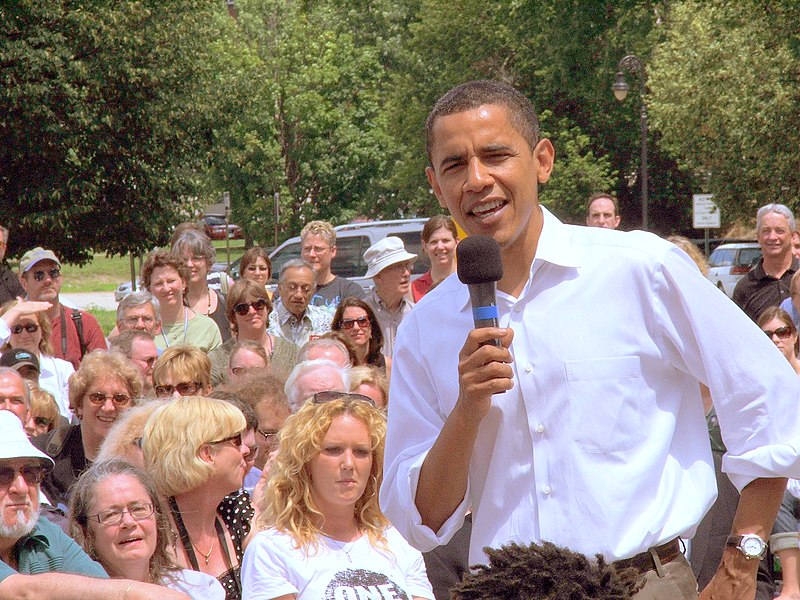
File:Barack Obama in New Hampshire.jpgA friend once explained to me the strategy of tic-tac-toe. Everyone who has ever played the game, he said, has at least once strove for the center of the board. The thinking is that the center offers the greatest destination for security. But the center gives the illusion of safety, my friend told me.

Essentially, going to the center is disadvantageous for several reasons. One, you've wasted a move to go to other areas (say the left, for reasons of being cute), and in tic-tac-toe there are few moves to make. Second, being in the center not only does not help you construct a scenario where your opponent doesn't have enough moves to stop you winning, but actually hinders you from winning. "You basically win by your opponent not noticing that you have amassed a strategic position," he told me.

Now we have the case of Barack Obama. By now, it has been a bit of time since the "shellacking" of 2010 (remember President Bush's "thumping" four years ago?). The Democrats suffered a humbling defeat of losing control of the House of Representatives and thus a great deal of Obama's agenda (most notably climate change legislation, immigration reform, and LGBT rights legislation). Is it time for Obama to move to the center?

Let me first say that everyone should calm down. For starters, the past three presidents who lost control of the House during their first term (Truman, Eisenhower, and Clinton) were re-elected, and I stand by my prediction that Obama will win re-election in 2012, even with Republicans in the House and a high unemployment rate. Second, this is the first time in decades that the opposition party did not take back both houses of Congress, and there is one reason for that--the Tea Party. Yes, the Tea Party might be have given further momentum in the goal of re-taking the House, but it undoubtedly cost the Republican Party the Senate. Because of the Tea Party, we still have Harry Reid, a senator who would have been defeated by any other Republican besides Sharon Angle. Because of the Tea Party, we do not have a Ken Buck or Christine O'Donnell or a Linda McMahon. We probably won't have a Joe Miller. And Mitch McConnell is still the Senate Minority Leader. Fifty-three Democratic senate seats looks a lot better than forty-eight, which is what it would be without the Tea Party.

On to the larger point, it may seem like the necessary thing for Obama to do is compromise. I'm not totally opposed to compromise, although I still believe bipartisanship is very overrated. Still, that does not mean Obama should pretend that the Earth is suddenly clean or that a Don't Ask, Don't Tell repeal should be shelved or that all (excuse me, any) of the Bush tax cuts should be extended. Only two centrists presidents--Dwight Eisenhower and Bill Clinton--won re-election in the past hundred years. Paul Begala has argued that Obama needs a centrist economic policy. Fine, I guess. Begala knows more than I do--he was, after all, a top level adviser to President Clinton.

But a major ideological shift to the center is not the right path. At this point, for Obama, the center is an illusion for safety. The center is where he will be most vulnerable to Republican attacks. Obama can still win the independent vote by not going to the center (it worked for him two years ago). So there's no need for him to make such a move, and, other than some areas, I doubt he will.