Showing posts with label christopher lee. Show all posts

Saturday, October 31, 2015

7 Days of Halloween: The Hound of the Baskervilles

File:CC No 33 Sherlock Holmes.JPGMr. Burns of The Simpsons has a simple command to "release the hounds," and it could have its origin in The Hound of the Baskervilles, the 1959 adaptation of Sir Arthur Conan Doyle's third Sherlock Holmes novel, directed by Terence Fischer, which starts with an aristocrat sending loose his fiendish hounds to attack other human beings. From there, the movie is an aristocratic back-and-forth whodunit featuring a diabolical hound of hell, summoned to forever haunt the Baskervilles family, and of course, it features the most famous English detective in history trying to figure out who--or what--is really causing all this mayhem.

Hugo Baskervilles (David Oxley), a cruel aristocrat, was the Gaston before there was Gaston. This guy is horrifyingly cruel to his servants, one of whom he nearly kills and another (the first servant's daughter) he stabs in the heart, just before he appears to be destroyed by some kind of terrible beast. Fast forward to the early 20th century, where Dr. Mortimer (Francis de Wolff) is reading to Detective Holmes (Peter Cushing) and Dr. Watson (Andre Morell) the spooky legend of the curse, but being men of science, Holmes and Watson are naturally skeptical. They do, however, agree to investigate. It's here where we meet the last of the Baskervilles, Sir Henry, played by the late, great Sir Christopher Lee, who is made up to be more handsome and a lot less grotesque than his previous outings with his friend Cushing at Hammer; his nice suits replace the rotting flesh and attire of Frankenstein's creature.

Because Henry's uncle, Sir Charles, has been killed mysteriously, Sir Henry is summoned from Johannesburg to run Baskervilles Hall in England. He, like his uncle, suffers from a heart problem, and when a tarantula is found in Henry's boot--a tarantula that could easily kill a man with a heart condition, Holmes tells us--Holmes suspects that foul play is involved. What adds to all these characters' angst is that a criminal has escaped from a nearby prison and could be the one engaging in all this mischief. But it could also be Henry's mysterious and angry-looking neighbor (played by Ewen Solon) and/or his Spanish daughter (Marla Lindi). Or it could be Dr. Mortimer, who has received a considerable sum of money from the will of Sir Charles, or it could even be Sir Henry himself who killed his uncle. One way or another, Mr. Holmes does not believe that there is any sort of supernatural "hound of hell" on the loose haunting about, ready to avenge what happened centuries before.

Lee became critical of how gruesome and disturbing horror films have become in recent years, and I can't imagine this adaptation of Doyle's famous story being scary to basically anyone, even in 1959. But that's not the intent, is it? Despite having never read the original novel or seen any of the other numerous adaptations (I have a DVD of the Basil Rathbone version but have never watched it), it's my understanding that this is not a horror story (but maybe I'm wrong). Why should it be scary, despite all the mist and howling our characters periodically hear? Still, as one of them mentions, "there is more evil around us here than I have ever encountered before."

The acting here is decent; Lee portrays Henry as a sympathetic figure, especially considering how helpless he is. Cushing is a joy to watch, as usual. Miles Malleson shows up in a fairly humorous comic relief part as the local bishop (and who, I think, we're at one point supposed to all suspect as being behind all this trouble). Cecil, the Spanish girl, is a somewhat interesting character bitter about being in England but intimately drawn to Henry. There's a hint of class warfare metaphors sprinkled throughout this film, and it really comes into focus during the scenes featuring these two. The reveal at the conclusion is a bit odd and slightly disappointing, but it is a thrilling climax nonetheless. It's better than The Curse of Frankenstein or Horror of Dracula. The Hound of Baskervilles is not perfect--"elementary" might be an appropriate adjective--but it's good fun and very much recommendable.      
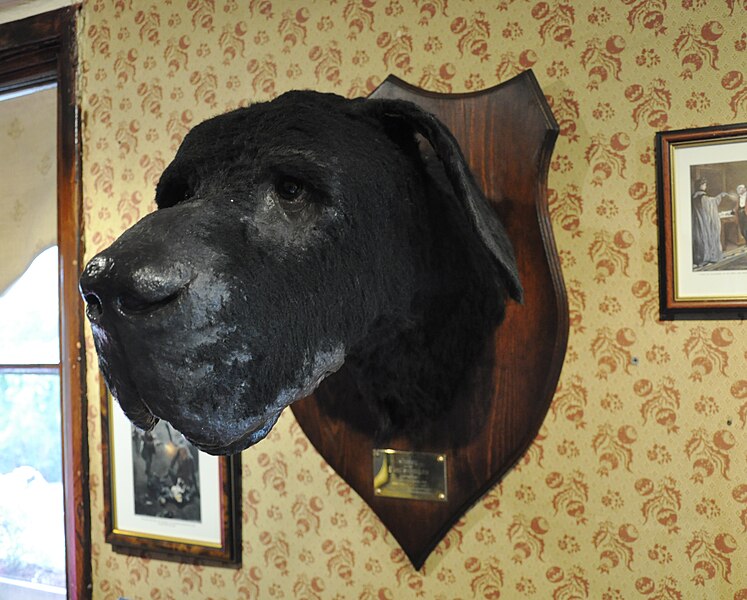
File:Sherlock Holmes Museum The Hound of the Baskervilles.jpg

Thursday, June 18, 2015

Christopher Lee

I was recently telling a friend (who's a Brit) about some of the English films I'd seen recently: "The Life and Death of Colonel Blimp," "Zulu," "The Meaning of Life," etc. One of them was Richard Lester's 1973 adaptation of "The Three Musketeers." I mentioned that while I found the fight scenes to be a bit dull, I was very much amused by all the comedy in it, and that the cast was terrific. One of the members featured was the towering figure with a deep baritone voice, Christopher Lee, one of my favorite actors. In it, Lee plays Rochefort, the one-eyed henchman of Cardinal Richelieu (played by Charlton Heston), a man whom he despises but ultimately is obedient to. Lee as Rochefort struts around with such confidence that he doesn't even flinch as a bumbling future musketeer (played by Michael York) comes crashing down near him, desperate for a fight with the man we know he can't possibly beat. And if Lee's performances over the years had anything to do with that character's realization, it's understandable: Lee fought 17 sword fights in films (a record), including one of his last, with Yoda, in "Star Wars: Attack of the Clones." Their fight was so entertaining that they won the MTV Movie Award for Best Fight, and Yoda accepted the award and gave a complimentary shout-out to his on-screen adversary Lee (as well as giving thanks to the audience and "your queen...Latifa").

Anyway, I mentioned the words "still kicking" in regards to 93-year-old Christopher Lee to my friend, to which he raised an eyebrow and responded that Lee had died. I told him that wasn't true, that Lee, who was knighted in 2009 and received an honorary Bafta two years later (and who holds the record for the most film appearances--244) was still alive. A quick Google search revealed that I was wrong, that Lee had actually been dead for over a week. What an actor we have lost. This is a man, an actual descendant of Charlemagne and a trained opera singer, who on his 91st birthday released a heavy metal album. According to Rob Bricken, his life featured numerous incredible events, both tragic and impressive: He met the assassins of Rasputin when he was a child, could speak six languages, witnessed the last public execution by guillotine in France, fought the Nazis in North Africa and helped retake Sicily, and worked for the secretive Special Operations Executive (aka "The Ministry of Ungentlemanly Wars"). His bravery earned him commendations from the British, Polish, Czech, and Yugoslavian governments, and all of this was before he was 25. All that triumph meant there were more than enough episodes of disturbances. He claimed to have seen many people die in front of him, some of them blown to pieces. On the DVD commentary of "The Lord of the Rings: The Return of the King," Peter Jackson described how Lee re-directed the acting of a death scene to show how someone actually dies when being stabbed, but didn't need to elaborate on how he knew.

Like many young people, I first saw Lee in 2001 in "The Lord of the Rings: The Fellowship of the Ring," his best film. In it, he plays Sauruman the White, the wizard corrupted by Saron's power. His fight scene with Ian McKellen as Gandalf the Grey is truly spectacular. I don't think I really understood quite who Lee was as an actor until I was introduced to some of the Hammer horror films he first became known for. He appeared in 1957 as the Creature in "The Curse of Frankenstein," a gorier version of the famous story, but despite the gore, Lee appeared to have never judged these characters he played. He once said that he "always felt sorry for them, that they didn't want to be that." The grotesque makeup applied to him and the lack of dialogue do not do much to present an image of the actor's abilities, but the film's follow-up did. That film was in 1958 as Dracula, the elegant count. The Guardian put it this way: "Christopher Lee was Dracula; he had taken over the character as clearly as Sean Connery took over James Bond."


And these two films weren't even his best horror films. The best was what's been called the "'Citizen Kane' of horror movies," the disturbing movie from 1973 called "The Wicker Man" (not to be confused with the one featuring Nicolas Cage and his bees). Here Lee is not disfigured or suave, but fairly normal, as are most of the citizens in the peculiar pagan village. The climax at the conclusion of the film is utterly terrifying, perhaps because, unlike Dracula and Frankenstein, this scenario seemed, for whatever reason, to be quite real.

But the '70s and especially '80s weren't all that glorious for Lee. He was continually being overplayed as Dracula (and even claimed that he was being blackmailed to keep appearing in those films), and aside from "The Wicker Man" and "The Three Musketeers" trilogy, there wasn't anything that truly challenged him. He appeared as a Bond villain against Roger Moore in "The Man With the Golden Gun" (Ian Fleming was a cousin of his), and yet that film comes across as tremendously flat (and Lee's character having three nipples added unnecessary absurdity). But he owes a lot of his renaissance to Tim Burton, who was such a fan of Gothic horror that he cast Lee in a small yet powerful role in "Sleepy Hollow," his 1999 adaptation of the famous story. From there, Lee was used in practically all of Burton's films: "Corpse Bride," "Alice in Wonderland," "Dark Shadows," and best of all in "Charlie and the Chocolate Factory," playing Willy Wonka's strict dentist father. ("Lollipops. What we call cavities on a stick!") From there, George Lucas cast him as Darth Tyranus in the "Star Wars" prequel trilogy, and then Martin Scorsese picked him for a small but memorable role in "Hugo."

The role he was most proud of was in "Jinnah," playing the founder of modern-day Pakistan. The role he was most ashamed of is unclear, though he clearly grew sick of the Dracula image. There is one film, though, that he perhaps would like not to be remembered for. In 1970, he flew to Spain to shoot a film about the Marquis de Sade for one day's worth of work as the film's narrator. According to an interview with Nigel Farndale of the Telegraph, Lee had a friend who told him there was a dirty theater showing a movie he was in. Heavily disguised in dark glasses and a scarf, he found out that it was indeed true: the movie he had filmed turned out to be a softcore porn film.

The opponent of many of Lee's characters on screen was Peter Cushing, but they were tremendously good friends in life. When asked about Cushing, who died in 1994, Lee sadly said the following:

"I don't want to sound gloomy, but, at some point of your lives, every one of you will notice that you have in your life one person, one friend whom you love and care for very much. That person is so close to you that you are able to share some things only with him. For example, you can call that friend, and from the very first maniacal laugh or some other joke you will know who is at the other end of that line. We used to do that with him so often. And then when that person is gone, there will be nothing like that in your life ever again."

I think the same could be said of Christopher Lee, a man unlike any other in the cinema, and there will be no one else like him in our movie-going lives ever again. Rest in peace, Sir Christopher.