Saturday, August 1, 2015

White People

"For thus hath the Lord said unto me, Go set a watchman, let him declare what he seeth...And he answered and said, Babylon is fallen, is fallen; and all the graven images of her gods he hath broken unto the ground."

White spore print icon.pngThat's from the Bible's Isaiah, and it's mentioned in the conclusion of Errin Whack's thought-provoking and analytical review of Harper Lee's "Go Set a Watchman," the controversial sequel to her beloved "To Kill a Mockingbird," in which we have all learned that Atticus Finch apparently is a not the progressive civil rights champion as Gregory Peck played him in 1962, but a devout racist in the mold of George Wallace. Lee's novel has received fairly mixed reviews, and the negative ones seem to really focus on the revelation of Atticus' real beliefs and actions on race. Atticus, Lee wants us to believe, is a graven image of a god broken unto the ground of reality, and he probably benefited from white privilege.

White privilege has benefited most whites in this country--racist or not--and the topic is the subject of Pulitzer-winning journalist Jose Antonio Vargas' contentious documentary for MTV in the mist of troubling race-related events: the Black Lives Matter interruptions of campaign events, killings in Baltimore unseen in 43 years months after the riots related to the death of Michael Brown, and the firing and indictment of University of Cincinnati police officer Ray Tensing, who, if not for the mandatory body cam revealing the truth of the murder of Samuel DuBoise, would still be a cop, and DuBoise's family would have no way to prove that their son was innocent. This is a troubling time in America, especially with regards to race relations. We're told by authority figures on the news and by our family members around the table that rioters are "thugs" while forgetting that riots are what actually pushed society to change, for as Martin Luther King said, "riot is the language of the unheard." America is a nation crumbling under the vicious malice of gun violence, which has killed more Americans since 1968 than the entire amount of Americans killed in every single American war going back to the Revolutionary War (combined); blacks are twice as likely to be killed in gun violence as whites. And the optimists tell us that at least the Millenials will rescue this nation from the hideous reality of modern-day racism. It's fair to say that Dylann Roof, the young man (for lack of a better word) who entered a predominantly black church in South Carolina and shot and killed nine black people, probably did more than anyone to remind us that we Millenials aren't helping. The most recent research finds that Millenials may be less racist than generations before them, but only by about 1-3 percent. Michael Denzel Smith's fascinating article this past March informs us that this isn't necessarily Millenials' fault. Millenials, he believes, are taught from those in older generations to be fluent in the language of so-called colorblindness ("I don't see color") but illiterate in the language of anti-racism. Racism is a system. The government is racist, the law is racist, the education system is racist. We are made to believe that Brown v. Board of Education in 1954 eradicated segregation in schools. The sad reality, as just about any teacher would tell you, is that segregation in schools still very much exists, but now it's simply de facto.

A Canadian recently told me that diversity is not a strength of the United States but a weakness. I don't agree with him, but there has to be a better way of ensuring equality and justice for all in our society. (Incidentally, this Canadian is one of the very few white individuals I know who has experienced--albeit indirectly--racism against him, when he was in South Korea, and an elderly Korean man approached him and his Korean girlfriend and spat on her face.) My formative experiences do not provide me with many examples of being around people of color. The place where I grew up, according to the 2010 census, is 93 percent white. My university has over 17,000 whites but only about 2,000 blacks, and if not for me visiting my mother's urban school, I probably never would have seen a person of color growing up. To say my family didn't have it's fair share of Atticus Finches would be untrue; the night before I left for Korea, my grandmother, whom I adore, warned me that I "better not marry a chink."

I have taught in three different nations outside of the U.S., and in each one I was often the only one who looked like me. I didn't really feel awkward in any of them, I think. Was it because of white privilege? White privilege is a topic that seems to provoke so much rage among white people, and I'm not sure why. I can only think that a young white college student featured in "White People" was correct when she said that most straight white men in this country these days feel like something is being taken away from them. I'm not sure why. Thomas Jefferson had slaves and Andrew Jackson killed Indians, and we won't even remove them from our money!

"White People" is not as eye-opening as Jane Elliott's famous "brown eyes/blue eyes" lessons for her elementary school students, and it's not a documentary that will live forever. But for these difficult times, it's a necessary watch, particularly for young people. Virtually everyone interviewed is a university student, and they seem to agree with Vargas. Vargas first meets Dakota, a Southern gay, white student who chose to go to a predominantly black university. He has dinner with his white friends and black friends, who meet for the first time at the dinner. One of his white friends uses the word "ghetto" in a lackadaisical manner, which almost immediately causes one of Dakota's black friends to break down and cry. I was reminded of when I worked as a waiter at university; we were serving sorority girls at their annual end-of-the-year awards dinner. One superlative was "most ghetto"; I turned my head to my supervisor, a young black woman, whose mouth was hanging open with shock and anger. Words matter, and this is one of the reasons why I think political correctness still has, for the most part, a valid place in our society and its vernacular.

Vargas goes to an Indian reservation, where all the students are Indians and their teachers are almost all white (which is not uncommon in the U.S.). One teacher mentions how he did not give permission for one of his students to leave class to use the restroom. The student's response was to joke: "You stole our land and you won't even let us go to the bathroom," he tells him. Joking aside, the white teachers are concerned. There are obvious lingering resentments about the treatment of Indians by whites over the years, but it made me think of how us white people tend to dismiss the past as past. While I've never taught in an Indian reservation, this part of the documentary reminded me of my student teaching experience in a predominantly white school in which I asked my students if the Cleveland Indians Chief Wahoo image was racist; they profoundly said no.      

Ultimately, the United States is a country that, for some reason, has a problem not only with race, but with talking about it. Vargas meets an 18-year-old woman who tells him of her experience being denied scholarship based on her skin color. The scholarship issue is almost always brought up by those who claim that whites experience discrimination on a similar level to non-whites. But facts are stubborn things: The distribution of private scholarship funding by race as recently as 2007-2008, according to Mark Kantrowitz's analysis, was 65 percent white, 12 percent black, and 8 percent Latino. When confronted with a counterpoint, the young lady originally feels like she is being attacked, but eventually comes around to Vargas' data. This documentary, it seems, would be a great starting point for a discussion with young high school students, and I only wish it had been made before I student taught all those years ago. But ultimately, more is needed than simply an MTV documentary. A conversation is a great first step, but actions speak louder.
Wednesday, July 22, 2015

Mad Max: Fury Road

1979 seemed like such a peaceful time. In that universe, Australia didn't seem so hot and sandy, and Max wasn't all that mad. Things have changed so much. In the fourth installment of the "Mad Max" franchise, "Fury Road," Max is indeed very mad, and things are very chaotic. George Miller returns Mad Max to the screen after a thirty-year hiatus. Miller had quite the challenge in revitalizing his famous character: 9/11, Mel Gibson's controversies, and the death of Heath Ledger all stalled the release of a fourth "Mad Max" film. I have to tip my hat to Miller. I was completely bored by his first "Mad Max" film, released in 1979. I'm willing to acknowledge its importance and influence, especially in the action/sci-fi genre, but that doesn't erase my boredom from it. I didn't think that the sequel, "The Road Warrior," was much better. I did, though, enjoy the third film, "Beyond Thunderdome," which I feel is about tied with "Fury Road." These two are good but not great films, in my mind.

The two most recent films in the saga are vastly different. "Beyond Thunderdome" has a fairy tale-like feel, as if Max is the leader of the Lost Boys (and girls). Here in "Fury Road," Max is haunted by illusions of dead people, including children, who believe he could have saved them but failed. Max is a haunted man, and at the beginning of the film he is kidnapped by henchmen to be used as a blood donor for road warriors. The leader of the citadel where Max is taken to is a frightening figure named Immortan Joe. Joe is a complete despot, and he sends his band out to fetch some oil. The team is led by a one-armed lady named Furiosa (played by Charlize Theron), but things go awry when she takes a detour. Joe discovers that Furiosa has taken his five beautiful young wives, one of whom is pregnant with his child, in an attempt to escape to a land of (literally) greener pastures. From here, the movie is a non-stop chase scene, featuring some of the most impressive stunts and visual effects in recent memory. The only problem is that Miller and his team once and a while show little subtlety when more is needed. One scene in particular takes place in a sandstorm and is completely unnecessary; brace yourself for a massive headache. But still, Miller and his team have done a good job with their loaded budget. I firmly believe that there should be a category for stunts at the Academy Awards, and if there were one, "Fury Road" would certainly be nominated and probably would win. The stunt coordinator, Guy Norris, apparently commanded over 150 stunt performers. As for the visual effects, Miller has claimed that 90 percent of the effects were practical ones. Compare that to the dreadful "Avengers: Age of Ultron," in which the performances prance around in front of a green screen while fighting an enemy who's not really there.

In "Fury Road," however, the villain makes quite a show. Hugh Keays-Byrne appeared in the original "Mad Max" as the antagonist. He does here, too, but in a much more frightening performance. His role in the first film was pretty minimalist, and his most recognizable feature probably remains that giant blond maim. Here, he plays a different character, Immortan Joe, and the role is unlike virtually any previous villain we've ever seen. He's pasty white with darkness completely surrounding his eyes; he apparently needs some kind of breathing machine, which is decorated with the teeth of a demonic skull. He has complete control over the people, and showers them only briefly with water for them to fight over. Keays-Byrne does a fine job portraying this tyrant. Nicholas Hoult is one of Joe's warriors who is so much a believer of Joe's propaganda that he's willing to die and ascend to Valhalla. If you know your Norse mythology or at least watch "Vikings," you'll know that the warriors of Scandinavia believed that the toughest and most righteous fighters gained access to Valhalla. Hoult's character, Nux, really wants to die in a glorious battle, but he becomes disillusioned with it all. Hoult is pretty good here, intense and fiery, almost humorously so, and has again demonstrated his ability to play almost any kind of character. It's so radically different from his performances in "About a Boy," "A Single Man," "Warm Bodies," and the "X-Men" movies that he's becoming a young Lon Chaney.

As for the other actors, I was less impressed. The performance of Hardy as Max is something that I had mixed feelings about. By now, Max is so destroyed that I imagine his suffering inspired Hardy to grunt and talk in a manner that likely was frying his vocal chords and probably left his larynx in a lot of pain by the end of the day. Hardy's choices have also revealed a wish to do just about anything, whether it's playing a villain (in "The Dark Knight Rises") or doing essentially a one-man show ("Locke") or appearing in grittier films ("Lawless" and "Warrior"). But it seems it's always his vocal decisions that turn me off of his acting. Similarly, Furiosa is an interesting character, but Theron gives a pretty uninspired performance. But again, it's Mr. Miller and his production team who deserve a lot of credit for helping to tame the love affair the movies have had with CGI. That being said, this doesn't mean that I really think there should be another "Mad Max" movie. 1979-2015 is a pretty long run. Leave Max be.

Tuesday, July 14, 2015

The Best Scene in "Casablanca" Involves a Song, But It's Not "As Time Goes By"

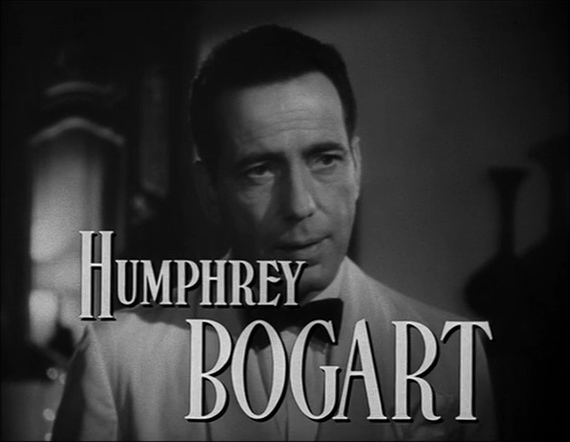
File:Casablanca, Bogart.JPGI would bet that the scene audiences like most in "Casablanca" is the scene involving the singing of "As Time Goes By." It's a scene many adore and cherish, justifiably so; the American Film Institute even ranked it second in their list of the best songs in American films, second only to "Over the Rainbow." As much as I like that scene, I think there's a better scene in the film involving a song. The scene I'm referring to involves "Le Marseillaise." If you have forgotten about the scene, here's basically the gist of it, as well as my thoughts on why the scene is so wonderful:

Just before the scene begins, Rick (Humphrey Bogart) is revealed to be a "rank sentimentalist" when he helps a young man win loads of money (by cheating in a gambling game) so that he and the young man's lover can escape Casablanca. But Rick is not a sentimentalist; he's a bitter man who's been burned by a lover of his own (Elsa, played by Ingrid Bergman). Rick meets with Victor Lazlo (Paul Heinreid), a freedom fighter against the Nazis, and Elsa's current lover. Lazlo desperately needs help to keep up the fight, and he knows of Rick's reputation for "being on the side of the underdog," helping to fight fascists in Spain and Ethiopia. But Rick politely yet somewhat tersely claims that he's not interested in politics, and that if Lazlo really insists on knowing why he won't help, he should ask his wife. The reason for Rick not wanting to help Lazlo is more than obvious to the viewer, as all of this information has been shown earlier in the film.


The meeting ends, and then "Casablanca" gets even more interesting. Rick and Lazlo's conversation concludes when the Germans arrive in Rick's cafe and proudly sing "Die Wacht am Rein." The camera pans in to Bergman as her eyes follow Lazlo, who approaches the band and orders them to play "Le Marseillaise." They look at Rick; he nods, and then they play. The non-Germans join in, and they are so loud that the Germans cannot match them, no matter how hard they try. It gets a bit overly sentimental here, but Bergman's deep breathing is likely similar to what the audience experiences upon first watching the scene. The Germans, and especially their leader, Major Strasser (Conrad Veidt), are enraged, and Strasser orders Captain Louis Renault (Claude Raines), the Vichy leader, to close the cafe. "But I have no excuse to close it," he insists. "Find one!" is the stern reply. Renault follows his orders. Rick is angry now, too, and demands an explanation, to which Raines replies with one of the many oft-quoted lines in the movie: "I'm shocked--shocked--to find out that gambling is going on here," just before receiving his winnings of the evening.

Why is the scene so good? Much of it is because of Bogart. In the 1960s, in an article for "Esquire," Peter Bogdonavich quoted writer Nathanial Benchley who claimed to have met a Harvard student "who believed in only two things: the superiority of Harvard and the immortality of Humphrey Bogart." In those days, there was a cult of Bogart, and it's sad to realize that today most college students probably have never heard of him. But regardless, Bogart adds weight to the scene, as does the audience's appreciation of the character. As mentioned already, Rick is revealed twice in just the span of a few minutes in "Casablanca" to be a sentimentalist who likes sticking his neck out for the underdog, no matter how loudly he protests that it isn't true.

But beyond the weight he brings as an icon, it's his acting (and his director) that further make the scene excel. David Mamet has a good explanation. In his book "On Directing Film," he authoritatively states that "most actors are, unfortunately, not good actors." The reason? There are many, he claims, but the main reason is that the theater has fallen apart. It used to be, he writes, that actors would have spent their entire acting careers on stage by the time they reached thirty, but not anymore. Bogart started on the stage, earning his share of good and bad reviews. According to Mamet, Bogart claimed that to make the scene work, "Michael Curtiz, the director, said, 'stand on the balcony over there, and when I say action take a beat and nod,'" and that's what Bogart did. Mamet: "That's great acting. Why? What more could he possibly have done? He was required to nod, he nodded. There you have it. The audience is terribly moved by his simply restraint in an emotional situation--and that is the essence of good theater: good theater is people doing extraordinarily moving tasks as simply as possible." Contemporary theater and film, according to Mamet, tend to offer the audience the reverse, in that characters perform predictable actions in an overblown way. Mamet again: "The good actor performs his tasks as simply and as unemotionally as possible. This lets the audience 'get the idea'--just as the juxtaposition of uninflected images in service of a third idea creates the play in the mind of the audience"

It's an exceptional scene in an exceptional film. I've seen "Casablanca" several times, and the scene is by far my favorite (and there are many, many great scenes in the movie). "Casablanca" is probably also a great film to watch as our French friends celebrate Bastille Day. Our two nations have had a strong relationship (with some bumps along the way) since the beginning of our republic, and I hope it stays that way. In the meantime, enjoy "Casablanca" and the continuation of our two nations' beautiful relationship.

Saturday, July 11, 2015

Jurassic World

File:Jurassic Park Entrance Arch at the Universal Islands of Adventure.JPG"I'll tell you the problem with the scientific power you're using here: it didn't require any discipline to maintain it. You read what others had done and you took the next step. You didn't earn the knowledge for yourselves, so you don't take any responsibility for it. You stood on the shoulders of geniuses to accomplish something as fast as you could and before you even knew what you had, you patented it and packaged it and slapped it on a plastic lunchbox, and now you're selling it, you want to sell it...your scientists were so preoccupied with whether or not they could, they didn't stop to think if they should!"
-Jeff Goldblum as Ian Malcolm, "Jurassic Park"


I can still remember the day I saw "Jurassic Park" somewhat vividly. It was a hot summer day in 1993, and as I jumped out of our family's car, my mother explained to me that I might find the film to be scary because in the movie "some of the dinosaurs eat other dinosaurs." From the opening moments, I was completely mesmerized, and I probably had no idea that movies were capable of presenting such images. I loved it from start to finish. We left the theater, had lunch, then came back to watch "Free Willy." It remains one of the greatest days of my life. I can't imagine that twenty years from now I will remember watching "Jurassic World," the fourth installment in this franchise, the one where the movie's makers stood on the shoulders of geniuses and were so proud of their ability to make what is now the world's fifth-highest-grossing movie of all time (with $1.4 billion in just one month) and bring back the franchise from the dead. The trouble is that they never stopped to think if they should.

Should they have? I say no, and loudly so. The 1993 film at the time seemed to have ushered in a new age of cinematic wonder, but instead in retrospect closed an era of better movie magic. If you don't believe me, just consider some of the visual effects before 1993 (like "2001: A Space Odyssey" and the original "Star Wars" trilogy) and then consider some of the modern-day ones (like "The Avengers" and the "Star Wars" prequel trilogy). True, there are some directors, like Christopher Nolan and Darren Aronofsky, who seem to take the time to really give their audiences impressive visuals, but Colin Trevorrow is not one of them. Trevorrow directed the mediocre independent film "Safety Not Guaranteed" three years ago, and he does deserve some credit for his work here. He and his cinematographer, John Schwartzman, use a camera that's fairly active, and their decision to use film stock instead of digital cameras was the right one because it creates a better visual link to the previous installments. But unlike Steven Spielberg, the director of the first two "Jurassic" films and the executive producer of the two most recent, Trevorrow is one of the many newer directors working with visual effects who seem to have no restraint. David Christopher Bell's article for "Cracked" explains this in more detail in a brilliant article in which he calls the visual effects of "Jurassic World" and other recent films "photorealistic carnage." He makes a further very important point: except for four minutes of computer-generated imagery of only fourteen minutes of actual dinosaur screen time in "Jurassic Park," every special effect utilized was an animatronic (or puppet or other practical effect) created by Stan Winston. In other words, CGI, itself groundbreaking in 1993, was a last resort and was used to better the visual experience on a case-by-case basis. In "Jurassic World," there was only one scene that I thought was using an animatronic. The scene features two protagonists who discover a butchered dinosaur and feel sorry for it. The audience seemed to share these characters' sympathy, conveniently not carrying that practically a dozen characters were eaten moments earlier.

Part of this wreck is not Trevorrow's fault. There was a profound sense of awe with that first movie, but then with each and every subsequent installment in the franchise, there was less and less. But had Trevorrow and his visual effects team used the same restraint and lack of color grading that was used in 1993, I think "Jurassic World" would have been much better. Its story and actors try to fill the gap. The world of "Jurassic World" is one in which the idea of living, breathing dinosaurs is no longer a novelty but a bore. Jurassic World is an amusement park much like Sea World, featuring roughly 20,000 visitors a day. Irrfan Khan plays the new owner, a billionaire so irresponsible he not only demands his scientists make bigger and meaner dinosaurs but also personally takes a helicopter out to do battle with the dinosaurs wrecking his park. The park's operations director is played by Bryce Dallas Howard, and she, too, is not very responsible, sharing the concerns that closing the park would be the end of the company. Finally, there's Vincent D'Onofrio, who's just as good a villain here as he is on Netflix's "Daredevil." D'Onofrio plays the hawkish security chief who believes that InGen, the corporation featured in most of the films, could use these animals for war purposes.

None of them seem to heed any of the advice of Owen Grady (Chris Pratt), an animal trainer for the park who seems to be one of the few adults in the room. Pratt has continued to show that he can carry a film as an action lead and do so with humor as well. At one point, Grady gets into an argument with Howard's character, Claire Dearing, who needs Grady's help finding her nephews after a dinosaur breaks out. She insists that he track the boys' footprints or scent. "I was with the navy," he barks, "not the Navajo!" But while I could appreciate the humor of Pratt, I found his character's situations so unfathomably stupid. Grady works for the park training the Velociraptors and actually leads them into battle against the Indominus, a genetically-mutated dinosaur that is terrorizing the island (and looks unbelievably stupid). At one point, Grady and Dearing take a moment to break from shooting at the Pterodactyls flying around chewing on their fellow human beings so that they can smooch. I think if the talking raptor from "Jurassic Park III" had made an appearance, it would have been more believable than any of this junk.  

There are still other fine performances here. Omar Sy appears here as a fellow trainer of Grady's; you may have seen Sy in the international French hit, "The Intouchables." It's also interesting to see Wong return, and his role this time is much more interesting that his small appearance in "Jurassic Park." And really, at the heart of this movie are the two boys who are sent to visit their aunt Claire, who is too busy to spend time with them and sends them to explore the park with her assistant. They are played by Ty Simpkins (whom you might recognize from the "Insidious" movies) and Nick Robinson as the older brother, more interested in girls than dinosaurs, and who is particularly annoyed by babysitting his brother. Simpkins in particular is very good here. The two boys become aware that their parents are getting a divorce, and this understandably troubles the younger one. It made me think that Spielberg, whose films often feature a child's relationship to his father, insisted that the moment be included here. But that's another flaw of "Jurassic World": there are some real moments that work well with the human characters, but there are zero interesting moments featuring dinosaurs.

I think back again to that day as a six-year-old in 1993. Children are arguably the best audience members; they possess no prejudice towards movies. It doesn't matter if it's a black-and-white film, or whether or not it's in sound, or whether or not the language is a language they understand and use. To most children, particularly younger ones, "The Lost World: Jurassic Park" can be just as exciting and thrilling as "The Lost World," the 1925 silent adaptation of Sir Arthur Conan Doyle's work. Certainly the young boy two rows behind me who wouldn't shut up the entire time found "Jurassic World" to be quite good fun. But it's the parents of these children who have a duty to find their young ones better movies to watch. My advice: if you have children, show them "Jurassic Park," and then lie to them and say that there were no sequels.


Dedicated to Carrie and Eileen.

Thursday, June 18, 2015

Christopher Lee

I was recently telling a friend (who's a Brit) about some of the English films I'd seen recently: "The Life and Death of Colonel Blimp," "Zulu," "The Meaning of Life," etc. One of them was Richard Lester's 1973 adaptation of "The Three Musketeers." I mentioned that while I found the fight scenes to be a bit dull, I was very much amused by all the comedy in it, and that the cast was terrific. One of the members featured was the towering figure with a deep baritone voice, Christopher Lee, one of my favorite actors. In it, Lee plays Rochefort, the one-eyed henchman of Cardinal Richelieu (played by Charlton Heston), a man whom he despises but ultimately is obedient to. Lee as Rochefort struts around with such confidence that he doesn't even flinch as a bumbling future musketeer (played by Michael York) comes crashing down near him, desperate for a fight with the man we know he can't possibly beat. And if Lee's performances over the years had anything to do with that character's realization, it's understandable: Lee fought 17 sword fights in films (a record), including one of his last, with Yoda, in "Star Wars: Attack of the Clones." Their fight was so entertaining that they won the MTV Movie Award for Best Fight, and Yoda accepted the award and gave a complimentary shout-out to his on-screen adversary Lee (as well as giving thanks to the audience and "your queen...Latifa").

Anyway, I mentioned the words "still kicking" in regards to 93-year-old Christopher Lee to my friend, to which he raised an eyebrow and responded that Lee had died. I told him that wasn't true, that Lee, who was knighted in 2009 and received an honorary Bafta two years later (and who holds the record for the most film appearances--244) was still alive. A quick Google search revealed that I was wrong, that Lee had actually been dead for over a week. What an actor we have lost. This is a man, an actual descendant of Charlemagne and a trained opera singer, who on his 91st birthday released a heavy metal album. According to Rob Bricken, his life featured numerous incredible events, both tragic and impressive: He met the assassins of Rasputin when he was a child, could speak six languages, witnessed the last public execution by guillotine in France, fought the Nazis in North Africa and helped retake Sicily, and worked for the secretive Special Operations Executive (aka "The Ministry of Ungentlemanly Wars"). His bravery earned him commendations from the British, Polish, Czech, and Yugoslavian governments, and all of this was before he was 25. All that triumph meant there were more than enough episodes of disturbances. He claimed to have seen many people die in front of him, some of them blown to pieces. On the DVD commentary of "The Lord of the Rings: The Return of the King," Peter Jackson described how Lee re-directed the acting of a death scene to show how someone actually dies when being stabbed, but didn't need to elaborate on how he knew.

Like many young people, I first saw Lee in 2001 in "The Lord of the Rings: The Fellowship of the Ring," his best film. In it, he plays Sauruman the White, the wizard corrupted by Saron's power. His fight scene with Ian McKellen as Gandalf the Grey is truly spectacular. I don't think I really understood quite who Lee was as an actor until I was introduced to some of the Hammer horror films he first became known for. He appeared in 1957 as the Creature in "The Curse of Frankenstein," a gorier version of the famous story, but despite the gore, Lee appeared to have never judged these characters he played. He once said that he "always felt sorry for them, that they didn't want to be that." The grotesque makeup applied to him and the lack of dialogue do not do much to present an image of the actor's abilities, but the film's follow-up did. That film was in 1958 as Dracula, the elegant count. The Guardian put it this way: "Christopher Lee was Dracula; he had taken over the character as clearly as Sean Connery took over James Bond."


And these two films weren't even his best horror films. The best was what's been called the "'Citizen Kane' of horror movies," the disturbing movie from 1973 called "The Wicker Man" (not to be confused with the one featuring Nicolas Cage and his bees). Here Lee is not disfigured or suave, but fairly normal, as are most of the citizens in the peculiar pagan village. The climax at the conclusion of the film is utterly terrifying, perhaps because, unlike Dracula and Frankenstein, this scenario seemed, for whatever reason, to be quite real.

But the '70s and especially '80s weren't all that glorious for Lee. He was continually being overplayed as Dracula (and even claimed that he was being blackmailed to keep appearing in those films), and aside from "The Wicker Man" and "The Three Musketeers" trilogy, there wasn't anything that truly challenged him. He appeared as a Bond villain against Roger Moore in "The Man With the Golden Gun" (Ian Fleming was a cousin of his), and yet that film comes across as tremendously flat (and Lee's character having three nipples added unnecessary absurdity). But he owes a lot of his renaissance to Tim Burton, who was such a fan of Gothic horror that he cast Lee in a small yet powerful role in "Sleepy Hollow," his 1999 adaptation of the famous story. From there, Lee was used in practically all of Burton's films: "Corpse Bride," "Alice in Wonderland," "Dark Shadows," and best of all in "Charlie and the Chocolate Factory," playing Willy Wonka's strict dentist father. ("Lollipops. What we call cavities on a stick!") From there, George Lucas cast him as Darth Tyranus in the "Star Wars" prequel trilogy, and then Martin Scorsese picked him for a small but memorable role in "Hugo."

The role he was most proud of was in "Jinnah," playing the founder of modern-day Pakistan. The role he was most ashamed of is unclear, though he clearly grew sick of the Dracula image. There is one film, though, that he perhaps would like not to be remembered for. In 1970, he flew to Spain to shoot a film about the Marquis de Sade for one day's worth of work as the film's narrator. According to an interview with Nigel Farndale of the Telegraph, Lee had a friend who told him there was a dirty theater showing a movie he was in. Heavily disguised in dark glasses and a scarf, he found out that it was indeed true: the movie he had filmed turned out to be a softcore porn film.

The opponent of many of Lee's characters on screen was Peter Cushing, but they were tremendously good friends in life. When asked about Cushing, who died in 1994, Lee sadly said the following:

"I don't want to sound gloomy, but, at some point of your lives, every one of you will notice that you have in your life one person, one friend whom you love and care for very much. That person is so close to you that you are able to share some things only with him. For example, you can call that friend, and from the very first maniacal laugh or some other joke you will know who is at the other end of that line. We used to do that with him so often. And then when that person is gone, there will be nothing like that in your life ever again."

I think the same could be said of Christopher Lee, a man unlike any other in the cinema, and there will be no one else like him in our movie-going lives ever again. Rest in peace, Sir Christopher.


Sunday, June 14, 2015

Steve Martin

I am not a man of too many accomplishments, but there is one achievement that I am very proud of. In college, as a Theatre minor, I got to direct an adaptation of Steve Martin's play "WASP." "WASP" is a clever satire of 1950s American nostalgia, using a family of four as a vehicle to poke fun at the "Leave It to Beaver" traditionalism and "simplicity" of the time. I cast a group of friends and fellow Theatre folks for the project. One of them, a very talented young man who excelled at improv and creating eccentric characters, had a goatee and long, curly red hair; he was cast as the young boy of the family--the goatee remained. It was an introduction for me to theatre of the absurd.

Steve Martin, who was rightfully and humorously described by Steve Carell as an "American treasure," is one of the great masters of absurdism. Consider his stand-up career in the '70s when he would strut around the stage with an arrow through his head, or when he danced majestically with Gilda Radner on "Saturday Night Live." Hell, in his first movie, "The Jerk," he told us he was "born a poor black child" and is stunned to learn that in reality is white. "The Jerk" is not his funniest film--the winner of that title goes to John Hughes' "Planes, Trains & Automobiles." Playing a common man struggling to make it home in time for Thanksgiving, he faces hurdle after Job-like hurdle, and on his journey he is joined by the late, great John Candy. Martin's character clearly despises Candy's, despite how gosh-darn nice the latter is. Perhaps the most famous scene is when the two, forced to share a hotel room, wake up to find themselves a bit too close to each other. But the best scene, the scene where we really connect with him, is his diatribe to the car rental lady, and here it is verbatim:

Car Rental Agent: How may I help you?
Neal: You can start by wiping that fucking dumb-ass smile off your rosey, fucking cheeks. And you can give me a fucking automobile: a fucking Datsun, a fucking Toyota, a fucking Mustang, a fucking Buick! Four fucking wheels and a seat!
Car Rental Agent: I really don't care for the way you're speaking to me.
Neal: And I really don't care for the way your company left me in the middle of fucking nowhere with fucking keys to a fucking car that isn't fucking there. And I really didn't care to fucking walk, down a fucking highway, and across a fucking runway to get back here to have you smile in my fucking face. I want a fucking car right fucking now.
Car Rental Agent: May I see your rental agreement?
Neal: I threw it away.
Car Rental Agent: Oh, boy.
Neal: Oh boy what?
Car Rental Agent: You're fucked!


I think we all sort of fantasize about delivering a tirade in that manner when things don't go our way, particularly when we're up against a company, but the result Neal faces is what we truly fear and what ultimately deters us. Incidentally, reading the dialogue makes Neal appear quite psychotic, but watching Martin deliver the lines, slowly and clearly emphasizing all those f-bombs without being bombastic, shows us he's just really, really stressed and really, really thinks (knows) he has been wronged.

The American Film Institute's honor of Steve Martin will air tonight on TBS. Truth be told, the AFI ceremony is usually the best of the year. It's better than the Oscars, the Kennedy Center Honors, and even the Golden Globes. Past ceremonies have included Sean Connery dancing better than any man half his age to Scottish music, Jim Carrey bringing Meryl Streep to tears of laughter, Betty White performing an adaptation of "Hello Dolly" to Morgan Freeman, and William Shatner singing "My Way" to his fellow star voyager, George Lucas. Another highlight was when Bill Clinton showed up to explain to the audience how Warren Beatty single-handedly convinced a woman to vote for George McGovern (who also was in attendance that night). Martin himself is no stranger to the ceremonies, as he attended the one for Jack Lemmon and years later for Tom Hanks, reminding everyone that Hanks has spoken some of the most iconic lines in movie history: "Houston, we have a problem," "life is like a box of chocolates," and of course, "I prefer it my way, Mr. Spielberg."


In recent years, Martin, a legend of American comedy, has rightfully earned a plate of honors, and now the AFI award, which the AFI claims is the highest honor one can receive in American film. In addition to "The Jerk," "Planes, Trains & Automobiles," and the wonderful "Dirty Rotten Scoundrels," attention might be given to some of the weaker Martin films, like "Three Amigos," but one way or another, with appearances by Conan O'Brien, Tina Fey, Martin Short and others, the show is likely to be an entertaining one. Steve Martin is one for the ages, a true delight, and one whom America will love for all time.

Sunday, May 31, 2015

The Fifth Star Is Superfluous

File:4 stars.svg

I can tell you exactly what a four-star movie is. A four-star movie is one in which you leave the theater thinking about. It's a film you tell your friends they have to see. Sometimes a four-star movie is one that is one of the year's best, but you're not sure if it will ultimately stand the test of time (though you're confident it will). Some recent examples include "Wadjda," "Mother," and "12 Years A Slave." Some might require a second viewing for you to know that, indeed, they are essential films made by master filmmakers; for me, "2001: A Space Odyssey" and "Goodfellas" come to mind. And some, like "The Wizard of Oz," "Modern Times," and "Schindler's List," will live with you forever.

I can tell you exactly what a three-star movie is. While a three-and-a-half star movie is one that is really good (but not quite great), like "To Kill A Mockinbird" or "The Wolf of Wall Street," a three-star movie is good but ultimately forgettable. Some recently three star movies I've seen are "Trees Lounge," "Die Hard With a Vengeance," "The Battleship Potemkin," "About Elly," "Going Clear," and "Withnail and I." Some are guilty pleasures, like "Congo." I hope that the majority of the films made each year achieve at least three stars, for viewers deserve to be inspired and entertained, not irritated and maddened, by their experience with the movies.

But now I come to the movies that do madden us. Two-and-a-half stars go to bad movies that are bad but not awful. Some (like "Spider-Man 3") start off decently but progressively fall apart with each passing minute. Some are betrayed by their ambition (like "The English Patient") and probably would have been better kept in the written word. (Add the injustice of "The English Patient" beating a much more deserving film like "Fargo" for Best Picture, and it fuels the motivation to give it a low ranking.) Some (like "Man of Steel") simply have good elements but too many bad ones. These films have at least some good qualities to them, unlike the dreaded two-star movies, which in reality probably are the majority of movies. It's easy to qualify these films: they are bad. "Westworld," "Waterboy," "The Lost World: Jurassic Park," "License to Kill," and "Shadow Dancer" are all, for various different reasons, bad.

The (fortunately) rare movies that get one star are movies that make your blood boil, like "Grey Gardens," a horribly overrated documentary that made me think it would have been better to spend an-hour-and-a-half listening to cats mate while simultaneously scratching their claws on chaulkboards. Some, though, like "The Tingler" or "The Giant Claw" are, of course, so bad, they're good. Fortuantely, I cannot think of any zero-star movies off the top of my head. It should be noted, however, that viewing these sordid movies is necessary to remind oneself to really appreciate the good ones.

I have no idea what a five-star movie is. No one has ever been able to explain to me what is is. I don't understand why Rotten Tomatoes, Flixster, and others use it (or why IMDB uses a whopping ten). The five-star rating is superfluous; just use four.

Thursday, May 14, 2015

The Incredibly Stupid Ending of "Cat on a Hot Tin Roof"

Paul Newman's character in "Cat on a Hot Tin Roof," the 1958 adaption of Tennessee Williams' iconic play, is a disillusioned, depressed drunk. He's borderline abusive towards his wife, played by Elizabeth Taylor, and he cares not for his brother, sister-in-law, nieces and nephews, nor his parents, one of whom is dying. He is childless and has quit his job. Any joy from any other character only seems to exacerbate his misery, and he stays upstairs for as long as he can, drinking himself practically to death, resting his broken leg (which he got from an accident caused by his drunkenness).

He's also clearly a gay man.

LGBT themes are surprisingly somewhat prevalent in 1950s American cinema. Watch "Rebel Without a Cause" and tell me that's not an incredibly gay film. "Suddenly, Last Summer" (also featuring Taylor) and "Ben-Hur" also have gay subtext. So, too, does "Cat on a Hot Tin Roof." Just about anyone in the modern era watching it would recognize that Newman's character, Brick, is meant to be a gay or bisexual man, almost obtrusively struggling with his sexuality while his wife suffers from a loveless, bitter marriage. But at the conclusion of the film, during the incredibly stupid ending of "Cat on a Hot Tin Roof," he suddenly becomes straight, I guess. Out of nowhere, he gets his libido back and is about to make love to his wife just as the end credits arrive. But this isn't the only thing irritating about its conclusion. The wife, Maggie (Taylor), is not completely innocent herself; her major flaw is struggling to get the inheritance of her father-in-law's estate, and she'll do practically anything to get it. Her father-in-law, "Big Daddy" (Burl Ives) is a tyrannical mammoth of a titan who is said to have favored his alcoholic son over the more responsible one, is flirtatious with Maggie, and shouts venom at his adoring wife. Big Daddy's other son, Cooper (Jack Carson) and his wife (Madeleine Sherwood) are just as eager to get their hands on that money, so just about every character has some obvious crookedness--even the doctor lies and the deacon, too, wants Big Daddy's money.  

But at the ending, just before Brick and Maggie are about to get funky, suddenly most of these characters are washed of their sins. Cooper gives up the fight, and Big Daddy suddenly is kind towards Big Momma. The only villain still villainous is Sister Woman; she still wants that money, and her children are still monsters.

"I need something to believe in!" This is the line Brick shouts when explaining his melancholy. Did 20th Century Fox really think audiences in the late 1950s were that stupid that they would believe, and enjoy, such a dumb line? That line is essentially the essence of the adaptation's diversion away from the gay theme. Brick in the film apparently isn't depressed because his male lover is dead, and that Maggie may have been the cause. He instead is depressed because when his friend died, he lost something to believe in. I don't quite get that, and I can't imagine anyone--in 1958 or in 2015--buying it. It's as if Ike and Dick themselves got their hands on Williams' play and scrubbed it with moralistic simplicity. Ben Gazzara, the original Brick on Broadway, turned down the role in the adaption, and I imagine that was partly the reason. Ives, who would win the Oscar the following year for "The Big Country" and who was also nominated for his role (a role he originated on Broadway), complained about the changes, as did Newman. (Newman deservedly was nominated for an Oscar.)

This is not to say that "Cat on a Hot Tin Roof" is a bad movie--the cast, especially Ives, more than help make up for the deficit. It's a recommendable movie, but one with a stupid yet typical ending, one where all's well that ends well.


Friday, May 1, 2015

Duck, You Sucker!

A Marxist quote followed by someone urinating on ants is a most peculiar way to begin a film, and I wish "peculiar" was the worst thing I could say about "Duck, You Sucker!" The second (and more commonly forgotten) part to the second trilogy Sergio Leone is most famous for, "Duck, You Sucker" (sometimes known as "A Fistful of Dynamite" and sometimes known as "Once Upon A Time...the Revolution") has pretty terrible acting, dismal dialogue, and overall presents nothing compelling whatsoever. It's a long, at times miserable, mess.

Rod Steiger is Juan, a thief and loyal father of many children. Where we first meet him (it's him, incidentally, who is doing the urinating), he hops on a large stage wagon filled with a grotesque band of racists enjoying copious amounts of food. But soon we find things aren't what they seem--Juan and his many sons are to rob these individuals. This is a shaky start to the movie, but it quickly becomes downright disturbing. After the sabotage, Juan corners the sole female in the party and rapes her. Because there are other examples of rape in Leone's films, like in "Once Upon A Time in the West" and "Once Upon A Time in America," this film is not unique, but as blogger John Bleasdale pointed out, "Duck, You Sucker!" was the first time in his films where the protagonist committed the crime, though it hardly seems that Leone even thought of such acts are criminal. He awkwardly defended the rape scene in "Once Upon A Time in America" by calling it an "act of love." Why is it that there is such violence and mistreatment of women in Leone's films, and why is he rarely criticized for it?

What could have been yet another example of Steiger's ability to be a chameleon of an actor quickly evolves into a horrendously annoying performance. He slaps around his children and spends most of the rest of his time parading about and unleashing a massive barrage of stereotypes. Steiger's performance might be one of the cinema's most irritating portrayals ever, and he's matched by an awful "Lucky Charms" accent by his co-star. The said co-star is James Coburn, who shows up on a motorcycle almost immediately after the raping and pillaging of the opening scene. Coburn plays John, an Irish revolutionary and quite the fan of explosives, so much so that if some of them go off simultaneously, "they'll have to alter the maps." Coburn seems to be going in and out of his attempts at an Irish accent, and even with all the camp, it's difficult to take seriously his frequent use of saying "duck, you sucker." So off they go, John and Juan, not exactly fond of each other and prone to trick one another, but they become revolutionaries together in Mexico in 1913.

At this point (barely a third into the movie), it becomes more than clear that this is one of Leone's weakest movies. There is hardly anything to praise in in; it's a dull, boring misfire in between two stronger films, which makes it such an odd trajectory, since the "Dollars" trilogy might be the only trilogy in cinematic history that gets better with each film. Unlike Leone's "The Good, the Bad and the Ugly," the greatest western in history, "Duck, You Sucker!" is a film you are likely to care less and less about as it progresses, and just about everything in it is uninteresting: its macho duels, its attempts at humor, its use of history (if it can be called that), its technical design. Coburn and Steiger do have their moments, with some instances of genuine chemistry and rivalry, but most of the time, it's flimsy performances from two very talented actors.

"Duck, You Sucker!" has all the big, grand, epic movie-making that is expected, but there are far too many flaws.

Friday, March 20, 2015

Let It Be

File:The Beatles in America.JPGRingo Starr and Paul McCartney, who today are the two remaining Beatles, dash to a piano and have some fun with it. Even with his beard and long hair, Paul is still the "cute one" (though no one would imply that the other three were ever ugly). They're eventually joined by George Harrison and John Lennon to sing "Don't Let Me Down," before "Maxwell Silver's Hammer." George is still the quiet one; in five minutes, he's hardly uttered anything. Paul seems a bit bossy, which he reportedly had a reputation for being. They all sing a silly version of "Two Of Us" before "I've Got a Feeling," two of their least appreciated songs. This iconic documentary is "Let It Be," which presents for audiences the Beatles recording their album of the same name, and yet it seems to have been forever remembered as the film documenting the breakup of the most iconic, influential, and excellent group of musical individuals in practically all of human history.

But the center of "Let It Be" seems to be focused on Paul. He calls Ringo "Rich" (the latter's real name, as in Richard Starkey) as they have a ball at the piano, sings with John, and annoys George to the point that during their slightly heated argument, George tells him, "I'll play, you know, whatever you want me to play, or I won't play at all if you don't want me to play. Whatever it is that will please you, I'll do it." He's frustrated, and it's more than clear that he's had it with being "pushed around" like a kid brother from his band mate.

It's almost sadistic of me to say so, but I really preferred to see more scenes like this. The back part of my conscious was yearning for something akin to the hysterical fight between the four in India in the film "Dewey Cox: Rock Hard," when Lennon (Paul Rudd) wonders if McCartney's (Jack Black) songs will "still be shit when I'm 64," before telling Ringo (Jason Schwartzman) that he should just feel lucky that they still let him play with his drums. Ringo smiles and says he just likes having fun, then waves his ever-present peace sign, barely opening his eyes. "Beatles," they are told, "stop fighting in India!" But for the most part, in "Let It Be," the four of them appear surprisingly cordial, which is intriguing especially considering all the tension behind the scenes. What's remarkable is that they stayed together for so long; George did, after all, have an affair with Ringo's wife. "No woman was out of bounds," George's ex-wife Pattie Boyd has said. And yet, here George is giving Ringo some tips on "Octopus's Garden," though he's cheekily grinning; perhaps he's teasing Ringo, or something. Everyone knows that despite their divisions, they all collaborated with each other in some form or another post-breakup, and my favorite consortium is an usual choice: "Photograph," which Ringo and George wrote for Ringo's album "Ringo." As Ringo pointed out at the "Concert for George" event Eric Clapton and Jeff Lynne organized in 2002, the song's lyrics, originally about a hopeless lost love, can also be applied to the death of a loved one. And this is a song he co-wrote with someone who had an affair with his wife.

The documentary won Best Original Song ("Let It Be"), but none of the four were present at the Oscars that year to receive the award. It's a shame we never saw them all together -- the closest was during the making of the "Anthology" documentary in the '90s. There are certainly highlights in "Let It Be," among them "Two of Us" and, of course, the rooftop concert. The director, Michael Lindsay-Hogg, caught some almost surreal-looking scenes, such as a closeup profile of Lennon's lips as he sings, and an almost mesmerizing dance with Yoko. Speaking of, she appears, some might say, in an icy state, and fans probably are still under the impression that she broke up the band and will forever remain a terrible person. If you still think she did breakup the band, consider that McCartney has claimed that this isn't true, and if you think she's the real wicked one, consider that she and Lennon once received a letter from McCartney where he called her Lennon's "Jap tart."

Despite this being an essential for rock fans, and definitely Beatles fans, it's a letdown nonetheless. The music is great. The documentary, not so much.