Sunday, February 21, 2016

Oscar Predictions

Having more or less hit it out of the park two years ago but having egg on my face last year, I've become a bit more cautious in my approach to predicting the winners of next week's Oscars. Perhaps I don't need to, for this looks like a fairly easy year to predict, especially awards like Best Actor and Best Director. Some (like the top award) are far more challenging. For my take on who will win, who should win, and who should have been nominated for awards at next week's Academy Awards, read on.

But before I begin, a word on #OscarsSoWhite: They are. They always have been, and at least for the near future, they always will be. We've known this since 1996, when the media first started reporting on it (in People magazine of all places), and so it shouldn't be surprising, given that the vast majority of its members are male and virtually all of them are white. But their excuse is often to say that they are not the disease but the symptom. This is partially true. The Oscars reward movies made mostly by Hollywood, an industry that does not make movies by, of, or for people of color.

But the Academy has less of a case in the past two years. Last year, Selma, a kind of movie that the Academy usually salivates over, only earned two nominations, and this year, despite a considerable number of potential candidates (like Michael B. Jordan, Corey Hawkins, Ryan Coogler, Idris Elba, Oshea Jackson Jr., Jason Mitchell, Benicio Del Toro, and Samuel L. Jackson, among others), the Oscars nominated mediocre performances from actors like (with all due respect to them) Matt Damon, Mark Ruffalo, and Christian Bale. People, especially people of color, have more than enough reasons to be frustrated. I don't know if the Academy's recent measures will help solve the issue. We'll simply have to wait and see.

But given the lack of diversity in the nominations (and considering just how friggan boring the show in recent years has become), I might not watch them this year.

Beyond that, here are some predictions:

Best Picture
What will win: The Revenant
What should win: Room
What should have been nominated: Inside Out

The Revenant has successfully squeezed by as the front-runner for the top prize, as Spotlight, despite some early buzz and impressive wins, fell behind. Make no mistake about it: this is still very much a horse race, and don't be too surprised if a dark horse movie like Mad Max: Fury Road pulls off an upset. The Revenant is not much better of a movie than Spotlight or some of the other nominees, but the Academy will likely be impressed by just how epic a movie The Revenent is, and it might be able to win by riding Leonardo DiCaprio's coattails, as he's guaranteed a win for his acting in the film.

Best Director
Who will win: Alejandro Gonzalez Innaritu (The Revenant)
Who should win: George Miller (Mad Max: Fury Road)
Who should have been nominated: Ridley Scott (The Martian)

I remain a moviegoer who still is not the biggest fan of Innaritu, but this is his best movie and best work as a director. The Academy might be uninterested in giving it to him again this year (he won last year for Birdman), and it would make him the first since the 1950s.

I'm rooting for George Miller, whose Mad Max: Fury Road is one of the most active movies I've ever seen. That being said, both Innaritu and Miller (along with a host of other directors in the past several years) have succeeded in making movies look authentic again, and so both should be applauded.

Best Actress
Who will win: Brie Larson (Room)
Who should win: Brie Larson (Room)

Brie Larson is simply astonishing in Room, the best film of the year and perhaps the decade. She plays a kidnapped mother who has been forced to raise her young son (played by Jacob Tremblay) in a shed they've been held hostage in for years. This is the most emotionally intense performance of the year, and yet Larson makes it look incredibly easy. She also deserves praise for working so well with a young actor like Tremblay, and it's a real shame that he was not nominated. Tremblay not receiving a nomination is the rob of the year.

Best Actor
Who will win: Leonardo DiCaprio (The Revenant)
Who should win: Leonardo DiCaprio (The Revenant)
Who should have been nominated: Michael B. Jordan (Creed)

Like Larson, DiCaprio also gives a rather messianic and committed performance. It's not a very vocal performance, as he's often alone in the wilderness and his throat has been damaged by a bear attack, so more is required of him. As many have pointed out, it's as if he's doing his very best to scream loudly and clearly at the Academy that if surviving filming in the harsh winter of North America won't win him an Oscar, nothing will.

Best Supporting Actress
Who will win: Alicia Vikander (The Danish Girl)
Who should win: Alicia Vikander (The Danish Girl)

Vikander had an amazing 2015, and in The Danish Girl as artist Gerda Wegener (the wife of artist Lill Elbe, who became one of the first to receive sex reassignment surgery), she shows a variety of different qualities: smart, funny, vulnerable, angry, sexy, sympathetic. If Vikander has shown us just how tremendous she can be in the movies, particularly with The Danish Girl and Ex Machina, just think of what a wonder she will be to watch in the future. I can't wait to see what she'll show us next.

Note: You may have noticed that there are no "who should have been nominated" for both female acting categories. Hollywood has a problem with racial diversity; they also have a problem with gender diversity. Year after year, there are enormous amounts of great male roles and fewer female ones.

Best Supporting Actor
Who will win: Sylvester Stallone (Creed)
Who should win: Sylvester Stallone (Creed)
Who should have been nominated: Idris Elba (Beasts of No Nation)

Stallone in some respects is lucky in that Idris Elba for Beasts of No Nation was not nominated and Mark Rylance for Bridge of Spies never seemed to catch momentum. After winning the Golden Globe and Critics Choice Award, Stallone is in a strong position. Momentum or no momentum, he deserves it. In Creed, the seventh installment of a franchise he helped create in 1976 (he wrote and starred in the first six and was the director of four of them), he may not get beat up like he used to, as he's now the mentor to the son of his former adversary-turned-ally, but his appearance as Rocky Balboa here is a remarkably subtle one, with enormous weight behind it.


Best Original Score
Who will win: Ennio Morricone (The Hateful Eight)
Who should win: Ennio Morricone (The Hateful Eight)
Who should have been nominated: Michael Giacchio (Inside Out)

Ennio Morricone is 87 years old, a legend not only of Italian cinema, but cinema as a whole. His score for The Mission is spiritual, hypnotic, and empowering. Similar adjectives could be used to describe his score for The Untouchables. Morricone's music for The Mission lost to Herbie Hancock for Round Midnight. It was one of five loses out of over 500 scores. His music for The Untouchables wasn't even nominated.

Morricone might be most recognizable for his western films music, even though, as he has pointed out in the past, westerns only account for eight percent of his music. Still, you'd be hard-pressed to find someone who hasn't heard his music for Sergio Leone's Dollars trilogy--A Fistful of Dollars, For a Few Dollars More, and The Good, the Bad, and the Ugly. Like the films of the trilogy, Morricone's music gets better with each one.

Morricone may not like being recognized as a composer for music for westerns, but indeed he is nominated for this year's Academy Awards for The Hateful Eight. But a win for Morricone shouldn't been seen as a career prize. It is, in fact, the best score of the year. It's haunting and appropriately so for such a horrifyingly violent movie.


Other predictions:

Best Visual Effects: Star Wars--The Force Awakens
Best Adapted Screenplay: The Big Short
Best Original Screenplay: Spotlight
Best Documentary: Amy
Best Makeup: Mad Max: Fury Road

Sunday, February 14, 2016

The Revenant

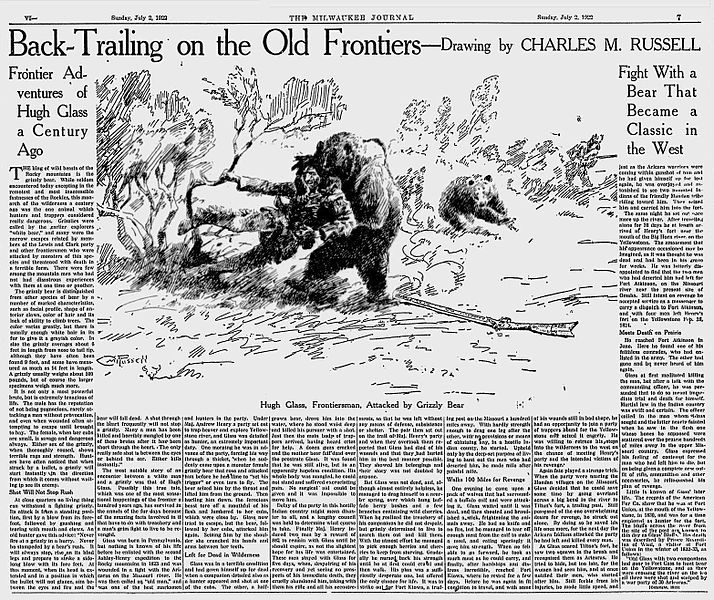
File:Hugh Glass News Article.jpg“Pain is temporary, film is forever.” That quote is from Leonardo DiCaprio in a recent interview. The viewer witnesses in the new film The Revannt just how much DiCaprio apparently believes in this. You could argue that after more than 20 years, he truly wants that Oscar, a prize that has shockingly been denied from him over and over again. DiCaprio earns it here—there's no question about that. In The Revenant, directed by Aalejandro Gonzalez Inarritu, who won three Oscars for Birdman, he plays real-life figure Hugh Glass, who, in 1823, was attached by a bear and left for dead yet crawled back and survived.

This movie is simultaneously a story of survival and a story of revenge. The revenge elements are unfortunately fairly uninspiring. The survival scenes, however, are unlike just about any other you've ever seen. Film critic Patrick Bromley mentioned on his podcast how he sometimes wakes up with neck pain if he sleeps incorrectly on his Swedish mattress. His point was that compared to most people of the mid-19th century, most of us from the present would be long gone if we had to survive in the wilderness of what was then the Dakota Territory. Everyone back then appeared to be horribly malicious, at least from what occurs in this film, and Glass' colleague John Fitzgerald, who was scalped by Indians and therefore deeply hates Glass partly because of his half-Indian son (Forrest Goodluck), particularly so. Fitzgerald is played by Tom Hardy, who had quite a year, having also appeared in the acclaimed Mad Max: Fury Road. Watching Hardy throughout his career, I usually am annoyed by his accents, regardless of what it is; whatever role he plays, it tends to require subtitles. Here, however, he's quite good. It's an intimidating performance; with one single, slow turn of his head, he says more than he needs to throughout the rest of the film.

File:Wpdms nasa topo hugh glass route.jpg
I'm a product of American culture and history, so I know next to nothing about the American Indian tribes depicted here. I can't say how accurate its depictions are, but the days of Anthony Quinn are long gone; there are American Indians cast here, like Melaw Nakehk'o as a young Arikara woman captured by French fur trappers, and Arthur Redcloud as a Pawnee man who assists Glass in his journey home. The other actors are pretty good, too. Domhnall Gleeson (who may be the actor of the year, having also starred in Star Wars--The Force AwakensEx Machina, and Brooklyn) is the captain of the party. Will Poulter is also here as a young member of the trappers. who is conflicted about his complacency in what the crew (particularly Fitzgerald) has done to Glass.
 
But DiCaprio is the one everyone is talking about. DiCaprio, it should be noted, does overdo it in a scene or two, but find me a movie in which he doesn't. He almost never relies on his voice for this performance; it's like something from a silent film. Having serious damage to his larynx from the bear attack, he's mostly left to communicate in a tactile manner. This helps DiCaprio, because accents are not his thing. Watch Gangs of New York, The Aviator, The Departed, and Blood Diamond and tell me those are good accents.

Inarritu is not my favorite director, but this is eons better than Birdman. He has taken his cast and crew into the deep, dangerous (and cold) wilderness of the U.S. and Canada to film some absolutely gorgeous locations. There hasn't really been a movie like this in a while, and not since The Grey in 2012 has there been a shoot that has looked so painful. Indeed, the production has come under criticism for the dangerous filming, with one member calling it a "living hell." That being said, Glass escapes death so many times that it's hard not to role one's eyes. He's clinging to death when I think most of us (well, at least me) would easily give up, but why doesn't he? Revenge. When we are pricked, do we not bleed? And when we're left for dead after a bear nearly kills us, do we not really, really want to hurt the jerks who left us?


Thursday, February 11, 2016

The Best Films of 2015 (And the Most Overrated)

Movie Theater
Hey there, cats and kittens.

The year 2015 was not as dismal as 2014 in terms of movies, but it was still not a phenomenal year. There were lots of good movies--movies as varied as Ant-Man, Slow West, Listen to Me Marlon, and others--and there weren't as many overrated movies. Some of the best of the year were truly phenomenal and should be seen by everyone; some of them include the following:

Paddington
It's disappointing that 2015 featured the return of puppetry with Star Wars and a bear that nearly ate Leonardo DiCaprio in The Revanant, but we still have a CG protagonist in Paddington. Still, this is a great family film, and even though the title character doesn't have an iota of realism in how he looks, he's still a terrific character in a family film championing the role of family. The cast, which includes Ben Winshaw, Sally Hawkins, Julie Walters, and Peter Capaldi, is spot on, and Nicole Kidman does a fine job in her first role (to my knowledge) as the villain. In one particular moment, she's far too nefarious, but that scene is the only blight in this otherwise fine film.

Trainwreck
I was very much prepared to hate this movie. From the few clips I've seen of Amy Schumer's hit Comedy Central show, Inside Amy Schumer, I wasn't impressed. And Trainwreck is a fairly standard rom-com in many respects, mostly poking fun at the genre but then suddenly embracing it. But I quickly loved this hysterical comedy. Schumer plays a woman whose rule is to never spend the night post-sex with a man. She's a "modern chick who does what she wants" and sleeps with whomever she wants, even though she's seeing someone, an incredibly muscular bro who actually is kind of sweet but a little dumb. That character is played by professional wrestler John Cena in one of the film's funniest roles, particularly as he uses sports lingo to talk dirty in the bedroom. Another sports figure who appears (as himself) is the surprisingly hysterical LeBron James, who according to the film, appears to be quite the fan of Downton Abbey. "Listen," he says, "I'm watching it tonight, because I'm not going to practice and all the guys are talking about it and I'm left out." Why exactly did this lose Best Comedy to The Martian (apparently a rip-roaring laugh fest) at the Golden Globes?

Brooklyn
Brooklyn is a simple movie, perhaps the simplest on the list, and yet it is one of the best of the year. It feels like a story we've seen over and over again, and yet it feels so fresh. Its supporting cast is charming, particularly Emory Cohen, Jim Broadbent, Julie Walters, and Domhnall Gleeson. But the real star is of course the lead, Saoirse Ronan, who plays Eilis, a young lady who emigrates from Ireland to the United States in the 1960s. Her performance is one of the very best of the year. In the hands of a weaker writer and director, the choices her character has to make would be much easier from the audience's perspective. Not so with director John Crowley and writer Nick Hornby, adapting Colm Toibin's novel of the same name, who really make just about all the right moves.

Inside Out
Inside Out is a movie that tells children (and adults) that sadness is a necessary, even helpful, emotion. This is the most emotionally powerful Pixar film since WALL-E and Up, and while it's not as unforgettable as those films, it deserves to be in their rank. Few animated films look anywhere near this incredible, and what a cast to back it all up, including Amy Poehler, Phyllis Smith, Richard Kind, Bill Hader, Lewis Black, Mindy Kaling, and others. Many were disappointed with Pixar's follow-up later in the year, The Good Dinosaur, and many are nervous about the upcoming sequel to Finding Nemo, but let's hope Pixar still has a plethora of other fantastic tales to tell.

Room
Room is just about as perfect as a movie can be, a movie that had water in my eyes and a lump in my throat for practically its entirety. There are few films this powerful, this well written, this well acted, this well directed, this exceptional in virtually every way. The entire cast is great, but of course the best accolades should go to its two leads, Brie Larson and Jacob Tremblay, who are truly exceptional. Larson (who also played Amy Schumer's sister in Trainwreck) hands-down deserves the Oscar. This might be the best movie of the decade.

Note: The trailer for Room is the reason why there should be no movie trailers at all. I was stunned to watch it (fortunately, after I had seen the film) and to see that a pivotal moment in the movie is completely revealed in the trailer. Don't watch the trailer before seeing the movie!

Honorable Mentions

Ex Machina
Ex Machina is the best science fiction film of the year, giving us a terrific directorial debut from screenwriter Alex Garland and three great performances from Alicia Vikander, Domhnall Gleeson, and Oscar Isaac. All three of these stars had a phenomenal 2015, with Vikander the front-runner for an Academy Award for The Danish Girl, and Isaac and Gleeson appearing in the biggest film of the year: Star Wars--The Force Awakens. Gleeson may have overdone it in Star Wars, but he was charming in Brooklyn and vulnerable here in Ex Machina. Vikander's role, particularly during the climax, is haunting, and Isaac definitely performs the dance of the year in the film's lone offbeat comedic scene.

What We Do In the Shadows
What We Do In the Shadows has a much funnier first half than second. Upon second thought, I realize that I watched the first half in the hospital right before my tonsillectomy, and the second half right after, so that probably had something to do with my reaction. Still, this mockumentary from New Zealand about vampires is one of the funniest of the year.

I Am Big Bird: The Carol Spinney Story
This documentary about Carol Spinney, the man behind Oscar the Grouch and Big Bird, starts off the same sort of bland way that dominated much of the 2011 documentary Being Elmo. The second half, however, really elevates the story, as the viewer truly gets a sense of just how enormous a presence someone like Spinney has remained for the past several decades.

Mission Impossible--Rogue Nation
I never thought there would be a year in which a Mission: Impossible movie would be better than a Bond movie, but in 2015 that was definitely the case. This is the best in the franchise since the first in 1996, and probably justifies its continuing.

The Walk
Sure, Man on Wire won the Oscar for Best Documentary about Philippe Petit, the man who walked on a wire from both towers of the World Trade Center in 1974, but you really cannot understand that feat without having a visual effects powerhouse like what director Robert Zemeckis and his team deliver in The Walk. True, most of the film is good, not great, and Joseph Gordon-Levitt's accent is, well, as a vast majority of respondents in one poll put it: "Sacreblue! He might as well wire walk with a French accordion and a croissant." Still, the final third of the film--the walk--is a tremendous work of special effects.

The Hunting Ground
This is the kind of documentary that will leave your blood boiling. If your friend tries to tell you there is no such thing as rape culture, show them this film.


Best Trailers

Forget my above criticism of trailers for just a moment to appreciate three trailers that I did watch in 2015 and enjoy. If you're going to do a trailer, these film makers show you how to do it right:

3. Creed


2. Suicide Squad (click here to watch the even better second trailer, released this past January)


1. Star Wars--The Force Awakens


Actress of the Year
Alicia Vikander (The Danish Girl, Burnt, The Man From U.N.C.L.E., Ex Machina)

Actor of the Year
Domhnall Gleeson (The Revenant, Star Wars--The Force Awakens, Brooklyn, Ex Machina)

Comebacks of the Year

Jennifer Jason Leigh (Anomalisa, The Hateful Eight)

Kurt Russell (Furious 7, Bone Tomahawk, The Hateful Eight)


But a negative note must end this post. Movies still "aren't what they used to be," at least in terms of quantity. For every great film the critics told us to go out and see, there were twice as many piles of feces they sold us. Some of these films we have ourselves to blame; perhaps if Jurassic World didn't make nearly two billion dollars (and had over seventy percent of critics not liked it), we wouldn't have to suffer through anymore of these. Some of them (Timbuktu) were missed opportunities, others (The Duke of Burgundy) were dreadfully boring, and some were just pure garbage, like the number one pick for the most overrated movies of 2015:

Honorable Mention: White God

10. Girlhood
9. Jurassic World
8. Cinderella
7. Predestination
6. Timbuktu
5. The Duke of Burgundy
4. Testament of Youth
3. The Avengers: Age of Ultron
2. Shaun the Sheep
1. Me and Earl and the Dying Girl

2015 was better than 2014, but let's hope 2016 is better than 2015.

Friday, January 1, 2016

The Hateful Eight

File:Tarantino caricature.jpgA vast, snowy landscape is the introduction to the eighth film directed by Quentin Tarantino, The Hateful Eight. Reuniting him with some old pals like Samuel L. Jackson, Kurt Russell, Tim Roth, Michael Madsen, Bruce Dern, Walton Goggins and being joined by Demian Bachir, Jennifer Jason Leigh, and Channing Tatum, this is his most violent film in a decade. It is also the first time (not including Kill Bill Vol. 1 and Vol. 2) that Tarantino has done two films of the same genre back to back. That genre is one that has influenced his entire career: Spaghetti Westerns.

It is unfortunate that the western has fallen from grace around the world, for it was once, as Andre Bazin (the father of the "auteur theory") wrote, that the western is cinema par excellence. Why? Because cinema is movement, and the galloping horses and fights were "usual ingredients" in these films. How ironic it is that Tarantino is the one who might resurrect the genre, for his films are very talky with (for the most part) few fights. Here, the vast majority of The Hateful Eight takes place in a wooden mountain pass in the midst of a terrible blizzard. It's not a tale of morals, as many famous American westerns are, but instead a mystery featuring the most vile, violent humans imaginable. This is appropriate because the Wild West was a horrifyingly violent, despicable time in human history, not some romantic period in which we should strive to return to. Tarantino gets this. He's a director (or, if you must, auteur) who understands that details are important. He is helped enormously in this regard by utilizing a score by legendary composer Ennio Morricone, the 87-year-old musical genius returning to the genre after a 40-year absence. His score here is awesome, helping to immediately set the mood in which our roughly eight or so characters find themselves trapped together.

The first two we meet are Daisy Domergue and John Ruth. Daisy is played by Leigh, and it's one of her very best performances. She's a notorious gang member captured by the bounty hunter Ruth (Russell), a rugged monster with a gravely voice and a John Wayne-like way of speaking. Ruth may be a cruel animal (it's probably Russell's most diabolical role ever), but he's on par with Daisy in viciousness. Ruth is transporting Daisy to a town called Red Rock, where she will be hanged. The trouble is he is trying to outrace a terrible storm. Along the way, he is joined by another bounty hunter, Major Marquis Warren (Jackson), who is also transporting persons (though these ones happen to be dead), and a man claiming to be the sheriff of Red Rock, Chris Mannix (Goggins) joins as well. While Ruth seems to like Warren, Mannix and Daisy are both explicit racists, and they make it known. Speaking of racists, at the mountain pass, the elderly Confederate general Sandy Smithers (Dern) is resting, as is a British hangman named Oswaldo Mobray (Roth), the quiet "cow puncher" Joe Gage (Madsen), and a Mexican employee of the mountain pass named Bob (Bachir). They're all cold characters in a cold world.  

Say what you will about Tarantino, but few other writers can create dialogue like him, and perhaps even fewer directors have such nostalgic love for the traditional looks of classic Hollywood. He and his cinematographer Robert Richardson filmed this in 70 mm, which also is a bit ironic considering there are not a whole lot of landscape shots of rural Wyoming but instead a claustrophobic cabin (though this 70 mm is effective for the close-ups of the eyes, an important feature of Sergio Leone's Spaghetti Westerns). That being said, Tarantino also frequently uses violence that will disturb many viewers; it's not Greek-like and unseen like in Reservoir Dogs. With The Hateful Eight, the violence is quite explicit, and the movie itself is inferior to his previous Western, Django Unchained, and his revisionist World War II drama Inglorious Basterds.

Act Two is when the movie suffers a bit as it falls into a pit of exposition for practically each character; in essence, there is too much telling and not enough showing. This is, for better or worse, the talkiest Tarantino film ever. There is unnecessary repetition of a "comic" scene involving the opening and shutting of the door. After an hour, we finally have all of our characters assembled in this room, and one of the most interesting to watch is Dern's fiery Confederate general and his feud with Warren. Dern is a master of acting and a joy to watch. Madsen is gruff, and yet his scene where he is humiliated by Ruth is actually rather touching. Roth is hyperbolic, but there's a point to it, revealed in the third act. Tarantino rarely (if ever) is political, but when Roth's character tells Warren that slavery "was a long time ago," Tarantino makes it clear that he embraces Black Lives Matter (and that he has been vocal in his criticism of police brutality). Finally, Tarantino's movies are not for everyone. His films have malicious characters spewing loads of vile lexis (for lack of a better word) out of their mouths. Speaking of spewing, there is a particularly memorable scene involving such a literal act, and it demonstrates perhaps Eli Roth's influence over Tarantino's recent works.

Channing Tatum shows up and there's still 45 minutes left in the movie. Indeed, the film sometimes feels more like we're reading a mystery novel than watching a Western. And despite a less interesting second act, the final section of the The Hateful Eight really helps save it, making the film holistically quite a good one. Perhaps one day Tarantino will be thought of as one of the individuals who helped resurrect the Western to excellence.         

Friday, December 25, 2015

White Christmas

From the very first frame, a color palate of red, green, and white (with eventually a consistent dash of blue) set the audience for certain amount of holiday cheer. Seriously, there is some well-done color here. Most films directed by Michael Curtiz that you might think of off the top your head--Casablanca, Yankee Doodle Dandy, Angels with Dirty Faces, Mildred Pierce--have cinematography that is sharp and dark. But sometimes, like in The Adventures of Robin Hood, there is such bright color, and here, the cinematography of Loyal Griggs made with Vista Vision and Technicolor loudly visualizes the awesome costumes by Edith Head. There are few other films I can think of that have this kind of color. This reason alone might be good enough to watch the 1954 holiday film White Christmas.

There is a pretty good cast in this Christmas classic, perhaps more memorable than the cast of the film that more or less was its spiritual predecessor: Holiday Inn. Both feature Bing Crosby in the lead at one point singing the immortal song "White Christmas," as well as a hotel trying unique ways to get guests for the holidays (or in this case, just the big one in December). The comic relief of Fred Astaire is instead provided effectively by Danny Kaye, and there's more comedy from Mary Wickes, playing the hotel's feisty housekeeper. But this is a movie that tries to tug emotionally not simply with humor. Case in point is the movie's opening scene, where it gets its famous song out of the way pretty quickly. It's 1944 in Europe as American army men are taking a Christmas break watching a vaudeville show by Crosby and Kaye's characters. After a more upbeat number, Crosby sings "White Christmas," the song that won an Oscar for Holiday Inn. The men are moved. From a personal perspective, being away from home in the desert heart of Islam in a country where Christmas is illegal, as I have for the past five years, has really made the song, a favorite of mine, far more poignant. However, my complaints have no merit when one thinks of the reality of wartime soldiers in any country being away from home during a time meant for celebrating being home with one's family. The film only requires Crosby's exceptional voice and the soldiers sadly staring at the ground to provide a really effective opening. From there, though, it's not exactly the most memorable of classic holiday films, but it's an enjoyable one nevertheless.

Crosby and Kaye become Wallace and Davis, post-war hits, topping radio and awing their audiences. But despite their success, Crosby is miserable, unhappy, and lonely, according to Kaye, or at least "happy for the wrong reasons." They are in a business where the women they meet are young and ambitious, so Wallace (Crosby) is not opposed to the idea of settling down necessarily but is more or less convinced that he won't find the love of his life anytime soon. Davis (Kaye), however, is adamant that they try. The two go to see a sister act, and (despite genuinely looking for talent) they meet the Haynes sisters (Rosemary Clooney and Vera-Ellen), and there is immediate chemistry, though less so with Betty (Clooney) and Wallace. Betty thinks Wallace is cynical for believing that everyone has an angle in virtually every decision they make. This disagreement is a major impetus for trouble between the two later in the film.

I mentioned that the rest of the film isn't exactly memorable, and it's true. What will likely stick out in your mind after watching it is the following: the quasi-drag number Wallace and Davis provide, a moment where the two really seem to be having a riotously fun time; the practically angelic dance between Vera-Ellen and Kaye in which they virtually fly over water; the musical number "Snow" the four of them sing on the train, which is basically the only non-"White Christmas" song that could stick in your head; and finally, the really endearing performance by Dean Jagger, who plays the army general Wallace and Davis fought under and who owns the hotel the four leads end up in. The Vermont hotel is struggling to get guests in, especially with the lack of snow in December. He's poured just about everything into the hotel, and yet business is slow. Wallace and Davis are determined to help him out by bringing in a number of terrific musical performances to his hotel to attract customers. Here, the movie is similar to Singin' in the Rain whereby the numbers have no relevance in advancing the plot but are still quite fun to watch. And also, Jagger's performance as the fatherly retired general is the one performance that really will send shivers down your spine.

Vera-Ellen in particular is marvelous to watch dance, and it becomes obvious that the other three--even Kaye--cannot keep up with her. The dancer John Brascia may not have any lines, but he is the only one who can come close to match her dancing skills, and keep an eye out for the handsome George Chakiris making a brief pre-stardom appearance as one of the dancers in an act with Clooney. Vera-Ellen's great dancing is matched by the wonderful singing of Clooney, the charisma of Kaye, and the voice of Crosby. Most folks don't particularly like the sound of their own voice when they hear it, but how could this possibly be for Crosby with that nearly perfect bass-baritone voice of his?

Still, there's almost nothing worth remembering in the third act beyond the final fifteen minutes when it suddenly becomes a Christmas movie, though Clooney's "Love, You Didn't Do Right By Me" scene is iconic, or at least it should be. Is White Christmas the best Christmas movie? No. Is it better than Holiday Inn? No. Is it satisfactory for the holiday season. Absolutely.

Merry Christmas.
  

Friday, December 18, 2015

Star Wars: The Force Awakens

There has been an awakening...have you felt it? Those words, terrifyingly spoken by a character we know now to be Snoke, were the introductory lines we heard right after Thanksgiving 2014 in the first of three terrific trailers for the first Star Wars film in a decade (not including the not-so-well-received animated film from 2008) and the one featuring most of the original stars since 1983. Fans have indeed felt it: Episode VII made more than $14 million dollars alone in its first day of release, and it will undoubtedly be the film of the year in that sense. But does it deservedly rank as the single greatest Star Wars film ever, as Rotten Tomatoes claims? That's a bit more complicated.

By now many fans know that producer Kathleen Kennedy, George Lucas' hand-picked choice to lead Lucasfilm in the post-Lucas era, convinced J. J Abrams, the man who helped reboot the Star Trek franchise and who initially turned down the chance to direct The Force Awakens, to direct it when she asked him, "Who is Luke Skywalker?" Luke (Mark Hamill) does appear, as does his sister Leia (Carrie Fisher), but of the three original stars, Han Solo (Harrison Ford) appears the most (and receives top billing), but even he takes a bit of a back seat to the three newer protagonists: Rey, Finn, and Poe Dameron. So the makers deserve enormous credit for bringing back the original three plus, Anthony Daniels as C-3PO and Peter Mayhew as Chewbacca, but also credibility for assembling an incredible list of some of the most talented newer actors: John Boyega, Oscar Isaac, Daisy Ridley (in her film debut as Rey, the lead), Lupita Nyong'o, Gwendoline Christie, Domhnall Gleeson, Adam Driver, and Andy Serkis. Filling out the acting list is Swedish legend Max von Sydow and Abrams' frequent collaborator Simon Pegg. Even if The Force Awakens were a bad movie, it would be worth seeing it simply to see all these actors.

The Force Awakens takes place decades after the Empire fell in The Return of the Jedi. Out of the Empire's ashes comes the First Order, an authoritarian government in conflict with the Republic and its only Jedi, Luke Skywalker. Skywalker, however, goes into a bit of a depression after a particularly tragic failure and goes into a self-imposed exile. Poe Dameron (Oscar Isaac) is sent on a mission to retrieve part of a map to Skywalker but is hunted by the First Order's Kylo Ren (Adam Driver), a Darth Vader "fan-boy", and General Hux (Dumhnall Gleeson), two sort of sibling rivals for the love and attention of the mysterious Dark Side leader Snoke (Andy Serkis). In a powerful opening sequence, Stormtrooper FN-2187 (played by John Boyega and renamed Finn) goes into a Saving Private Ryan-style state of shock and has had enough of the First Order's violence. After Kyle Ren captures Poe in an attempt to retrieve the map to hunt down Skywalker, Finn breaks out with Poe and escapes to the desert planet Jakku, where they become separated. Poe's droid BB-8 survives the hunt and finds Rey (Daisy Ridley), a talented scavenger, and eventually Finn, and then the three of them become hunted by the First Order. They escape in the only "piece of junk" ship they can find: the Millennium Falcoln. But it's original owners (you know who) want it back, and sure enough they are successful. As you can see, while this movie contains maybe a bit too many parallels to the original trilogy, it's a complex but not too crowded and complicated story line and an exciting one.  

The author of a Lucas biography, Dale Pollock, is just about the only person who has read the outlines for all nine of Lucas' original stories and has said that this trilogy is the best. But as Vanity Fair reported earlier this year, Disney (the new owner of Lucasfilm) and Kennedy decided to go in a different direction. It would be interesting to see just how different Lucas' version and the final version are, but my hunch is that going back to the genesis of these stories, our original heroes were always meant to be supporting roles in this trilogy. Hamill even hinted at this in an interview with Gene Siskel back in the 80s promoting The Return of the Jedi.

There are a lot of grand moments here. The reunion of Han and Leia, separated and not particularly interested in each other anymore, is a powerful and touching moment, one of the best in the film. But there was one scene in particular that made me fairly angry. It's a scene that is executed with enough gravitas and emotion to be an impressive one, but it's one that left me disturbed and puzzled. That's sort of the basic element of this movie: it's so well-crafted that it's difficult to dislike, but it's not a masterpiece. To use Star Wars vernacular, Abrams has learned much, but he is not a Jedi yet. The Force Awakens may not look as breathtakingly fresh as those first films from 1977-1983, but it still looks like much more painstaking effort was put into it than the films from 1999-2005 were. Still, while The Force Awakens is far superior to The Phantom Menace or Attack of the Clones, I couldn't help but like Revenge of the Sith better, though I suspect I'm in the minority. But here's one aspect that I think most folks will agree with me: the villains here are not nearly as interesting as Star Wars villains of the past. A Star Wars movie is sometimes as strong as its villains, and whereas the films of old featured Darth Vader, Emperor Palpatine, Grand Moff Tarkin, Boba Fett, Jabba the Hutt, Darth Maul, and Count Dooku, the strongest villain here (Kylo Ren) is essentially Vader-light, with his only truly impressive moments being his frightening temper tantrums. The Palpatine-like character is Snoke, in another motion-capture performance by Serkis (who appeared in similarly filmed roles in The Lord of the Rings, King Kong, The Adventures of Tintin, and the Planet of the Apes films). (Serkis' company, The Imaginarium Studios, which focuses on motion-capture film making, has provided consultation for Godzilla, The Avengers: Age of Ultron, and The Force Awakens.) But despite how impressive the technology has looked in some of the movies mentioned, Serkis gives Snoke a menacing voice but a visual that looks dated and not consistent with the tenacity of the rest of the film. While Snoke looks silly, the rest of the film has a look of determination. Abrams and team deliver on their promise to feature more sets, practical effects, make-up design, and puppetry, using what seems to be a limited amount of computer-generated imagery. What CGI that does appear is mostly well-done by Industrial Light & Magic.    

But all in all, there were only three moments in this film that made me completely thrilled: the first time we see Han and Chewie, the first time we see Leia, and the first time we see Luke. Some moments, though, are actually funny, with Boyega, Isaac, and Ford providing most of the humor. Finn enthusiastically hopes to storm the enemy's base with no plan. When confronted by Solo on this lack of preparation, Finn excitedly tells him that they will use the Force. Solo is not impressed. "That's not how the Force works," he grumpily tells him. C-3PO (with a red arm for some reason) and R2D2 appear, but BB-8 does more than a fine job standing in as the new it-droid; he even gives Finn a thumbs up, certifying audiences' love for him with his puppy-dog eyes and WALL-E characteristics. The droid was created by Disney Research to be a practical part of interacting with the actors, and he is part of the unique combination of characters new and old, a combination that got just the right amount. And this movie is a sign that perhaps the times are a-changin', because The Force Awakens is a Star Wars movie with a feminist bent: it's the first time we see a woman fight with a lightsaber, Princess Leia is now General Leia, and there's even a lady Stormtrooper (Captain Phasma, played by Game of Thrones star Gwendoline Christie).

I'm shifting back and forth between criticism and praise, so let me be clear: This is a good movie. Abrams' team (especially the production designers Rick Carter and Darren Gilford, costume designer Michael Kaplan, and creature-shop head Neal Scanlan) have created a Star Wars movie that more or less looks like what a Star Wars movie should look like, shunning the excessive CGI of a decade ago.

But is this the best Star Wars movie ever? No. Is it even the third of fourth best? No to that as well. But by my count, there will be a total of about 20 Star Wars movies (three trilogies plus three stand-alone films to be released within several years, as well as about six spin-offs and specials, including the infamous Holiday Special), so fifth best out of about 20, I assume, ain't bad. Ultimately, if you like Star Wars, you will like The Force Awakens, and I am confident that the next two will be entertaining escapism as well. The Force is strong with this one.        

Friday, November 27, 2015

Tangerine

File:Pomological Watercolor POM00006443.jpgSean Baker has directed a film with an iPhone, a movie that starts with two transgender L.A. prostitutes sharing a doughnut on Christmas Eve. "Merry Christmas, bitch!" is one of the first lines spoken by one of the prostitutes, someone who has just been released from prison. Let's just say that your right-wing uncle would probably be more interested in seeing Spectre and talking about it during yesterday's Thanksgiving dinner, but this new movie by Baker and his team is a superior movie. The movie is called Tangerine (not to be confused with the Estonian-Georgian war production Tangerines from last year, which also is a recommendable film), and there have been increasing calls for it to be nominated at next year's Academy Awards after making its debut at Sundance this winter. (Baker and the two main trans actresses were all nominated for Independent Spirit awards earlier this month.)

These two sex workers, Alexandra (Mya Taylor) and Sin-Dee (Kitana Kiki Rodriguez), begin their chat with a revelation that Sin-Dee's boyfriend and pimp Chester (James Ransone) has been cheating on her with a "real fish" (you might need to visit Urban Dictionary if you need help understanding that term). Alexandra tries to calm Sin-Dee down; it's "all about our hustle," she tells her, "and nothing else." Sin-Dee, however, is furious, and begins her day-long Christmas Eve hunt for Chester's "real fish." The story takes us in Act II on three different routes, as Alexandra has had enough of the drama Sin-Dee is partaking in, and the two temporarily go on their separate ways. A third major character makes his way into the story: Razmik (Karren Karagulian), an Armenian immigrant taxi driver, and at first it's not clear how his story is related--he may be Chester, for all we know. Razmik is a family man and appears to be competent at his job, chitchatting with a lady whose dog has just died or making sure a Cherokee man terribly drunk is okay. It eventually becomes evident that Razmik takes time away from his work to cruise; he picks up a (cisgender) worker, and Razmik suddenly is disappointed at what he finds down under. Eventually, though, he gets his release when he meets Alexandra, who calls him a "sight for sore eyes," and they have a quickie while going through a car washer. When Ramik learns that Sin-Dee is back, he gets an immediate crush--the difference in his demeanor when he's at home having Christmas dinner with his family and when he's on the lookout for Sin-Dee is obvious yet subtle.

Taylor and Rodriguez are untrained actors, but they both act better than most of the other (trained) actors involved. Baker has said in interviews that using only phones and not film cameras helped both of them avoid nervousness. Taylor in particular really shines. On the street she is a tough negotiator, and when a transaction goes wrong, she tells her shady customer, "You forgot I have a dick, too." A fight breaks out. What would the inspiration this kind of unique story be? I don't know, but it is engaging nevertheless.

There is an eclectic array of music in the movie, with immediate shifts from classical to hip hop and "Toyland" from the Laurel and Hardy movie Babes in Toyland throughout. The result is that it's practically a musical. Most viewers will probably tell you that (while it may take a while), it's difficult to believe that this is a full-length feature film shot entirely on smartphones. Part of the reason why it looks so good is because of its post-production work; the polluted hues of L.A. are augmented to give the movie a professional look. Boom mics and other audio technology were also used, which probably was the only thing on the street that gave it away that an actual movie was being shot.

Sin-Dee's actions become hard to watch and difficult to justify as she aggressively and violently tracks down Chester's supposed new girlfriend (one of his cisgender prostitutes, played by Mickey O'Hagan); her actions toward Dinah, the new girlfriend, are scenes that become increasingly disturbing, more so due to the fact that those who witness it do nothing to stop it. When it's not disturbing or revealing or funny or dramatic, Tangerine can probably best be described as surreal. Your conservative uncle might lecture you about our "lack of morals" in a movie depicting prostitution, drugs, and such, but Tangerine is a film with an incredibly diverse cast featuring a story about people, some of whom do bad things, but real people (in scenes that are admittedly sometimes hard to buy). Spectre, on the other hand, is a movie celebrating a mass-murdering quasi-rapist. So really, who should be the one doing the explaining? "Tangerine" might be considered unique for the average moviegoer, but it's one you should see: an enjoyable, well-crafted film, all shot on an iPhone.

Saturday, October 31, 2015

7 Days of Halloween: The Hound of the Baskervilles

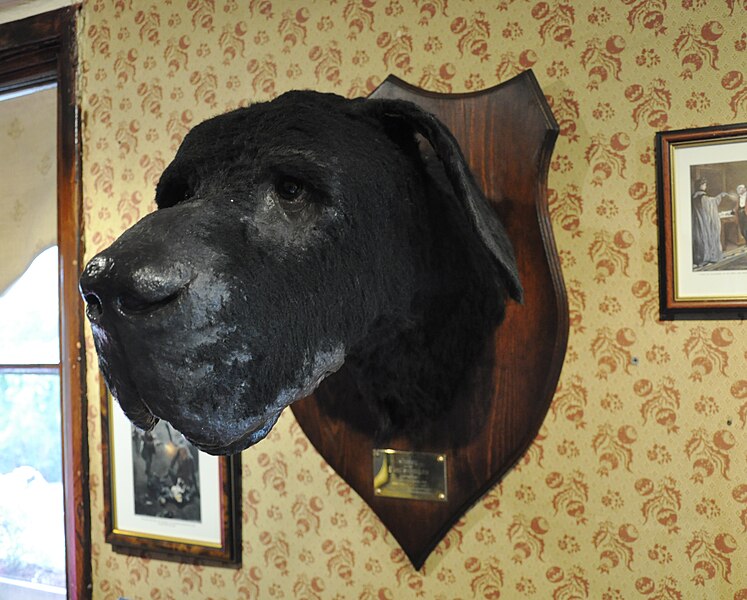
File:CC No 33 Sherlock Holmes.JPGMr. Burns of The Simpsons has a simple command to "release the hounds," and it could have its origin in The Hound of the Baskervilles, the 1959 adaptation of Sir Arthur Conan Doyle's third Sherlock Holmes novel, directed by Terence Fischer, which starts with an aristocrat sending loose his fiendish hounds to attack other human beings. From there, the movie is an aristocratic back-and-forth whodunit featuring a diabolical hound of hell, summoned to forever haunt the Baskervilles family, and of course, it features the most famous English detective in history trying to figure out who--or what--is really causing all this mayhem.

Hugo Baskervilles (David Oxley), a cruel aristocrat, was the Gaston before there was Gaston. This guy is horrifyingly cruel to his servants, one of whom he nearly kills and another (the first servant's daughter) he stabs in the heart, just before he appears to be destroyed by some kind of terrible beast. Fast forward to the early 20th century, where Dr. Mortimer (Francis de Wolff) is reading to Detective Holmes (Peter Cushing) and Dr. Watson (Andre Morell) the spooky legend of the curse, but being men of science, Holmes and Watson are naturally skeptical. They do, however, agree to investigate. It's here where we meet the last of the Baskervilles, Sir Henry, played by the late, great Sir Christopher Lee, who is made up to be more handsome and a lot less grotesque than his previous outings with his friend Cushing at Hammer; his nice suits replace the rotting flesh and attire of Frankenstein's creature.

Because Henry's uncle, Sir Charles, has been killed mysteriously, Sir Henry is summoned from Johannesburg to run Baskervilles Hall in England. He, like his uncle, suffers from a heart problem, and when a tarantula is found in Henry's boot--a tarantula that could easily kill a man with a heart condition, Holmes tells us--Holmes suspects that foul play is involved. What adds to all these characters' angst is that a criminal has escaped from a nearby prison and could be the one engaging in all this mischief. But it could also be Henry's mysterious and angry-looking neighbor (played by Ewen Solon) and/or his Spanish daughter (Marla Lindi). Or it could be Dr. Mortimer, who has received a considerable sum of money from the will of Sir Charles, or it could even be Sir Henry himself who killed his uncle. One way or another, Mr. Holmes does not believe that there is any sort of supernatural "hound of hell" on the loose haunting about, ready to avenge what happened centuries before.

Lee became critical of how gruesome and disturbing horror films have become in recent years, and I can't imagine this adaptation of Doyle's famous story being scary to basically anyone, even in 1959. But that's not the intent, is it? Despite having never read the original novel or seen any of the other numerous adaptations (I have a DVD of the Basil Rathbone version but have never watched it), it's my understanding that this is not a horror story (but maybe I'm wrong). Why should it be scary, despite all the mist and howling our characters periodically hear? Still, as one of them mentions, "there is more evil around us here than I have ever encountered before."

The acting here is decent; Lee portrays Henry as a sympathetic figure, especially considering how helpless he is. Cushing is a joy to watch, as usual. Miles Malleson shows up in a fairly humorous comic relief part as the local bishop (and who, I think, we're at one point supposed to all suspect as being behind all this trouble). Cecil, the Spanish girl, is a somewhat interesting character bitter about being in England but intimately drawn to Henry. There's a hint of class warfare metaphors sprinkled throughout this film, and it really comes into focus during the scenes featuring these two. The reveal at the conclusion is a bit odd and slightly disappointing, but it is a thrilling climax nonetheless. It's better than The Curse of Frankenstein or Horror of Dracula. The Hound of Baskervilles is not perfect--"elementary" might be an appropriate adjective--but it's good fun and very much recommendable.      

File:Sherlock Holmes Museum The Hound of the Baskervilles.jpg

Friday, October 30, 2015

7 Days of Halloween: The Descent

I once went spelunking in rural Pennsylvania when I was in Boy Scouts. I feel very fortunate that the experience was nothing like "The Descent." In my experience, like that of virtually every human in recent human history who has gone caving, the scariest thing is when your guide tells you to turn off your helmet light so that you can see just how dreadfully dark it is under the earth. I might have been as pale as the grotesque creatures featured in "The Descent," the 2006 horror movie directed by Neil Marshall about a spelunking trip gone wrong, but I'm fairly certain there were none of them when I went caving, and if there were, they certainly left us alone.

Forgive me for the digression, but "The Descent" made me think of the recent discovery of homo neladi in a cave in South Africa, and how it has not provided an answer as to how those skeletal remains got there in that secluded cave area. Some think they were deliberately put there as burial grounds, some think they became accidentally trapped there, some think they were deliberately trapped there. Either way, it would be frightening to be trapped there with no way out and such primitive, if any, technology. Just imagine adding dozens of bat people who only make their way to the surface to hunt. That's the situation six British women find themselves in.

The six of them meet in North Carolina for their epic trip. Their leader, Juno (Natalie Mendoza), explains the symptoms they could experience while being down there: claustrophobia, hallucinations, and the like. (It does make one wonder why people do this sort of thing in the first place.) Predictably, the women become trapped and find themselves in the wrong cave. Being lost in the woods, like in "The Blair Witch Project," is scary enough. I can't possibly imagine being lost in a cave. Juno reveals to them that she left the guide book in the car, and they argue and shout for a while. They find caving equipment from a hundred years ago and ancient, possibly pre-history, paintings. Fascinating to see, perhaps, but something else is wrong: not only are they lost, but they are being hunted. Something is clearly down there; some kind of humanoids that make odd echolocation noises to hunt for their food. They are some kind of creatures who've evolved to live in the dark caves. In a movie sense, they're like a hybrid of vampire, zombie, and general monster, biting the neck, eating the body, and hiding in the dark. There's a pit of graves that only further reveals the reality that they are in terrible danger. Like in many other horror movies, they become separated; it becomes fight-or-flight to the extreme.

The caves are a convincing set design at Pinewood Studios by Simon Bowles that make you wonder if they actually filmed it in a cave or not, and there are thunderous trumpets provided by David Julyan's score that heighten the intensity of the scenes. Sam McCurdy's cinematography is also spot-on; occasionally, we are able to see what the characters see in the dark through their hand-held camera, and these are the spookiest moments. Obviously, the makeup effects by Paul Hyett of the creatures are terrific. And there's lots--lots--of blood, an almost "Carrie"-like amount. Despite all these great elements, it doesn't equal a great movie.

The biggest flaw is this: Caves are scary. Being in the dark is scary. Being hunted is scary. Being hunted by those things (whatever they are) is scary. But if your movie, with all those elements, is not scary enough that you need to insert nightmare sequences and characters accidentally bumping into each other, bats and birds flying out, and other formulaic parts, you've done something wrong. Nightmare sequences in horror movies, in my opinion, are usually cheap. They feel almost as if someone has mandated their insertion simply to fill a scare quota. So, too, it is here. The main character, Sarah (Shauna Macdonald) experienced an awful tragedy a year before while white-water rafting when her husband and young child were killed in a car accident. This is a scary enough scenario that nightmare sequences are unnecessary.

That doesn't mean I didn't like "The Descent." I did, and I recommend it. I actually thought it would be far scarier. It oddly brought back memories of my Boy Scout days, but it also made me think that I probably would never go spelunking again. It's a wonder if "The Descent" did for caving what "Psycho" did for showers.  

Thursday, October 29, 2015

7 Days of Halloween: Nosferatu

The first time I saw "Nosferatu," the first adaptation of Bram Stoker's "Dracula," was in high school, and regrettably, it was a DVD of the 1998 "remastering" with an introduction from David Carradine and a soundtrack provided by the metal band Type-O Negative. However, this newest version, released in 2006, is a fine compilation of various surviving German and Czech copies of F.W. Murnau's adaptation, the most famous "Dracula" you might not have heard of. And if you do find yourself hunting for "Nosferatu" this Halloween, go for the 2006 version and listen to James Bernard's score instead of Type-O Negative.

Taking place in 1838, Nosferatu is, as we're told, a word that sounds "like the deathbird calling your name at midnight." The story is meant to be a retelling of a supposed "Great Death" in Wisborg. We meet Hutter, a young lawyer played by Gustav von Vangenheim. (While the overacting universal in virtually all films of the Silent Era is certainly prevalent here, Von Vangenheim is probably the worst offender in this movie.) Hutter is madly in love with his young wife, Ellen (Greta Shroeder), but he must be separated from her for awhile as he attends to a trip into the "land of phantoms" to secure a building purchase of a mysterious count named Orlok (Max Schreck). His trip there will provide the modern-day viewer with views of beautiful German architecture, nature, and a trip down film history lane, as he or she will see an example of pre-color coloring using chemical reactions to create a blue hue for nighttime and sepia for indoors.

Hutter on his travels laughs off the locals' warnings about werewolves in the forests, vampires, and "bad feelings." He journeys on until he reaches Orlok's estate. Here there's another technological antique: Murnau used fast-motion, which was probably quite the novelty in 1922, to show us the entrance of Orlok's hearse. (Francis Ford Coppola understood the neat effect but made it more appealing to an audience in 1992; for the same scene in his adaptation, he simply used slow-motion.) Hutter may be a pretty forgettable character, but Schreck's portrayal of Orlok is probably almost as iconic in cinema as Bela Lugolsi's Dracula. If you don't believe, observe the character of Petyr in the recent comedy-horror mockumentary "What We Do in the Shadows." Instead of the sensual eroticism of Lugosi, Christopher Lee, or Frank Langella, Orlok is a frightening figure of long fingers and ghoulish, exaggerated features: grotesque, large ears and obvious animal-like front teeth. Upon first seeing a picture of Hutter's wife, he remarks how nice her neck looks.

The cinematography of "Nosferatu" by Gunther Krampf and Fritz Arno Wagner may not be as oft-mentioned as that of other Expressionism landmarks like "Metropolis" or "The Cabinet of Dr. Caligari," but it still influences filmmakers today, as is evidenced by last year's Australian horror film, "The Babadook." "Nosferatu" certainly is not terrifying by today's standards nearly a century later, but it does possess the required traits of spooky tales of wonder: coffins filled with rats, ghostly quiet sea shots, and the fear of disease. Orlok soon makes his way to Wisborg and begins feasting. Unlike the vampire of Stoker's novel, those the vampire bites do not turn into vampires themselves; they simply die (even though we never get an explanation as to why Hutter, who initially thinks he's been bitten by mosquitoes, doesn't).

After the epidemic scenes in the ship, basically right after Orlok rises from the coffin, the movie starts to bore in Act IV and especially so in Act V, where, unlike the previous acts, not much happens. Orlok basically goes on the hunt for Ellen; here we see the famous shadow up the stairs moment. He finds her and is about to feed. What happens next basically concludes the film in an anticlimactic ending, where the only conclusion one could have is that you better hope that vampires aren't fans of wearing watches. Still, "Nosferatu" is pretty much required viewing for film buffs and historians.