Friday, February 22, 2013

The Most Overrated Movies of 2012

There were some good movies this pasty year, some great ones (emphasis on the word "some"), and some bad ones. Unfortunately, there were some that we were told were good, but actually were quite bad. How easy it is to pick on those which were destined to be bad; I only wish more critics would call out those movies that were truly bad even though they received such high reviews. Here's a look at some of those such films:

Brave
Educator and writer Herb Kohl noted in a review of books written for elementary school students that the literature sections included classic European tales like Snow White and Cinderella, "tales of royalty and wealth filled with passive or wicked females, evil step-parents, pure and handsome princes...Young women need to be rescued from older women, purified for marriage into royalty or sacrificed to save their fathers." Pixar's "Brave" offered an opportunity to break away from this typical Disney portrayal of princesses. At first it seemed it would be true. Not only is the princess portrayed in the movie a lot tougher than the male characters but also is up against her mother, who is both un-evil and her actual parent. Unfortunately, that's where the opportunity ends. This movie is dull, and disappointingly so. What could have been a unique moment for tough princesses shies away into an unfortunate mess.

Beasts of the Southern Wild
Angry that Ben Affleck wasn't nominated for Best Director?  You can blame A) the Academy, B) the critics who for some reason adored "Beasts of the Southern Wild," and C) director Benh Zeitlin, who was for some odd reason nominated for Best Director instead of Affleck. Admittedly, Zeitlin has a talent, and I hope I enjoy his future work more than this one, but "Beasts of the Southern Wild" is interesting and appealing only if you've never seen "Whale Rider," "Where the Wild Things Are," and a whole host of other surreal movies about children.

The Cabin in the Woods
What a joy it was to see Bradley Whitford and Richard Jenkins in such wonderful roles. Unfortunately, the focus of the movie is on the "horror" scenes, which are not only un-scary but ridiculous. But that's the point, some will say. It's a joke, they will say. If it's a joke, then the joke's on me.

Killing Them Softly
Director Andrew Dominik and star Brad Pitt tried to recreate what worked so well in "The Assassination of Jesse James by the Coward Robert Ford." They failed. They would have us believe that in the world of "Killing Them Softly," angry thugs and murderers sit around watching C-SPAN and talking politics. At different points, Pitt's character goes on diatribes about Jefferson and different current events. "America's not a country," he says, "it's a business." Wow. That's deep.

Pitch Perfect
You've seen "Mean Girls" and "Bridesmaids," so skip "Pitch Perfect," because it's basically the musical version of these two movies, stripped of any enjoyment.

The Avengers
Can somebody please, please tell me what's so fantastic about this movie? Is it the silly dialogue? The annoying characters? The orgy of CGI effects? The headache-inducing fight scenes? The wooden dialogue? The bad acting to match the wooden dialogue? What a terribly overrated movie.  


I don't have the energy to complain any more, but I'd also like to issue a hiss to "Oslo, August 31st," "Gayby," and "The Master."  Hopefully, next year will feature less overrated movies.


Movies, movies, theater, cinema, watch, watching, watches, view,  see, saw, celluloid, cine, cinema, cinematics, cinematograph, feature, film, flick, motion picture,moving picture, photoplay, picture, screenplay, show, silent*, silver screen, talkie,talking picture, videotape, Brave, Cabin in the Woods, Pitch Perfect, Avengers, Killing Them Softly, Beasts of the Southern Wild  

Thursday, February 21, 2013

Oscar Predictions

Best Supporting Actor
This is one of the most challenging to predict this year. If the Oscar's play it safe, they'll pick Tommy Lee Jones for his role as abolitionist congressman Thaddeus Stevens. Particularly if it turns out that "Lincoln" ends up sweeping the Oscars, then Jones will easily ride those coattails. But "Lincoln" has had a rough couple of months; it owes it's likely win for Best Director due to the fact that Ben Affleck simply isn't nominated, and there has been a bit of a backlash against Tommy Lee Jones, I think for good reasons. For one, while it's hard not to admire Jones as an actor, in this performance he doesn't do much except yell a lot. Whereas the scenes with Daniel Day-Lewis in the title role are riveting, with Jones they are distracting. He hits usual, expected notes and with his usual Southern accent (Stevens was from Pennsylvania).

Jones' chief rival is Christoph Waltz for "Django Unchained." I would prefer Waltz to win over Jones, but (and this is a bit unfair), I don't think it's as good as a performance as he gave in the other movie with Tarantino he did ("Inglorious Basterds") which won him an Oscar. Alan Arkin was fine in "Argo," but he gives essentially the same performance he gave in his Academy Award-winning role in "Little Miss Sunshine," and if I didn't think he deserved it then, I don't think he deserves it for "Argo." That leaves Philip Seymour Hoffman for "The Master" and Robert De Niro for "Silver Linings Playbook." Hoffman is fine in "The Master" but not particularly noteworthy. De Niro, however, shines in one of his best performances in years. Here is an actor who is noted for his violent yet frequently complex characters and comedic roles in more recent ones. But it's rare to see De Niro in an emotional role, one in which the movie partially depends on how the father-son relationship plays out. He pulls it off terrifically.

While De Niro has not won any major prizes this cycle, the good folks over Goldderby have him only slightly behind the frontrunner, Tommy Lee Jones.

Who should win: Robert De Niro
Who will win: Tommy Lee Jones

Best Animated Feature
As long as the Academy does not award "Brave," I will mostly be happy. How disappointing a movie like "Brave" is (please see "The Most Overrated Movies of 2012," coming soon). Anyway, while "Wreck-It-Ralph" and "ParaNorman" are both admirable, enjoyable movies, the really winner here should be "Frankenweenie." This is Tim Burton's best movie in years, an homage to the B-movies of his youth (though I will concede it's getting old) and a unique reminder about the importance of science. Not only is the animation more impressive, but it's also a better movie. Still, with the Golden Globe going to "Brave" and the Annie Awards going to "Wreck-It-Ralph," it doesn't seem like this is Burton's year (the Academy has never shown much appreciation for him).

What should win: "Frankenweenie"
What will win: "Wreck-It-Ralph"

Best Supporting Actress
Nobody thinks Anne Hatheway won't win for her emotional performance in "Les Miserables." It is a commendable performance, and she will (and probably should) win. With that being said, not enough praise has been given to Helen Hunt in "The Sessions." Playing a character much more dangerous and complex than any found in "Les Miserables," Hunt navigates a precarious role that few other performers could. Some will say that she should be denied the award because she was "only nominated because of all the nudity." But her performance is so much more than this. Scenes with her and her interactions with John Hawkes, who stars as a paralyzed man in need of sex education, are some of the most emotional scenes of the year. Hatheway was excellent in "Les Miserables," but the Academy voters should consider Hunt as well.

Who should win: Anne Hatheway or Helen Hunt
Who will win: Anne Hatheway

Best Picture

So many nominees. What shouldn't win? I didn't hate "Les Miserables" like some did, and I highly recommend seeing a theatrical production of it. Still, "Les Miserables" is one of the weakest of the nominees (but not as weak as "Beasts of the Southern Wild"). "Zero Dark Thirty" is provocative, well-written, and controversial, but it's a bit dull compared to Kathryn Bigelow's previous film, "The Hurt Locker." "Life of Pi" and "Silver Linings Playbook" are both crowd favorites but are certainly underdogs here. That leaves a horse race between "Lincoln" and "Argo," with the latter having the most momentum. But the really terrific movies here are "Amour" and "Django Unchained." Both don't have a shot, but both are certainly better. "Amour" is Michael Haneke's most impressive work and Quentin Tarantino does a fine job with his tribute to spaghetti westerns in "Django Unchained."

What should win: "Amour"
What will win: "Argo"

Monday, January 21, 2013

Life of Pi

"There is a famous formula, perhaps the most compact and famous of all formulas...It appeals equally to the mystic, the scientist, the philosopher, the mathematician."
-Edward Kasner and James R. Newman, "Mathematics and the Imagination"

Pi is a a mystic and a philosopher. His parents are scientists, though they named him not after the mathematical equation but after a swimming pool, the Piscine Molitor pool in France. Piscine, or Pi, mostly rejects his parents' lack of faith because "to choose doubt as a philosophy of life," the author Yann Martel mentions in the book, "is akin to choosing immobility as a means of transportation."  This is a fascinating thought, and I wished it would have made it to the film. Unfortunately, much of this deeper thinking is omitted; instead, we are treated to more of a visual experience. Pi may be a philosopher as is the author, but director Ang Lee is a visual artist. As an artist, he is remarkable and deserves his nomination for Best Director.  But with "Life of Pi," he hasn't been able to marry the visual with everything else like he did with "Crouching Tiger, Hidden Dragon" and "Brokeback Mountain."

Pi's ship is called the Tzimtzum, which (I'm quoting Wikipedia) explains the concept that "God began the process of creation by 'contracting' his infinite light in order to allow for a 'conceptual space' in which a finite and seemingly independent world could exist." As we expect, the ship crashes and kills (we are to assume) not only the crew members but also most of the zoo animals belonging to his family. I say most because a Bengal tiger survives and fights for control of the lifeboat with Pi. Here on this boat is where Pi wakes up to find this infinite light, and now he is independent. It is this moment that Lee is at his finest. This is also the beginning of the second act and it's where Lee sometimes forfeits his storytelling ability to visually amaze us.

The first act shows us a young Pi (Ayush Tandon) as a teenager in school. His classmates have a lot of fun with his name ("Look, he is Piscine!" and "Are you Piscine right now?"). To avoid such mockery, he triumphantly ties the mathematical concept of pi to all his courses, chiefly with his math course as he writes all the numbers of pi on the board. The scenes with Tandon as Pi were my favorite because they embraced the coming-of-age aspect of the story. Here Pi is not a scientist like his parents but embraces not simply Hinduism but also Christianity and Islam--he praises Vishnu while also praying with the sign of the cross before his meals and praying five times a day towards Mecca. But as a young man (Suraj Sharma), he loses his faith(s) and is disappointed to hear that his family is moving their zoo to Canada. If you've seen the trailer, you've seen the gist of what happens next.

While barely surviving the ship's sinking, he's trapped on a small lifeboat with the tiger, the tiger his father warned him is not his friend. The tiger's name is Richard Parker, and it's best to hear why it's named that from the movie and not in this review. The second third is where Pi and Richard Parker struggle not only to survive but also to determine who will control the boat. The scenes are intriguing, but as mentioned before, the viewer has likely already seen a good chunk of this stuff from the trailer (I must stop watching trailers), and it's where Lee starts to try to impress us too much. The deeper thinking submits to visual effects, and obvious allegories are only briefly touched on. The third act is where the wheels really start to fall off.

This is not to say that "Life of Pi" is not a good movie. It is. And one of the reasons why it's so good is not only its visuals but also its fine performance by Sharma. He is virtually the only performer in the movie, and most of the time (I'm assuming) he's working with a CGI-tiger. This is Sharma's first movie, and I hope to see many more featuring him. As a visual experience, "Life of Pi" is a commendable job by Lee and his effects crew. As compelling, unforgettable storytelling, it's less appealing.


Friday, January 4, 2013

Lincoln

With malice towards none. This quote, I believe, does more to define President Abraham Lincoln than any other. Delicately balancing the enormous difficulties of his time in office, knowing when to give in and when not to compromise, Abraham Lincoln was a gentle man. Years ago, I read David Herbert Donald's biography of him which recounted one of his aides complaining that he wouldn't be surprised if Lincoln allowed his young son to use Lincoln's boot (or maybe it was his hat) as a toilet, and Lincoln would probably find it humorous.

Daniel Day-Lewis portrays Lincoln this way: a kind intellectual who would rather not fight but will if he has to. He loses his temper as most presidents do. (According to Jonathan Alter's "The Promise," aides who worked for both President Clinton and President Obama said that Clinton's tendency was to explode with range and humiliate someone, then apologize with a big hug. Obama's way is much more powerful: a cold stare, terrible silence, and no apology.)  Lincoln does not want to fight, but he will if he has to. A fan like everyone else of Daniel Day-Lewis, I was concerned that after watching him in Martin Scorsese's "Gangs of New York" and Paul Thomas Anderson's "There Will Be Blood," Day-Lewis would overdo it. As Abraham Lincoln he does not. He understands that most of the time he has to be subdued, with malice towards none. He doesn't need to be passionate, because that quality comes from Lincoln's wife, played by Sally Field, and the leader of the Radical Republicans, Thaddeus Stevens (Tommy Lee Jones) who always pushed Lincoln to move faster. At times, Mrs. Lincoln and Representative Stevens quarrel in public, as seen in one of the best scenes where Mrs. Lincoln gives Stevens a calm, cheeky diatribe, and Stevens, in the presence of the president, must stand there and accept it.

With the focus of a benign president in malevolent times (he is pointedly asked by an opponent how many hundreds of thousands of have men died during his time in office), we are spared some of the more mythological elements of the Lincoln story, and that is how it should be. Henry Ford's "Young Mr. Lincoln," which is still the best of the Lincoln film versions, shows us Lincoln as a lawyer; here that would be entirely unnecessary. (Sean Wilentz has an interesting article in the New Republic about this Lincoln movie and the Lincoln myth first set by D.W. Griffith's controversial "The Birth of a Nation.") Instead, we see Lincoln as a masterful politician, creating slightly unethical ways of securing passage of the Thirteenth Amendment. We get glimpses of Lincoln as a scholar, Lincoln as a husband, Lincoln as Commander-in-Chief, and Lincoln as a borderline-dictator. As the joke goes, Lincoln and other presidents may have suspended habeus corpus, but at least Lincoln told us.

Still, I couldn't help but feel a bit underwhelmed by Steven Spielberg's "Lincoln." One doesn't have to go back decades to find better movies from the master, just look at the movies he made last year. He combined new technology with old, "Indiana Jones"-esque material in "The Adventures of Tintin" and made his tribute to the Golden Age of Hollywood with "War Horse." "Lincoln" is a movie about one of our greatest presidents; "War Horse" is about a British boy's horse in World War I. I should have been much more engaged with "Lincoln" but in retrospect found "War Horse," as imperfect as it was, much more enjoyable.    

But undeniable praise should be given to Day-Lewis, considered by many to be the front-runner for this year's Best Actor winner. Unfortunately, even though he is in the vast majority of this film, it's too little, and we spend too much time with characters either less interesting and/or played by less talented actors. Some of the interesting performances are from Hal Holbrook (who once played Lincoln) as a conservative Republican more interested in ending the war than ending slavery, David Strathairn as Secretary of State William Seward, and a trio of John Hawkes, Tim Blake Nelson, and James Spader as the three dispatched by Lincoln to come up with more votes to pass the Amendment.  But this is Day-Lewis' movie, as it should be, and for his performance alone, it is recommendable.


Movies, movies, theater, cinema, watch, watching, watches, view,  see, saw, cinema,  film, flick, motion picture, Lincoln, Spielberg, Daniel Day-Lewis, Tommy Lee Jones, Obama, Clinton, Sally Field, Indiana Jones, David Strathairn

Monday, December 31, 2012

The Impossible

The Impossible is about a family doing all the right things. Mother doesn't allow the children to drink Coke Cola. The parents discuss their financial future. The boys for the most part get along.  The family even participates in the Yi Peng lantern festival in Thailand, where they are vacationing in Christmas, 2004. Life couldn't be more perfect. Naomi Watts and Ewan McGregor are a couple with three children (Tom Holland, Samuel Joslin, and Oaklee Pendergast) vacationing in Thailand in the winter of 2004. Things seem to be going well. The day after Christmas, however, the world found out that a tsunami had struck South Asia and Southeast Asia, with after effects reaching as far as the east coast of Africa, killing over 230,000 people. This family is caught up in it, separated and struggling not only to find each other, but to survive.

The Impossible works in several areas. Chiefly, as a visual and emotional experience, it's incredible. It's a coming-of-age story but a more realistic one, largely abstaining from using the fantastical elements of some of the more recent famous coming-of-age stories. Rarely do these kinds of stories deal with such serious topics. And because of its coming-of-age nature, young actor Tom Holland deserves much acclaim for his performance. Consider also that it treats the simple subject of human injury more realistic than many films today do. McGregor's eye appears bloody for most of the movie, Holland's vertebrae looks painfully bruised, and another character's wound sent groans throughout the audience (as it should have). Compare this to the recent "Hobbit" movie, in which the characters fall off of (how many?) mountains and hardly seem to have a single scratch.   

The suspense towards the end reminded me of the climax in Argo. In both, the scenes seem forced, like they're thrown in to dumb-down the material for audiences and to follow a more typical American film trajectory. But the negative reaction to this was not enough to not make me feel deeply moved by the movie. The characters are frequently crying and I suspect many audience members would be as well. The tsunami scene itself is incredibly powerful, and I must applaud a movie that makes me wonder how they were able to successfully create such a visual.

With that being said, is it ethical to profit from such tragedies? Hollywood has a long, long history of doing so, and we're much more forgiving towards Titanic than we are Pearl Harbor. Should we be forgiving toward The Impossible? Additionally, Hollywood has chosen to have its first major production regarding the 2004 tsunami to center on a white, European family instead of an Asian family; some have criticized this. I'm not so sure if it's the right argument. I did think about it while I watched The Impossible, and it's a worthy question, but regardless, this is a successful movie in reminding us of the fragility of life, the suddenness of death, and the ability to help fellow human beings. It is a fitting tribute to those thousands and thousands who perished.

Tuesday, December 25, 2012

Some Recommendations of Some (Less Seen) Christmas Movies

The Shop Around the Corner

File:Shop-Around-the-Corner.jpgThis is probably the best Christmas movie you've never seen (and by "you," I mean people younger than forty). Modern audiences would recognize the similarities between this movie and its remake, "You've Got Mail" (notice the name of Meg Ryan's shop in the latter), but this one is far superior. James Stewart is a clerk at a store, and he's stressing from the dual difficulties of quarreling with his new colleague (Margaret Sullivan) and coming under suspicion from his manager (Frank Morgan). As you can guess from the similarities between the two movies, Stewart and Sullivan's characters are also carrying on a pen-pal writing romance while being unaware of each other's identity. While "The Shop Around the Corner" is hardly a Christmas movie (neither is "It's a Wonderful Life," for that matter), it's charming, eloquent, simple, remarkable, and humorous.  Frank Morgan's lines are even more lump-in-the-throat-inducing than his lines are in "The Wizard of Oz."

The Bishop's Wife
Also remade in the 90s (as "The Preacher's Wife" with Denzel Washington and Whitney Houston), this is the other 1940s Christmas movie about a man in need of an angel.  Like "It's a Wonderful Life" and "The Shop Around the Corner," the movie combines the blissful atmosphere of the holidays with bitter resentment due to stress, anxiety, and economics. As a matter of fact, sometimes it relies a bit too much of the former instead of the latter; Cary Grant, who's perfect in this movie, rarely does not smile in the movie. His tone is not wittingly and loftily dismissive as it is in some of his more famous roles; here it is constantly rising, expressing confidence as an angel sent to help a bishop (David Niven) re-discover what is important in life.  Despite its over-reliance on cheer, it's a wonderful and highly enjoyable movie nonetheless.

Rare Exports
From Finland, this is the most surreal Christmas movie I have ever seen. I can't recall if the movie explored the mythological figure of the Tomte, but the movie does center on a sort of mythical, un-Santa-like imagining of the famous figure. Taking place in a mining town in rural Finland, Santa makes his rounds, this time to provoke chaos and danger instead of the usual niceties. Truly, this movie is difficult to explain; the surrealism mixed with the horror of it all perhaps is an acquired taste, but ultimately it's a recommendable film.

Babes in Toyland
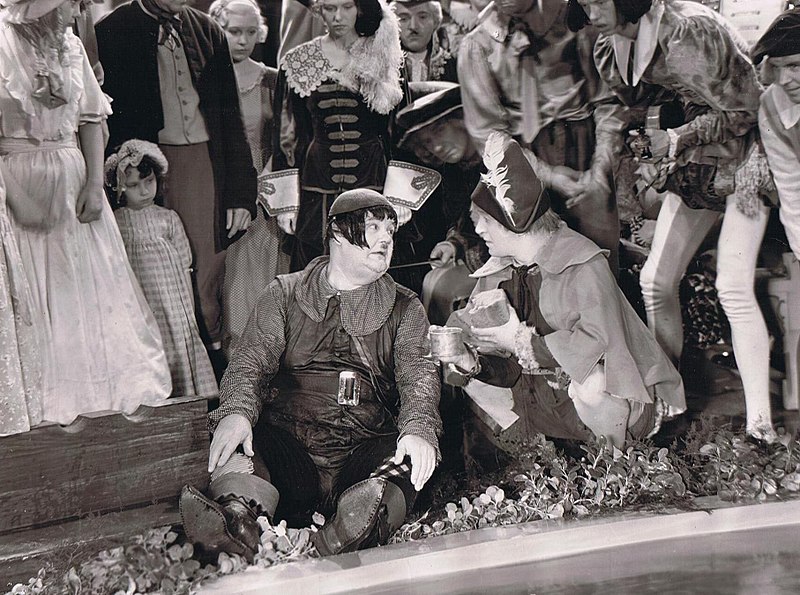
File:Babes.in.Toyland.publicity.still.jpgThe most famous adaptation of the 1903 Victor Herbert operetta, in some respects the 1934 "Babes in Toyland" feels ahead of its time.  While its production value seems inferior, Charlotte Henry as Little Bo-Beep is reminiscent of Snow White, Felix Knight looks and sounds like Robin Hood, Toyland looks similar to Oz, and in many ways it also captures some of what came before it: Henry Brandon reminded me of the ghoulish characters of German Expressionism, and the film makes use of Disney's theme for the Three Little Pigs when they show up (along with a mouse that resembles Mickey).  But it is first and foremost a Laurel and Hardy movie, and they are especially charming and humorous here. Comedic giants in a nice ensemble, they have numerous effective moments of humor, like trying to trick the villain Silas Barnaby by giving him a Christmas present in July. Santa Claus also shows up at one point to pick up the toy soldiers he ordered, which are far too big (but come in handy later for an exciting climax). One final note: Roger Ebert has commented that there is no comparison between the use of color and black-and-white cinematography in movies. He argues that black-and-white movies appear timeless, whereas color looks awkward.  The analogy he gives is asking his readers to compare the wedding photographs of their parents and grandparents: the grandparents are in black and white and look timeless, while the parents are in color and look goofy.  I generally don't agree with him (in terms of black and white versus color), but he's correct here: If you have a choice, pick the original black-and-white version, even for children. Children completely lack any prejudice towards black-and-white movies or towards any older movie or even silent films.  Instead, they're totally mesmerized by them, as they should be. It's only when they grow older that they develop ignorant views on the subject.


The Star Wars Holiday Special
"If I had the time and a sledgehammer, I would track down every copy of that special and smash it."    -George Lucas

This may be the king of all "it's-so-bad-it's-good" movies. This movie is awful and yet so awesome to watch. Just imagine, fans of "Star Wars," that after six movies, that animated show that children seem to like, and the recent announcement of the Disney purchase with three more movies on the way, and all that other stuff, that there in fact remains one more hardly-watched adventure of our beloved characters. A movie like this is one of those rare movies that nearly renders me speechless because it's so difficult to put everything so bizarre about it in print. The plot: Han Solo, Princess Leia, Luke Skywalker and gang all help Chewbakka get back to his home planet (where he apparently has a wife, child and father) in time for Life Day (strikingly similar to Christmas).  But our main stars sacrifice most of their appearance for 1970s television stars: Bea Arthur (who sings to the tune of the Cantina theme), Art Carney, and Harvey Korman.  Harvey...Korman. If you thought Jar Jar Binks was the most annoying "Star Wars" character, you haven't seen Harvey Korman in "The Star Wars Holiday Special." This movie tries to take what worked so well with "Star Wars" and turns into a farcical mess. At one point it's arbitrarily a cartoon (making it the first appearance of legendary character Boba Fett), or it's a sitcom, and never is it (intentionally) entertaining. Did I mention it's also a musical? Honestly, there are few movie-watching experiences as surreal as watching "The Star Wars Holiday" special. Conan O'Brien once played a clip for Harrison Ford and his reaction was priceless.


"You was here...and you was smoochin' with my brotha!"


Movies, movies, theater, cinema, watch, watching, watches, view,  see, saw, cinema,  film, flick, motion picture, Wizard of Oz, James Stewart, Jimmy Stewart, Cary Grant, Shop Around the Corner, Bishop's Wife, Star Wars, Holiday Special, You've Got Mail, Laurel and Hardy, Harrison Ford, Conan O'Brien 

Saturday, November 3, 2012

Some Advice for New English Teachers

Every so often, a friend from home or a former colleague will ask me about teaching English overseas. While I don't claim to be an expert and still consider myself a novice teacher, here is, I think, some helpful advice for those considering teaching English at home or abroad:

1. At times you have to be "the bad guy." I've referenced Robert MacKenzie's "Setting Limits in the Classroom" before, which incorporates William Glasser's "choice theory" in his work. MacKenzie gives simple examples to illustrate the differences between a permissive teacher (one who lets the students do whatever they want), an authoritarian teacher (one who rules as a tyrant), and a democratic teacher who finds the right balance. I am not exactly exaggerating when I say that in some countries, you will be the first person of authority who ever told some of the students the word "no."


With this in mind, remember that as a teacher you're in a particularly unique position where you have to constantly regulate your emotions. The inability to regulate your emotions can result in burnout and bruised feelings with your students (Sutton, Mudrey-Camino, and Knight 2009). Sometimes you just need to take a breath and relax. Choice theory helps put the emphasis of discipline away from anger and revenge and towards students' choices, and thus, helps teachers avoid losing their tempers.

2. Practice makes better. Bill Gates told a TED Conference that it takes about three years for teachers to "get it." Personally, this is true for me, and I look back in horror at my first year of teaching.  This is true, too, even for the reformers' cheerleader, Michelle Rhee, who supposedly once taped the mouths of students shut; when they peeled them off, the students started bleeding and were crying.

3. Remember the oppressed. Critical pedagogy (I prefer "critical teaching" because I hate the word "pedagogy") helps students challenge domination and the beliefs and practices regarding them, according to Freire, McLaren, Shor and a whole host of others. Consider that not all history, literature, language, science, etc. has been written by dead white guys. As Bill Bigelow asks, what is more beneficial for students: to remember the year Columbus set sail thanks to a clever rhyme, or to consider the consequences of his "adventure"?  (Incidentally, Bigelow's book "Rethinking Columbus" was banned in Tuscon.)  Consider Bigelow's article about teaching global warming called "The Big One."  Sure, students can and should learn the science behind the phenomenon, but the challenge is to help students grasp in a personal way what's at stake (and who benefits from the status quo). Some may argue that critical teaching has no place in language learning, but Sarah Benesch has written considerably about critical teaching in ELL, and McKinney and Norton found that adult ESL students found many classroom activities "domesticating," thus justifying critical teaching in the classroom. These two videos point out the need for critical teaching far better than I can, particularly the second one which is specifically about English language learning.


4. Less talking. Of course, you want the students to speak quite often, and that's likely why communicative activities are so popular these days. Remember, though, that while a teacher standing at the front may not only be easier and more like the education experience many of your students are familiar with, it's probably the least effective. And if teacher talk is not reduced, your students will be frustrated, especially if you are using native English speaker idiomatic language and pronunciation which likely will be above most of your students' levels. Try to forget to be so polite; in English, sometimes we are overly concerned with politeness. It feels natural to ask our students, "Can anyone please tell me what the answer is to number five?" But to students, particularly lower-level students, this is unnecessarily difficult. "Five?" is much more beneficial to use.

5. Technology, technology, technology. Technology in the classroom still seems to have a bad reputation for reasons I cannot understand. Someone once told me that technology hinders communication in a classroom. He was right to some extent. A teacher observing me once noted that I asked a student a question while simultaneously setting up a projector. I therefore wasn't really listening to her (and didn't even realize it until someone pointed it out to me). But if used correctly, technology can be incredibly beneficial. At the very least, there's a certain "wow" quality and it helps retain students' attention. There's dozens of websites on how to use it, and this one is particularly helpful. Show clips of movies (not full movies) but use them correctly: as listening activities, pre-writing or pre-speaking activities, or simply as a topic introduction. A classroom without technology is doable, but for me it's so much more frustrating.  

6. Beware the standardized tests. Unfortunately, all over the globe, education environments are engulfed in a "culture of testing." There is an obsession with testing. Standardized testing often not only doesn't incorporate different learning styles but also tests only knowledge (or rather a lack of knowledge), which is, according to Bloom's Taxonomy, the lowest form of thinking. There are much more beneficial ways of teaching, including those that allow for differentiated learning and problem-based (or task-based or project-based) learning. Meier, complaining about the standardization and "teaching to the test" of school systems, perhaps said it best: "It is a time when kids are busting with energy, intelligence and a capacity for learning--and we spend it boring the majority to death, systematically disengaging them from their native intelligence and compassion." Take a look at this video featuring a talk from Sir Ken Robinson, particularly what he has to say about divergent thinking and the problem of "educating" children.


7. Try not to be disappointed. If there ever was a baby-step process, it's language learning. I recently took the famous Meyers-Briggs personality test, and reportedly I am an INTJ. I found this passage on INTJs: they "are perfectionists, with a seemingly endless capacity for improving upon anything that takes their interest." It goes on to explain that this idea of a "perfectionist" conflicts with others' mistakes. As a teacher, this is not ideal, especially in language learning, because mistakes have to be made in order to learn that language. My point is to be patient. But also have high expectations of your students. (Incidentally, for advanced students, such an activity would be a great needs-assessment in helping you learn about your students.) So keep in mind several things, and hopefully they will help bring you down to earth: First, no one really learns a language by sitting in a classroom. And second, it is virtually impossible for non-children to perfect a second language. This doesn't mean that there cannot be valuable classroom time, but don't expect perfection.

8.  Grammar is important. Grammar can be boring, but it can also be fun. Many times it's the most fun part of my week in class.  Mario Rinvolucri's "Grammar Games" (available on Scribd) has numerous communicative activities. (This also means that you need to master English grammar; Folse's "Keys to Teaching Grammar to English Learners" and the Grammar Girl website can help.)


9.  Know thy students. Understand their cultures. Understand their life experiences. Understand if they have a learning disability and how to effectively teach them. Comprehend the differences between collectivist societies and individualist societies. Familiarization yourself with the sociopolitical considerations of your students' home countries and cultures. Learn about their languages--understand the stress patterns and grammar rules of the language to help you understand why they're making certain mistakes. As Brown pointed out, "Culture is really an integral part of the interaction between language and thought." For example, Eskimo tribes commonly have almost ten different words for "snow" to distinguish the different types of snow, such as falling snow, wet snow, etc., while certain African cultures in Zaire have no word for snow at all. Finally, there are way too many horror stories of what the lives of individual students are actually like to justify any sort of cruel rhetoric about your students, to their face or not.

10.  You can't, won't and shouldn't change their culture (for the most part).  In South Korea, there is such an emphasis on education that students become incredibly stressed; as a result, the country has the world's highest suicide rate. Georgia is a severely patriarchal society.  Saudi Arabia bans all non-Islamic religions from its country. These are frustrating parts of other cultures that I will never understand and never admire.  It makes me so angry that I could stay up all night thinking about it. But there's nothing I can do about it. Nobody wants to hear a guest criticize one's home country, and you as the teacher should follow this rule. You can't change their culture, only they can.

11. The world is your playground, but there are consequences for being dumb. One of the benefits of teaching overseas is that you are privy to a variety of different countries and cultures that few of your countrymen and women have even dreamed of experiencing. Travel the world and have fun. But try to remember two things: First, traveling is a benefit of teaching overseas--it's not the other way around. And second, if you do stupid things, the rest of us, and our reputations, suffer.

12. Don't forget the importance of play and remember to smile.  
Enjoy your time with your students.


Works Cited

Brown, H. Douglas (1994). Principles of Language Learning and Teaching.  Prentice Hall, Inc.

MacKenzie, Robert (1996). Setting Limits in the ClassroomNew York: Three Rivers Press.

Meier, Deborah W. (2006).  Undermining Democracy. Dissent.  (pp. 71-75).

McKinney Carolyn; Norton, Bonny (2008). Identity in Language and Literacy Education.  The Handbook           of Educational Linguists. New York: Blackwell Publishing Ltd. 

Sutton, Rosemary E.; Mudrey-Camino, Renee; Knight, Catherine C. (2009).  Teachers’ Emotion Regulation and Classroom Management.  Theory Into Practice. Volume 48, Issue 2, pp. 130-137.

Classroom, Robert MacKenzie, choice theory, classroom management, technology, Myers-Briggs, culture    


Wednesday, October 31, 2012

The Best Bond Movies


Happy 50th, James Bond! Here's a quick look at some of the best (and not so good) James Bond movies. (Admittedly, this is not necessarily a thorough review of each and every Bond movie, but more of light reflections.)

24.  Die Another Day
The bad guy is a North Korean with plastic surgery to make him look white and who resides in an ice palace. This is not only the worst Bond movie but also one of the worst movies I've ever seen.

23. Never Say Never Again
The "unofficial" Bond movie. After a lengthy battle in court, Warner Bros. created their version of "Thunderball" and actually brought back Sean Connery. (This was the summer of the "Battle of the Bonds," as Eon productions released the official "Octopussy" with Roger Moore.) While a majority of critics then and now generally praise the movie, I tend to agree with Norman Wilner's opinion that it's "pretty awful" (though it's been years since I've seen it). One fairly unjustifiable aspect that I recall is the way Q in this movie seemed to encourage Bond's debauchery, practically ruining the unique relationship between the two.  

File:Sir Roger Moore Allan Warren.jpg22. The Man With the Golden Gun
"The Man With the Golden Gun" features one of my favorite actors, Christopher Lee (who was a cousin of Bond author Ian Fleming). Unfortunately, he's not in the movie enough to make this movie anything but forgettable.

21. Tomorrow Never Dies
Other than the car, this one is basically skippable.

20. Live and Let Die
Roger Moore's first outing as Bond has some respectable elements to it. For one, some of the characters are interesting--Yaphet Kotto as the villain and Jane Seymour as the Bond girl--and being a fan of the Beatles and blaxploitation films, I like Paul McCartney's theme song and the incorporation of blaxploitation era characteristics. Still, in some respects Moore seemed to be copying Connery and it would take a while before he found his groove.

19. A View to a Kill
While "Live and Let Die" showed us a Roger Moore who didn't quite understand what role he wanted the character to head towards, "A View to a Kill" showed us when an actor gets too old to be Bond. By this point, he was over sixty years old and it was showing. But one awesome aspect of the movie is Christopher Walken as villain Max Zorin. (Seriously--Walken as a Bond villain!)

18. Octopussy
There's a train scene, and I love train scenes ("Mission: Impossible," "Indiana Jones and the Last Crusade," "Back to the Future III, etc."), but it pales in comparison to the excitement and adrenaline of the train scene in the new "Skyfall." Also, there's Bond defusing a bomb dressed as a clown.

17. License to Kill
Timothy Dalton's Bond was famously more brooding than the others, but this time that direction went too far. Here Bond has a merciless look in his face, and the overall style is overly violent. It's true that Bond movies seem to numb our minds to violence in the very way that movies shouldn't, but after half-a-century of almost lampooning violence, perhaps Bond movies should get a pass.

16. Thunderball
"Thunderball" is a favorite among many, but for me, I've never seen what was no great about this movie. Personally, I only really remember the villain's eye patch, but do I specifically remember the villain, or that Robert Wagner spoofed him in "Austin Powers"?

15. Moonraker
"Moonraker" was infamously made during the science fiction craze of the late 1970s. With "Star Wars," "Star Trek: The Motion Picture," "Close Encounters of the Third Kind" and "Alien," it's not surprising that the studio wanted Bond in space. Surprisingly, however, this is a rather enjoyable Bond film (if one skips the actual scenes in space). It plays like a traditional Bond film, with clever ways of getting the henchmen ("missing" the birds during a round of hunting but getting the bad guy) and Shirely Bassey's song is hypnotic and memorable. Unfortunately, the space scenes really do hurt the movie, especially with the laser gun fight outside the space ship.

14. Diamonds Are Forever
With Connery back (thanks to a million-dollar paycheck), I think "Diamonds Are Forever" is one of the more underrated Bond movies, showing audiences that Bond could survive in the 1970s and beyond. It's a bit on the simplistic side, but more often than not, we're not looking for sociopsychological subtexts or philosophical debates with Bond outings (though "Bond and Philosophy: Questions Are Forever" is an interesting read).

13.  Quantum of Solace
Marc Forster's "Quantum of Solace" is another one of the most underrated Bond movies. It's not perfect, and starts to shift back into that formulaic, box-checking approach that recent Bond movies have tried to avoid, but it's still an enjoyable (and surprisingly short) Bond film. One aspect that I didn't enjoy was that the fight scenes had become a bit too intense and headache-inducing; when I reviewed the movie for my university's newspaper as an undergraduate student, I titled my article "The Bond Identity," to draw attention to the filmmakers taking the wrong inspiration (from the "Borne" series).

File:Desmond Llewelyn.jpg12. The World Is Not Enough
Perhaps one of the reasons I like "The World Is Not Enough" so much is because at least half of the Brosnan-as-Bond movies were rather disappointing. This movie is mostly a step in the right direction. The opening chase is one of the series' most exciting and there are mostly enjoyable moments throughout the movie. It also features the final appearance as Desmond Llewelyn as Q (he died later that year) and he gives Bond some important advice before he departs, and it's advice that, wrongly or rightly, I have applied to my teaching:

Q: "I've always tried to teach you two things. First, never let them see you bleed."

Bond: "And the second?"

Q: "Always have an escape plan."

(Click here for a moving tribute to Llewelyn.)

11. Dr. No
Some might not recognize "Dr. No" as a Bond movie: there's no opening theme song, no Q branch, etc. But it did set a precedent for some essentials: hot Bond girls (this one iconically played by Ursula Andress), and Bond's introduction as "Bond, James Bond" (and Connery's is still one of the coolest, and one of the reasons Connery remains to many the coolest Bond). Still, it's at times too simple. (It should be noted, however, that this was largely due to budget concerns; the filmmakers chose Fleming's "Dr. No" over the first novel, "Casino Royale," because the main location of "Dr. No" was in Jamaica, while "Casino Royale" took place in a variety of countries). This movie also showed us that Bond can sing (please ignore the German).

(There's some interesting trivia on the movie and subsequent Connery-as-Bond movies found here.)  

10. You Only Live Twice
Some might argue that the attention to Bond gadgets (which is a positive or a negative, depending on your perspective) can find its augmentation beginning here; there is, after all, a jet pack. But there's also a terrific theme song from Nancy Sinatra, beautiful locations in Japan, and an entirely iconic villain; so iconic, that it is probably more likely that thanks to Mike Myers, we know him as Dr. Evil instead of Ernst Blofeld (played here by Donald Pleasence).

9. For Your Eyes Only
"For Your Eyes Only" is close to being the best Roger Moore Bond movie. One appealing aspect is its authoritative arrogance; what I mean by that can be found in its opening moments. Bond battles what's credited as the "bald man in a wheelchair." Clearly supposed to be Blofeld, Bond's main nemesis in many of the earlier films, the filmmakers couldn't refer to him as such because of the legal battles regarding "Never Say Never Again." The result? Bond kills off Blofeld once and for all in the very first moments. It was a nice, succinct way of saying, "Screw you. We don't need Blofeld. We can still make good Bond movies without him." It was also the first Bond film directed by John Glen, who argued (rightfully so) that Bond, after going into space, needed to get back to the basics. Here, our villain is not found on a space ship, but in various locations across the globe; he is played by Julian Glover, who has also appeared in the "Star Wars," "Harry Potter" and "Indiana Jones" series (also as antagonists). (Supposedly, Glover was once considered for the role of James Bond.)    

8. From Russia With Love
For many (including Sean Connery), "From Russia With Love" is the best Bond film. Despite being a bit slower than its predecessor and successors, it still serves as one of the few Bond films where the character doesn't rely so much on gadgets and fist-fighting. Bond has been best when his villain is effective, and here Robert Shaw is perfect as an incredibly-chiseled Russian. The BFI points out that "From Russia With Love" had an "intelligent script that retained the substance of Ian Fleming's novel while toning down the overt Cold War politics." This was a brave move on the filmmakers part, especially because, as the BFI mentions, the movie was released only a year after the Cuban Missile Crisis. Incidentally, the novel was one of President Kennedy's favorite books and supposedly it was the last film he saw before he was assassinated. 

7. Skyfall
"Skyfall" deserves the attention it has been receiving. It's not on the same level as "Casino Royale," but considering that I enjoyed "Skyfall" so much, and I think that "Casino Royale" was one of the best films of 2006 and also think that "Quantum of Solace" is underrated, it can be concluded that Craig has had a good run as Bond so far. Not only does it also feature an enjoyable and somewhat haunting performance by Oscar-winner Javier Bardem, but Ralph Fiennes and Albert Finney have also joined and are both great in their roles. And this is certainly the most beautiful Bond movie ever created, with absolutely gorgeous cinematography of scenes in Shanghai, Macau, Istanbul and Scotland; the work of Roger Deakins is worthy of an Oscar nomination. Director Sam Mendes doesn't waste his time or ours with gratuitous amounts of CGI. When he does, it's unfortunate--there's a somewhat silly moment with a dragon, and a character's fall appears to be computerized as opposed to what looked more like an impressive stunt fall seen in the trailers.

The book on Bond and philosophy I referenced earlier contains a chapter on the character as Plato's guardian archetype. There's an interesting conversation from the Guardian about Plato's idea of a just character. According to a philosophy scholar in the interview, Plato argued that an individual needs to be in control not only of his desires but also needs to be a man of wisdom. Undoubtedly Bond is a spirited individual--all the Bond films have contained some sort of romantic one-night stand. But he is also a wise one. Consider that he finally defeats Oddjob in "Goldfinger" not by destroying him with his high-tech car but by using his head. These Plato of a just individual, which Bond arguably is and arguably isn't, are explored in "Skyfall." When he is asked by a psychologist to respond to the word "murder," Bond responds with "employment." So there's a complexity in the film that often isn't seen in the Bond movies, and for once there's a villain who doesn't just want to take over the world. There's also clever references to former Bond moments, and the ending is quite fitting.    

6. On Her Majesty's Secret Service
This was the first non-Connery Bond film, and the reception at the time was quite critical. Audiences were not ready to see Connery part from the role, and especially due to the love story involved, audiences took out their anger on George Lazenby. Fortunately, reflective reviews have been a bit more positive, though some have argued that the film would have been better with Connery instead of Lazenby. I don't agree. While I like Connery as much as the next guy, I sympathize with his desire to get away from the role. And I especially sympathize with Lazenby; he has claimed in interviews that he was convinced by his agent that now that he had had a Bond movie under his belt, he would receive countless calls from Hollywood. This is not how it would turn out, and Lazenby really hasn't made a movie since. It's quite sad, because I truly believe he was good in the role. The amount of sympathy I felt towards Bond, the ultimate bachelor, in this movie still surprises me, and Lazenby expresses a certain amount of vulnerability that I'm not sure some of the other Bond actors could pull off. Still, many don't see it that way. Even fellow Bond Pierce Brosnan once referred to Lazenby as "poor George."


5. The Living Daylights
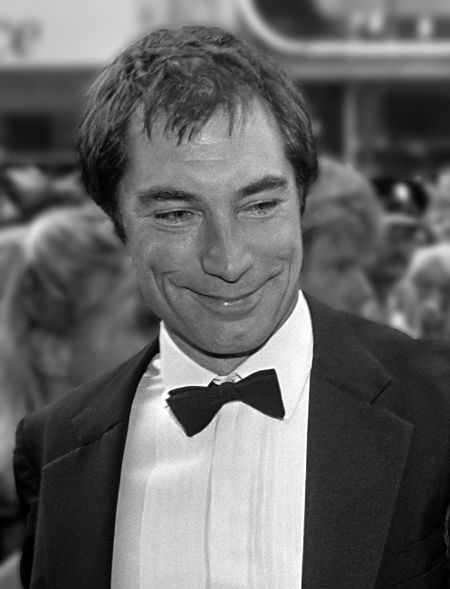
File:Timothy Dalton 1987.jpg
Timothy Dalton was offered the role as a replacement for Sean Connery, but considered himself too young. And by the time there was a need for a new Bond after the Moore years, Dalton was busy, paving the way for none other than Pierce Brosnan to take over the role. But when fans of Brosnan's series "Remington Steele" found out that Brosnan would be Bond, the show was scheduled for another season, leaving Brosnan without the role he so badly wanted. By this point, Dalton was available. This Bond movie is most interesting, I think, because of what Rita Kempley recognized as Bond now being consciously aware of sexually transmitted diseases in the late 1980s so much that he "explores monogamy and probably practices safe sex." This wasn't a Bond who would pat a girl on the rear end with a twinkle in his eye. That being said, there was a scene that was particularly disturbing in which Bond rushes in a woman's hotel room, violently rips off her shirt to expose her to the chasing henchmen, who is then obviously distracted enough for Bond to get him. James Bond was not a feminist yet (and alas, probably never will be one).

But as a Bond, I still think Dalton was incredibly good in the role. His take focused on the written material from Ian Fleming, so naturally his Bond was a bit more humorless than some of his predecessors. (Incidentally, the individuals who complain about Dalton's more brooding, serious acting usually are the ones who praise Daniel Craig; Dalton was obviously way ahead of his time.)

4. The Spy Who Loved Me
This Bond movie was made at a time when Roger Moore seemed to be having difficulty in the role after rather unsuccessful attempts in "Live and Let Die" and "The Man With the Golden Gun." The third time was the charm, as Moore (who admitted that he thought the role of Bond was more worthy of humor than machoism) finally found the rhythm he was searching fall. (Moore has much justification for playing it that way: as he put it, who would ever believe that in reality, James Bond would actually be a good spy?) It also features the first appearance of henchman Jaws, an exciting ski jump, and one of the best Bond songs of all time: Carly Simon's Oscar-nominated "Nobody Does It Better" (written by Marvin Hamlisch and Carole Bayer Sager).

3. Casino Royale
Like his previous task with "GoldenEye," Martin Campbell was hired as director to resurrect the Bond franchise. After the dismal "Die Another Day," it had been about four years with no Bond. There were numerous A-list actors considered for James Bond, but there was a bit of a collective gasp when it was announced that a fairly-unknown Daniel Craig would take over. Craig had effective supporting roles in Steven Spielberg's "Munich" and Sam Mendes' "Road to Perdition" (as well as a more embarrassing movie called "A Kid in King Arthur's Court"). He was and is not conventionally handsome like his predecessors, but critics were so outraged that they petitioned against him being cast, with some actually showing a video that digitally morphed his face into that of an ape. (Some former Bonds had to come to his rescue with praise.) But when "Casino Royale" debuted in 2006, Craig won the approval of fans and critics alike. Despite its length, "Casino Royale" remains one of the best, and it showed that the formula can be tweaked a bit without rocking the boat too much. Virtually every aspect here works wonderfully, and Campbell and company made a wise and smart choice by keeping Judi Dench as M, playing with continuity a bit, but it certainly proved to be the correct choice.

2. GoldenEye
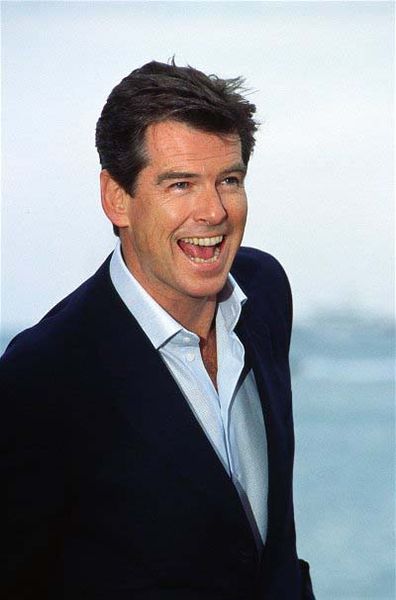
File:PierceBrosnan(CannesPhotoCall).jpgBen Evans infamously pointed out that "GoldenEye" was his favorite because he played the video game as a child. While I undoubtedly also spent much of my youth playing the game, I cannot see how nostalgia alone can serve as the most convincing argument for it. Still, "GoldenEye" comes quite close to being the best for several reasons. For one, Pierce Brosnan is incredibly effective in his first outing as Bond (and it's a sincere pity that his following Bond films were mediocre at best). He seemed to strike an effective balance between the machoism of the Connery era and the lax humor of the Moore era. Additionally, the film succeeded at accomplishing one of its most challenging goals: making Bond relevant in the post-Cold War era. There's still some bad guys with Russian accents, but we see Bond in a graveyard of former Soviet statues. Bond is, as M (Judi Dench) criticizes, a "relic of the Cold War." The Cold War was over, but James Bond wasn't.  


1. Goldfinger
Goldfinger is usually considered the greatest probably because it essentially set the standard for the following films. Unlike its two predecessors, there is an opening moment (unrelated to the overall plot), a theme song, a fancy car that can do anything, and a villain who at times is more interesting than our hero. But it's not simply setting a standard that makes it so great. John Barry's score is probably his best as the Bond composer. The villain, Ausric Goldfinger (Gert Frobe) isn't simply a two-dimensional caricature but an antagonist of haunting charm. How terrifying it is as he practically giggles as Bond is about to be split in half--quite slowly--by a gold-cutting laser (and from the waste-up, no less). "You expect me to talk?" Bond says, probably knowing that his rhetoric isn't working. "No, Mr. Bond," Goldfinger replies. "I expect you to die." Any other actor probably would have lowered the intonation of "die" to make it sound conventionally frightening, but Frobe was rather clever in rising the intonation to taunt and tease Bond. I could go and on about what makes this the best, but I suspect many have already heard what's so terrific about it: its car, its song, etc. But I think the best argument it has is that not only is there an exciting car chase, beautiful scenes in Europe, and a villain who can (almost) match Bond, but consider arguably its best scene: a tense golf match between Bond and Goldfinger. "Goldfinger" doesn't have to rely on the expected elements of what makes a Bond movie great; it has those, but more, and in this case, it's as simple as a golf match.

Movies, movies, theater, cinema, watch, watching, watches, view,  see, saw, cinema,  film, flick, motion picture, Bond, James Bond, Sean Connery, Pierce Brosnan, Daniel Craig, Skyfall, GoldenEye, Casino Royale


Wednesday, October 3, 2012

Obama 2012

With the first debate on its way in several hours, it's clearly election time. While the race is still close, this is a no-brainer: President Barack Obama should be re-elected.

There are many reasons to vote for a second term for President Obama, economic and non-economic alike. Regarding economic issues, there was his Recovery Act (popularly or unpopularly known as "the stimulus"). Now, ignore just for a moment that both Governor Romney and Congressman Ryan at one point supported stimulative economics and that Ryan, as did many Republicans, supported his state receiving some of those funds.  Ignore also that the country was in severe economic peril and that under virtually any other president, both parties would have come together to help solve the problem. Please ignore the fact that the Recovery Act was less than a trillion dollars worth of stimulus meant to fix a several-trillion dollar problem.

What's impressive beyond all those facts is that the law, according to Jonathan Alter, was essentially five major acts in one: the biggest funding for health care, education, and science since Lyndon Johnson; the biggest tax cut since Ronald Reagan; and the biggest infrastructure spending since Dwight Eisenhower. Many presidents fail to accomplish one major act in eight years; Obama accomplished five in one month. Many conservatives, the Romney team especially, have claimed that Obama's economic recovery failed. They are in disagreement simply with the facts, and you don't have to take my word for it: Mark Zandi (an economic adviser to Senator McCain's presidential campaign) of Moody's concluded that without the programs, gross domestic product would be almost seven percent lower and eight million more people would have been unemployed. I haven't even discussed the best part of the stimulus, that the funding for long-term expansion of green energy, making it the largest green bill in history, which Michael Grunwald explains:


Regarding Grunwald's praise of the President's green energy spending, this contrasts of course with the disappointment in the lacking of serious new laws to tackle undoubtedly the biggest problem facing us: global warming. Currently, though, at least the President is dealing with the problem through existing laws by treating carbon dioxide emissions as a pollutant. Compare this to his opponent, who once wrote that he believed climate change was happening and that "human activity is a contributing factor." He quickly changed his mind, surprisingly, and now claims "we don't know" what's causing the problem.


The other day, a Romney supporter, who plans on voting for Romney because he's a businessman (the only businessmen who have been presidents that I know of are Herbert Hoover and the Bushes, so that's not much of a record to bet on), complained to me that President Obama was responsible for the much maligned Troubled Asset Relief Program (TARP), ignoring the fact that one, the program was started under Obama's immediate predecessor, and two, the program has actually made a profit.

It is not simply the Recovery Act that will serve as President Obama's economic legacy. The Dodd-Frank Law, while unfortunately watered-down and not as strong as it should have been (especially since taxes were removed from the law, banks are still too big to fail, and Wall Street's behavior has not changed), nevertheless restored some of the protections needed to avoid another meltdown. Among its chief accomplishments are the creation of the Consumer Protection Agency and the Volcker Rule. (Incidentally, the public is on the President's side.)  And conservatives seem to be deeply (and somewhat justifiably) upset at our deficit situation. I would simply ask them where they were during the Reagan and Bush years, and second, remind them that federal spending is at the lowest it has been since the 1950s. In case you're having trouble opening that link, let me tell you that it's written by the notable socialist newspaper known as the Wall Street Journal and has been verified by the non-partisan Politifact. Consider also that most of what comprises our debt comes from Bush-era policies regarding guns-and-butter and that, should Mr. Romney find himself in the Oval Office, our debt would be severely worse. (If Republicans hate Obama complaining about his predecessor they should talk to this guy.) I haven't even mentioned the unpopular-at-the-time auto bailout, which Mr. Romney insisted was the wrong approach, but now believes he deserves credit for it.  

Aside from economic policies, President Obama has been remarkably successful in terms of social domestic policies and foreign policy. Personally, I was always annoyed at Democrats' inability to fight back against Republicans' outrageous charges. This time, it's Democrats making the dickish charges. They may be dickish, but they aren't untrue. In 2007, then-Senator Obama claimed that if there was evidence that Pakistan was holding Bin Laden and was unwilling to move to apprehend or eliminate him, then the U.S. would. He was criticized both from the left and the right over this. One of his conservative critics was none other than Romney, again campaigning for president, who said that Obama had "gone from Jane Fonda to Dr. Strangelove in one week." It was a clever line, but one which would come back to haunt him (as well as his complaint that it was not worth "moving heaven and Earth" to find Bin Laden). As Bill Clinton eloquently explained, President Obama risked an incredible amount: not simply the position of the United States and his election, but the lives of the Navy SEALs. I didn't vote for Barack Obama thinking he could actually get Osama Bin Laden. By that point, I was convinced Bin Laden was either dead-and-buried or forever hiding in some cave far beyond our reach. I thought that we had permanently lost our chance. That changed in May of 2011. John Kerry put things a bit more bluntly: "Ask Osama Bin Laden if he's better off today than he was four years ago."  Name another election in the past forty years in which the Democrat has the upper-hand against the Republican on foreign policy?


I'm probably boring readers by now by repeating stuff they probably (or at least should) already know. But in case they haven't, let me briefly summarize his other accomplishments: Obama not only supports equal marriage, but also will forever be known as the president who signed the Matthew Shepard Act into law after a decade of failed attempts and who also repealed the discriminatory and waste-of-money, backwards, bigoted policy known as Don't Ask, Don't Tell. The Iraq War is over and our troops in Afghanistan have begun coming home. Not only has the automobile industry been rescued, but they are producing cars with greater fuel efficiency. And finally, likely his greatest domestic achievement, both economic and non-economic, is his health care law, an accomplishment virtually a hundred years worth of presidents couldn't get. With his health care law, the deficit will be reduced, there is a ban on discriminatory rationing regarding pre-existing conditions, Medicaid has been expanded, and some are predicting that it will be the end of for-profit health care.

Has Obama disappointed me? Of course he has, particularly regarding the dangerous, lethal, and immoral policies regarding drones. And the way I see it, I agree with the Green Party on ninety percent of the issues, with the Democratic Party on eighty percent, and the Republican Party on about thirty percent (they do have some good ideas).  I don't think we human beings always fit into perfectly defined spaces of left-versus-right.  That being said, why waste my vote on a false sense of ninety percent when I can vote to realistically achieve eighty percent? (And I sure as hell am not going to vote to get only thirty percent.) As the Vice President likes to say, don't compare President Obama to the Almighty, compare him to the alternative.

We will be told by critics after an Obama victory that Republicans lose because they pick moderate candidates. Now, it is true that there was a time when Governor Romney was a moderate, but those days are long gone. He is, as he put it, "severely conservative." And even if that were not the case, Republicans had more than a handful of conservatives to pick from, including Michelle Bachmann, Rick Perry, Newt Gingrich, Herman Cain, Rick Santorum, and Ron Paul (although, based on that list, perhaps it is understandable why they went with Romney; see SNL's take on it). Republicans have essentially attempted to purchase this election (some of them quite single-handedly--"corporations are people, my friend"). But the real reason why Republicans have lost the past four-out-of-five presidential elections and why they will likely lose this one is not because their candidates are too weak (although that is certainly a factor). It's because they haven't changed their game plan and there's no evidence that they will any time soon. The base of the Republican Party--white, working class males--is shrinking, while the base of the Democratic Party--minorities--is growing. Romney is expected to do even worse among Hispanics this election than McCain did four years ago, and he has no one to blame but himself (and his harsh rhetoric against the "forty-seven percent" of "victims" and his opposition to the Dream Act).      


Obama simply isn't just a very good president; he is also up against an incredibly weak opponent. Romney has changed his opinion on virtually every issue--abortion, the Reagan/Bush years, stimulus, LGBT rights, gun control, etc. As someone once said, you're only allowed a certain amount of flip-flops before the American people doubt your character. Republicans have moved so far to the right that it's frightening (imagine President Reagan, who pulled out of Lebanon after an attack, raised taxes and the debt ceiling both around ten times, and supported closing tax loopholes, with today's Tea Party). Romney has happily embraced these ideologies. And we've heard a lot about his low tax rate, his overseas banking, and his love of Olympic horses, and pretty Michigan trees. It's not simply his far-right conservatism, his omnipresence of position changes, or the dire state of our economy and standing in the world should he become president that frighten me. It's his character. The video below should make your stomach so sick that you would have more than enough reasons to vote against Mitt Romney. Compare this to the character of President Obama. President Obama has had to deal with an opposition of intransigence whose own leaders have publicly admitted that their biggest goal was to make Obama a one-term president. He has had to deal with reporters and interviewers interrupting his answers to their own questions, as well as congressional representatives shouting out that he is a liar. He has had his faith and birth questioned. Through this all, he has shown remarkable composure and humor. The best example of this was during the Bin Laden raid; the week began with the release of his birth certificates while he rightfully claimed that he had more important things to do, then was hilarious at the White House Correspondents Dinner--even while comedian Seth Myers made a joke about Bin Laden--and only several days later, announced that Bin Laden had been killed. Remarkable.

Vote for Obama.


Finally, there's also this.
  

Friday, August 3, 2012

The Dark Knight Rises

It occurred to me recently that Christopher Nolan's Batman films are mostly about fear. They explore the fears not only of everyday citizens but also of a man most of us likely thought was never scared: the Dark Knight. Batman probably follows the advice to never let anyone see him bleed, but we see his premonition that perhaps one day he won't be able to prevent terrible things from happening. There are some really scary, terrible things in our world. A recent Gallup poll found that the things Americans fear the most are terrorist attacks, spiders, death, being a failure, war, heights, criminal or gang violence, being alone, the future, and nuclear war. All of these (except spiders and to a lesser extent heights) are featured prominently in Nolan's "The Dark Knight Rises," his final installment of his Batman trilogy.

Years after defeating the Joker and Two-Face (while keeping the true identity of Harvey Dent secret), Batman has left Gotham largely in peace. The Dent Act has kept police officers on the streets, and there is no need for Batman. Bruce Wayne is still injured from previous events, and largely remains a recluse, with hardly anything to do in the world, certainly not protect Gotham.  

But then Bane enters. He is played by Tom Hardy, as chiseled and intimidating as he was in last year's "Warrior." Bane's main goal seems to be to give the power of Gotham "back to the people." But democracy without rules isn't a democracy, it's anarchy, and this is perfect for Bane. He plans on getting his hands on a nuclear bomb and doing a whole lot more to severely disrupt the order of things. Batman is hardly a match for Bane's strength, and Bane seems to enjoy taunting him. "Oh, you think darkness is your ally," he mocks. "You merely adopted the dark. I was born in it, modeled by it...The shadows betray you because they belong to me." (This is Shakespeare compared to the last time we saw Bane, in the dismal 1997 film "Batman and Robin.") How haunting he sounds as he instructs Bruce Wayne that once Gotham is ashes, only then does he have Bane's permission to die. But it's not simply Bane and his malicious army Batman has to worry about--Selina Kyle, better known as Catwoman (Anne Hathaway), is causing quite a bit of mischief as well.  

Nolan is a director who knows his visuals. The opening sequence is a reminder of his talent for unusual, acrobatic stunts, and he seems more prone to use minimalist makeup and a lack of green suits for his characters (which certainly makes him part of a minority among directors). When he does use visual effects, he convinces the audience that every effort was taken to make it look as realistic as possible. One of the previews before the movie was for Sam Raimi's "Oz: The Great and Powerful." The movie looks like it will be filled with computer-generated effects. I was reminded of the visuals of "The Wizard of Oz" from 1939 (the same year as the first "Bat-man" comic) and I thought to myself that while I basically know that Raimi and his team used CGI for the effects, decades later I still don't know how the effects were made for "The Wizard of Oz" and yet they look so much better. The feeling I get from "The Wizard of Oz" is the feeling I get when I watch a Christopher Nolan movie; I'm so amazed at the attention to detail, and his appreciation of visual imagery and his shunning of lazy film making.
 
There are some flaws, of course. Do we need all of these characters? Michael Caine as Alfred, Gary Oldman as Commissioner Gordon, and Morgan Freeman as Lucious Fox are all back, but why have Matthew Modine here as an ambitious cop? What purpose does Marion Cotillard's character really have here?  I'm as big a fan of Joseph Gordon-Levitt as anyone, but what is he doing here?  (My question was answered at the end of the film, and I had mixed feelings about it.) There's a henchman who kind of looks like Willem Dafoe, and I was more interested in him than I was in numerous other characters. The Catwoman scenes are nice, but also are unnecessary. Additionally, this might be the most confusing Batman movie ever. There's something about the stock market and something else about a congressman or something like that. Three hours is a lot to ask for from an audience, and "The Dark Knight Rises" is unjustifiably long, overly ambitious, and increasingly clunky as it moves along. My reaction to "Batman Begins" was excitement that Batman was back; my reaction to "The Dark Knight" was excitement because I recognized that I had just seen a masterpiece. My reaction to "The Dark Knight Rises" was a bizarre sense of being simultaneously overwhelmed and underwhelmed, though ultimately feeling that it was efficient and satisfying.

Likewise, I had mixed feelings about Tom Hardy as Bane.  I admired his physical force, his performance that relies heavily on his voice and eyes, and the thought he likely put behind it.  Still, my reaction to his peculiar voice was similar to my reaction towards Bale's voice as Batman.  At times it works perfectly, and at times it sounds utterly ridiculous.  

At times I was so bored with the movie that I began to compare it to the previous Batman movies by Tim Burton; I still believe his "Batman" from 1989 is the superior one, as I have a preference towards fantastical stories and prefer it to the grittier Nolan versions. Still, one cannot deny Nolan's talent or understate our appreciation for him resurrecting what was surely a dead franchise. Beyond saving it, he brought it back with intelligence and force. Nolan toys with our emotions, as is the case with the scene where Bane and his crew shoot up Wall Street; Nolan shows us the criminality and horror of such weaponry and visualizes the chaos of terrorism.  

Batman has been such an important part of Americana. Originally meant to be a complement to the pride and patriotism (and frankly, lack of realism) of Superman, Batman, particularly Nolan's version of him, has intrigued Americans as the darker, more psychologically and sociologically interesting of the two, and indeed of any American character. Britain recently has shown us a lot of its pride with the Olympics, and who can blame them? After all, they have Bond, the Beatles, and Mr. Bean.  But America has and always will have Batman.


Movies, movies, theater, cinema, watch, watching, watches, view,  see, saw, cinema,  film, flick, motion picture, Dark Knight Rises, Bane, Christian Bale, Christopher Nolan, Batman, Anne Hatheway