Saturday, September 18, 2010

Easy A

"If a man, sitting all alone, cannot dream strange things, and make them look like truth, he need never try to write romances." Thus wrote Nathaniel Hawthorne, whose "The Scarlet Letter" serves as an influence for Will Gluck's "Easy A," a film about a teenage girl who indeed has dreamed strange things and tried to make them look truthful with unending consequences.

Emma Stone is Olive, a sharp and witty yet fairly unknown high schooler with essentially one close friend and a bit hungry for a need of belongingness. Olive is generally well-liked, at least to those who know her. She spends one weekend listening and singing to bad music, and then uses her imagination to create a story of how she actually lost her virginity to a "gentleman." While Olive is generally well-liked, there is a group who does not like her, and that is a group of Christian students lead by Marianne (Amanda Bynes). Marianee's friend taunts Olive in class, and Olive retorts, resulting in her first trip to the principal's office.

She receives a detention and spends one afternoon cleaning the school with her fellow troublemaker Brandon (Dan Byrd), who is gay and harassed on a daily basis. Brandon painfully tells Olive that he has had enough with the bullying, and he wants her to extend the make-believe. He asks her to pretend to have sex with him. That way, everyone will know once and for all that he is indeed quite straight.

Anyway, requests like this continue. Students with desperate "needs" request her "service" and thus Olive is rewarded with gift cards, coupons, and attention. Her life begins to resemble the protagonist of "The Scarlet Letter," which is being read in class. The trajectory begins to spiral downward as things progress.

I haven't read "The Scarlet Letter" but I do know enough about it to understand the allegories. The condemnation the lead characters in these two stories is symbolic, to me at least, of the double-standard facing women. A male who engages in sexual activity and has numerous sleeping partners is considered a stud; a female in the same situation is a slut. I also can recall from my school days that the author of "The Scarlet Letter" was Nathaniel Hawthorne, the great-great-grandson of John Hathorne, a judge of the Salem Witch Trials and who is portrayed in Arthur Miller's play "The Crucible" as being of the most vicious of the group. There is definitely a hint of that sentiment in "Easy A."

This film is much like "Mean Girls" and "Juno" before it, centering on female leads struggling with what Erikson would have described as identity versus role confusion. "Easy A" does not do enough to distinguish itself from the two, but it is quite funny. Like the two mentioned films, it becomes evident that actual people, whether they be teenagers or parents or teachers or Christian fundamentalists, do not in fact talk and act as they do in this film. But the farcical nature is forgiven, because these characters and the actors portraying them are very funny. The movie has an entertaining cast, with Thomas Hayden Church as Olive's favorite teacher, Lisa Kudrow as his wife who is also the school's guidance counselor, Malcolm MacDowell as the school's principal, Fred Armisen as a local preacher, and Patricia Clarkson and Stanley Tucci as Olive's parents.

But the real gem of this production is Emma Stone. There is a perfect sense of sarcasm in her tone, a lack of intonation which is surprisingly effective and a slightly raspy voice mixed with her confidence in the risks she takes as a performer that make her really enjoyable to watch. It can be written with assurance that she will continue to entertain and her audiences will be quite fortunate.

Tuesday, September 7, 2010

The Expendables

Roger Ebert used his review of "Shaolin Soccer" as a vehicle to describe his theory of the star-rating system in movies. He said, "When you ask a friend if 'Hellboy' is any good, you're not asking if it's any good compared to 'Mystic River,' you're asking if it's any good compared to 'The Punisher.' And my answer would be, on a scale of one to four, if 'Superman' is four, then 'Hellboy' is three, and 'The Punisher' is two."

If I might be excused for unoriginality, the same theory can be applied here. "The Expendables," directed by Sylvester Stallone and featuring Stallon and a whole host of other tough guys, is a film that needs to be taken for what it's worth. Here is a film not comparable to "Superman," or "Gone With the Wind" or "The Exorcist" or "The Fog of War," but it's a film comparable to "Raiders of the Lost Ark," which is better than "The Expendables," or "Die Hard 2," which ranks at two stars to the three stars of "The Expendables." Several days before I saw "The Expendables," I watched "Wo Ai Ni (I Love You) Mommy," a documentary about a young Chinese girl adopted into an American family and a much more compelling movie. I have, however, just deliberately violated Ebert's rule. "The Expendables" and "Wo Ai Ni, Mommy" are not really comparable films; yes, perhaps they work better for different people, but they must be seen through different prisms.

Stallone is the leader of a group of mercenaries dubbed the Expendables, simply because, of course, they are expendable. They are tough, brutal (yet surprisingly sensitive) individuals. They have Austrian, British, Chinese, Swedish, Latin American, and Stallone accents. They are played by actors who have helped define the tough-guy action genre for decades: Jason Statham, Jet Li, Mickey Rourke, Dolph Lundgren. Also appearing are Terry Crews, Randy Couture, Steve Austin, and Eric Roberts. To add to the delight, there are simultaneous cameos by Bruce Willis and Governor Arnold Schwarzenegger, in his first appearance in six years.

The Expendables are hired to remove a general who has led a coup de'tat on the fictional island of Vilena. This general is the puppet to a merciless ex-CIA agent James Munroe (Roberts). (Say what you will about the film being stupid, but intelligent viewers will recognize not only the ironies of the villain's name related to the president whose Doctrine dealt with Latin America but also the plot's similarities to the Noreiga situation of the late 1980s. Additionally, it appears Stallon has heeded Mickey Rourke's plea for directors to star hiring Roberts again.)

One thing about the film that struck me is that it is not as violent as I expected. Indeed, there were decapitations, exploding bodies, and knives in throats, but it's not nausea-inducing. The result is that the movie is quite fun, despite some things that are troublesome. One is a silly moment at the film's resolution, and another is the violence towards women. There is only one female character in this whole movie (thereby violating the Bechtel Test), and she's beaten up pretty badly for no logical reason. Additionally and expectedly, the final act of the film falls victim to a ridiculous amount of annoying explosions.

It could be expected that such a film, with an unbelievable amount of testosterone and improbable sequences, would be labeled as "dumb." There are dumber things in our world today, but this is not a type of "dumb" that makes me lose sleep at night.

Friday, August 6, 2010

Arbitrary but Admirable Movies

The DMZ

File:Dmz reunification memorial.jpgWhat I like to consider the "Pather Panchali" of Korean cinema, Park Sang-ho's 1965 Korean semi-documentary "The DMZ" (or "Bimujangjidae" in Korean) is a film once thought to be lost forever but was recently discovered. While possessing nice shots and a definite amount of risk (filming in the actual DMZ surrounded by troops and landmines cannot be too safe), it's not particularly well-made (the original film reviews agree with me), and it requires a tolerance of things like 1960s Konglish subtitles, but it is a film of impressive themes and emotions. Its actors--a boy and a girl playing two children lost in the DMZ searching for their mother--are sometimes annoying but mostly natural and interesting to watch. The idea for the film was sparked when director Park was visiting Japan and met with some Western tourists. The tourists asked him about Panmunjom and seemed to take a thrill in the idea of such a place, without recognizing the danger, tragedy or either countries to the north or south of the so-called truce village. He decided to make this film. It might be assumed that Park hoped and believed that within several years the peninsula would be united in one, but such is the tragedy of Korea.

The Lady and the Reaper


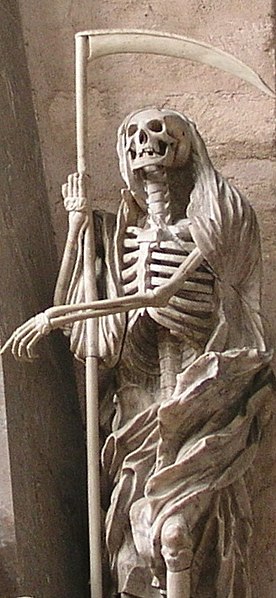
File:CathedralOfTrier Skeleton.JPGThe film that deserved the Best Animated Short Feature Award at last year's Oscars, "The Lady and the Reaper" is an eight-minute piece from Spain. It starts sentimental, then surreal, then absurd. We see an aging woman, longing for her husband and ready to pass away. One night, she dies, and her spirit happily takes the hand of the Reaper to go to the other side--until she's saved. Briefly, a Time magazine photo is seen introducing us to a "famous doctor who saves another miserable life." This doctor is proud of his accomplishment, regardless of the fact that his patient wants to die, but his stubbornness is only matched by the persistence of the Reaper, as the two begin in a seemingly-endless battle over this woman. It is probable that many could make arguments about end-of-life issues with this film, but it is also doubtful that such an idea was the intent of the film. This movie is funny, wonderfully engaging and has a very effective musical score from Serio De La Puente. In my formative years as an ESL teacher, I would show this to my students, regardless of age or level, and of course the activities and assessments would vary, but it was usually a very enjoyable lesson.

The Cow

Dariush Mehrjui's "Gaav," or "The Cow," is about a universal theme regarding a working individual in unordinary times. In this case, he finds himself pitted against every member of the community. Ezzatolah Entezami plays a villager whose proudest prize and accomplice is his cow. While journeying away from the village, the cow is killed by a rival village. The community is concerned that Entezami's character will be unable to cope with the loss. As a community, they decide to tell the villager that his cow has run away. In an interview, Mehrjui talked about how the film was produced in 1969, at the time of the Shah's hightened propaganda about Iran entering a new period of modernity. He noted that the Iranian government was ashamed that Iran was being represented by its "un-modern" villages at international film festivals. But Mehrjui felt the absence of art films of Europe and America in Iran, so he made this film. Incidentally, the film launched the career of Entezami, who is considered one of Iran's greatest actors. The film is also regarded as the start of the Iranian New Wave, and it was also supposedly a favorite of the Ayatollah Khomeini.

Star Trek IV: The Voyage Home

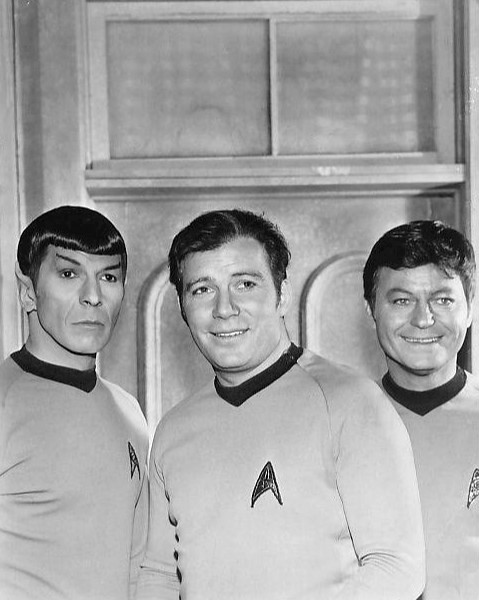
File:Leonard Nimoy William Shatner De Forest Kelley Star Trek 1969.JPG
After the seriousness of the previous "Star Trek" film, "The Search for Spock," the cast and crew decided to take a much more light-hearted approach. Practically a slapstick comedy but also with a sincere environmental message, Captain James T. Kirk (William Shatner) and his crew approach Earth to find that their planet is being destroyed by an alien species. Spock (Leonard Nimoy) quickly (in a matter of seconds) decides that it must be because whales are extinct, so they must return to the past (1986) to bring back a humpback whale to communicate with the aliens. Once that ridiculous exposition has passed, the film becomes incredibly enjoyable, as the characters try to make their way through San Fransisco. Chekov cannot understand that 1986 was still during the Cold War, and that it might appear supicious for a man with a Russian accent to be asking for directions to the nuclear vessels (or "nuclear wessels"). Scotty cannot figure out how to speak to the computer, speaking into the mouse as if it is a microphone. Bones finds the primitive surgeries of the hospital to be similar to practices used in the Dark Ages. And Spock's state is disguised by Kirk as being the result of too much drugs in the 1960s. It doesn't help their cause as they explain that in the future there is no money, thus making it difficult to pay for dinner.

Thirteen Days

President Kennedy is warned that the missiles are within range of American cities, that the government would only have five minutes notice, and that the missiles have the potential to kill eighty million Americans. He is surrounded by a group of various factions, led by pacifists like Adlai Stevenson, pragmatists like Robert McNamara and hardliners like Curtis LeMay. The tremendous amount of pressure on the Kennedy administration is efficiently demonstrated in this movie, a movie I would consider virtually the only film justifiably shown at full-length in a social studies classroom. Kennedy, played by Bruce Greenwood, is advised primarily by his brother, the Attorney General Robert Kennedy (Steven Culp) and his chief of staff (Kevin Costner), a role which was largely exaggerated for probably several reasons. Regardless, it's a fascinating film.

Powaqqatsi

Godfrey Reggio's "Powaqqatsi," the sequel to his "Koyaanisqatsi," is a similar-themed documentary. While its predecessor focused on the juxtaposition of nature and modern technology, "Powaqqatsi" has a focus on the impact on humans, specifically on the cultures and work ethics of third world nations. What drives this film, and Reggio's others in his trilogy, is Philip Glass's awesome score, particularly the opening moments as well as what is usually titled "Anthem: Part 2," which was used in trailers for films such as "Philadelphia" and "Dead Man Walking" as well as a sequence in "The Truman Show" (also scored by Glass, a decade later). Michael Dare wrote, "If I could send just one film to the stars as a tribute to the beauty and passion of our species and planet, I'd have a hard time choosing between the two films of Godfrey Reggio. They're both masterpieces, affirming and lifegiving, raising the art of film into the stratosphere. The common language of no language makes his films perfectly international; I can't image anyone from any country seeing them and not walking away with the same message--that our homeworld is beautiful and giving, that all humans are equal in the sight of mother earth, that if we take from her more than she's willing to give, we must suffer the consequences."

Harakiri

Known as the essential "anti-samurai" film, there are many reasons to watch this movie. Its eerie and almost demonic cinematography is reminiscent of more well-known Japanese films like "Onibaba" and "Throne of Blood." Masaki Kobayashi's "Harakiri" is a repudiation of feudalism and authoritarianism, set in the Edo period, as Japan ended its isolation and began the Empire of Japan. Imperial Japan was obviously a period of severe aggression, and it seems to be that Japan feels a great amount of guilt because of this but also wishes not to specifically apologize for its aggression. Anyway, this period served as an allegory for the film. The film's most powerful moment, for most, is its scene of seppuku, or, as it is defined, Japanese ritual suicide by disembowelment. The character must use a dull blade (he has sold his sword for food for his family) to commit the act. Supposedly, when the film was shown at the 1964 Cannes Film Festival, members of the audience fainted. See Joan Mellen's Criterion Collection essay and NonStoptoTokyo's Youtube post for more information about the film.

Murmur of the Heart

"Murmur of the Heart," directed by Louis Malle, explores a very unique family. The family, not dissimilar from other families depicted in films, particularly in French films, is led by an opinionated father, with an independent mother, two rambunctious older boys, and one younger boy who happens to be fourteen-years-old and desperate to lose his virginity. His route of doing so cannot be described as conventional, and can be viewed as quite shocking, but much time has past since 1971 when the film played in America, so I will not be the one to provide the details (just go ahead and watch the film). This boy, played by Benoit Ferreux, is more mature than his older brothers but willing to go along in search of his identity, and thus we have a quintessential coming-of-age story. He tries cigars and prostitutes (until that is spoiled by his older brothers), but his quest is postponed (or is it?) due to his heart condition, which requires a hospital stay away from the city. Here, perhaps, he will find what he is looking for.

The Purple Rose of Cairo

While Woody Allen's "Crimes in Misdeamnors" four years after this movie carried with it such a heavy weight which was a feature in some of his later films like "Match Point," "The Purple Rose of Cairo," while serious in romance and the emotions of disappointment, was much lighter. Like any character in an Allen film, Mia Farrow's leading role is one who despite her misery finds solitude in Depression-era America at the movies. Continuing to see the same romance film over and over again, she eventually falls in love with one of the characters, played by Jeff Daniels. A crisis is soon to unfold, as the character Daniel's plays in this fictitious movie jumps out of the screen and begins to talk with Farrow. The crisis, of course, is that now the movie cannot continue with its important character, so the studio sends the actor (also, obviously, played by Daniels) to try and convince this character to return to the movie. As might be expected, a love triangle commences. This movie's sentimentality is perfect, expressing a nostalgic tribute to movies without becoming too engrossing and is one of Allen's finest films.

Young Mr. Lincoln

While exaggerated in many parts for obvious reasons, I was surprised at how accurate many other parts were; the mysterious case Lincoln the lawyer must solve and the way in which he solved it are not entirely an invention. Henry Fonda in the title role (the same year his good friend yet ideological opponent Jimmy Stewart played another idealist politician in "Mr. Smith Goes to Washington") also looked remarkably similar to a younger Abraham Lincoln. I once asked on IMDb about the makeup effects, as I was convinced that Fonda's cheekbones and forehead were made to appear more robust as Lincoln's were; I was reminded that 1939 also saw the release of "The Wizard of Oz" and its even more impressive makeup techniques. Lincoln, as many are aware, was a complex president, a man of ambiguous nature who signed the Emancipation Proclamation yet who was the only serious politician in the country who endorsed such a silly idea of colonizing American blacks from American soil to Liberia. He was a man who is regarded as a principle figure in freedom yet was the closest an American president has come to tyranny. He fought a war to free slaves yet did so with the sole purpose being to keep the Union in tact. Lincoln was a man of depression, serious thought, and haunted by death. Yet these serious themes are largely ignored here, and Fonda's Lincoln focuses on the Lincoln of humor, wit, intelligence and storytelling.

Wednesday, July 28, 2010

The Ghost Writer

In "The Ghost Writer," Ewan McGregor's character, simply credited as the Ghost, is reassured by someone that he cannot be killed like his predecessor was, because ghostwriters are not cats. This is little comfort to the Ghost, for he is well-aware that he (like many characters in Roman Polanski's films), is someone in conditions that do not favor him, and against characters that are not ones to advance his well-being.

The Ghost is a writer, ignorant of current events but hungry for a good job, who has been hired to be the ghostwriter for Adam Lang, a former British prime minister and one of considerable controversy. Lang, played by Pierce Brosnan, resigned from his office after allegations spread that he illegally handed over British citizens accused of being terrorists to the CIA; the CIA tortured them and thus made Lang guilty of a war crime. The situation is made remarkably worse when the Ghost learns that Lang's former aide and the original ghostwriter was found dead in the waters next to Lang's compound.

Brosnan seems to be deeply concerned, as were some of his predecessors, as being typecast as James Bond. Brosnan was humorous in "The Matador," sang in "Mamma Mia!" and now is a nasty politician in Polanski's film. His performance is the most interesting to watch, though his scenes are few, but McGregor does his usual effective job in the leading role. McGregor's character is a typical one lost in situations beyond his control, as is often the case with Polanski's characters.

Oliver Wendal Holmes famously (and supposedly) said of Franklin Roosevelt that the president had a first-class temperament but a second-class intellect; Lang probably has neither. He is clearly influenced by others, drawing significant parallels to the Blair-Bush relationship. The allegories are not lightly-hinted--the America Secretary of State in the film looks remarkably similar to Condoleeza Rice. Additionally, he is half the talent of the Ghost, and it brings to mind other famous ghostwriters, as varied as Wolfgang Mozart and (speaking of Bond) John Barry, who has claimed he is the original composer of the famous Bond theme and not Monty Norman, who is credited with writing the score. (Incidentally, this is not a major theme of the film, but simply an observation.)

One disappointing aspect of the film is that it relies on the tired use of an ambitious, Lady Macbeth wife pulling too many strings, though the character is very enjoyable to watch Olivia Williams play her. And while this film may be a thriller, it's not always thrilling. The first and third half are fine evidence of thriller-making at its best, and while Polanski should be rewarded for not falling into cliches, he certainly does seem to lose a bit of bearing as it becomes dull and disorganized. Still, in an age of 3-D, CGI hyperbole, and the overuse of intensity, it is nice to see Polanski remind filmmakers how to make a good movie.

Friday, July 23, 2010

A Fish Called Wanda


Many have noted filmmaker Errol Morris' article in the New York Times on anosognosia. Morris tells the story of David Dunning, a professor of social psychology at Cornell University, reading the newspaper to discover a bizarre story. The article was about a man named McArthur Wheeler who was arrested after attempting to rob two Pittsburgh banks. He attempted to rob the banks in daylight, but what really made the story unique was that Wheeler did not attempt to disguise himself. Wheeler was totally perplexed after he was arrested: "But I wore the juice," he insisted. As Morris writes, "Apparently, he was under the deeply misguided impression that rubbing one's face with lemon juice rendered it invisible to movie cameras."

Wheeler had been told of the phenomenon of smearing lemon juice on one's face to mask it from surveillance cameras. He was at least somewhat cautious, as he conducted a test to verify the results; indeed, the pictures showed no face. Perhaps it was because he had in fact mistakenly turned away from the camera just before it went off.

We have all heard of stupid criminals, but Wheeler takes the cake. Dunning suddenly realized something as he was reading the article. Perhaps Wheeler was not simply too stupid to be a bank robber, but instead was too stupid to realize that he was too stupid to be a bank robber. This is identified by Morris' article as anosognosia, which is when a person suffers from a disability but either is unaware of the condition or is unwilling to admit it exists. In the case of McArthur Wheeler, he was too stupid to realize he was stupid.

Many characters in "A Fish Called Wanda" probably have such a condition.

Written by John Cleese and directed by Charles Crichton, the film opens with three of its main characters: Jamie Lee Curtis as the title character (sort of), Michael Palin (an alumnus of Monty Python with Cleese) as a stuttering animal lover named Ken, and Kevin Kline as a maliciously-witted Otto, not daring to hide any compassion and instead horrifyingly staring at Ken's obvious stutter. "That's quite a stutter you've got there, Ken," he teases, interrupting his sentence with a chuckle. Otto also isn't afraid to mention to Ken that he once had a friend in the CIA who had a stutter which "cost him his life."


Wanda and Otto, with Ken and Wanda's boyfriend George (Tom Georgeson), rob a bank, then double-cross the ring leader while pretending to be brother and sister. They discover though that they too have been betrayed, as the stolen jewels have disappeared. Cleese himself then appears as a lawyer attempting to find some actual satisfaction in his life but instead is taken for granted by his wife and daughter. Cleese, as Archie Leach (Cary Grant's actual name), will be representing George at his trial.

Curtis is perfect at portraying such a seductive and funny character. And while it's reasonable to believe that perhaps Cleese's character would be the smart one of the group, he is the one who dances in the nude (while speaking Russian), only to discover a family walk in on him. Kline in particular is wonderful to watch. He is as animated as Chaplin and as fast as Keaton. Moment after moment, he shines. He is ready to assassinate Ken (regardless of the consequences), he loquaciously speaks Italian as he makes love, and he deeply inhales the leather boot of Wanda in the film's best fetish moment. He likes winning, too, and when he is challenged on the United States losing the Vietnam War, he shouts, "We didn't lose Vietnam! It was a tie!" His jealousy, his hatred of the Brits, his constant need to complicate things are all marvelously done by Kline. But as clumsy as Otto is, there is something deeply troubling him. To tie in the Morris-Dunning-Wheeler aspect, Otto is frequently called stupid, and his voice slows--"Don't ever, ever call me 'stupid,'" he warns. There is complexity here, yet Kline allows hyperbole without losing control, and there is an endless amount of stupidity with his character. For Kline's performance, he was awarded the Academy Award for Best Supporting Actor.

There is a flaw with a certain scene involving a dog, and I stand with Betty White in the stance that violence against animals is not funny. (May Ms. White forgive me, for I couldn't help but at least smirk at such dark humor.) In a post-Capra era, though, this is one of the finest examples of slapstick humor the movies have seen.

Wednesday, July 21, 2010

Inception

Christopher Nolan's "Inception" is a film about characters who perchance to dream. There is something deeply philosophical and fascinating about man's ability to dream, to analyze and reflect on one's own dreams, one's own nightmares, that offers women and men the ability to command such creative power that would make everyone a Dante or Shakespeare, as H.F. Hedge put it, and Nolan capitalizes on this.

There seems to be a genuine dissonance between man's rationality of being awake and the insanity of dreaming, where all absurdity and surrealism is finally available. This is the case with Nolan's film, a film which almost entirely creates a perfect equilibrium between intellectualism and entertainment.

The story is likely inspired by the science and psychology of lucid dreams, that is when a dreamer recognizes and acknowledges that he or she is in a dream. Many characters have such moments in "Inception." The film toys with our own recognition of dreams in that it is difficult to recollect them; we in essence quickly forget what dreams we dreamed. Another aspect is dream incubation, or the placing of a seed in the brain, or inception.

Leonardo DiCaprio plays Cobb, a dream extractor who leads teams to steal secrets from people's dreams. But in this case, for a complicated and quickly-described reason, Cobb and his team are not extracting but creating an idea in someone's mind. Dreams within dreams are created, totems are used to detect whether or not the person is in a dream, and the subjects (those whom the idea is created or stolen from) possess subconscious protections against the extractors. The more dreams-within-dreams that are created, the more risk there is; usually "death" in a dream returns the dreamer to reality, but with heavy sedation (as is the case on the team's special assignment), being killed could result in actual death. To die is truly to sleep for these characters.

Like in Scorsese's "Shutter Island" from earlier this year, DiCaprio's character is a man struggling with deep guilt and alienation. It is as if he exists in a prison when he is awake, and dreaming provides him the perfect escapism. The dreams allow him to take enormous risks, regardless of the potential consequences to him and his team members.

Another wonderful aspect is the fact that Nolan has largely avoided shortchanging his actors. Aside from Michael Caine and Pete Postlethwaite who both have small roles, this is an ensemble piece, with DiCaprio, Ellen Page, Joseph Gordon-Levitt, Ken Watanabe, Marion Cotillard, Tom Hardy, Cillian Murphy and Tom Berenger all having important roles.

With Nolan, there is a special attention to detail, and when there are elaborate and expensive CGI images, one gets the sense that Nolan, unlike so many other directions, has not forgotten that the onus is on him to make the audience believe that these images are real. Cities fold onto themselves and characters fly like acrobats in a gravity-less corridor. There are nightmares--Cotillard's near-perfect moments as practically a ghost tormenting Cobb's guilt--filled with sudden horrifying glances, a look that could kill. And then a firm grip with a broken glass, and a powerful charge. And there is the wonder of subtext with regards to psychology and even architecture, all culminating in a film inspired by obvious previous science fiction films.

But this is a film with flaws. While there certainly is a sense of wonder here, that wonder unfortunately often does not go far enough. At times it feels as if there is nothing really new here, unlike other films that have dealt with similar subjects, as varied as Wilcox's "Forbidden Planet" to Hitchcock's "Spellbound," to Kurosawa's "Dreams." This film has been called a Kubrickian masterpiece; it is not. Part of the reason is that Nolan already is one of the best directors around, so the bar is just so high every time, but that does not mean one should not see "Inception." If you can tolerate the intensity, confusion, rapid speed at which the plot is explained, the lack of details to the plot, the real-or-not jargon about our dreams, the non-stop gun fights, etc., then it is a film worth seeing. There are many reasons to see this movie: its thrills, its acting, its cinematography, its ideas and especially its visuals.

You probably have heard about the ending. I won't mention much, other than it will probably make you smile (or groan if you are less patient or intellectually curious), and it would be best not to dwell too much time on it.

Saturday, July 10, 2010

Empire of the Sun

Steven Spielberg has created a legacy as the ultimate magician of the cinema. His movies have, for the most part, been bright, magical pictures, as is the case here in his 1987 film "Empire of the Sun." With this film, a coming-of-age World War II story, Spielberg indulges in familiar formulas: a lost boy without his parents, a yearning towards reconciliation, a feeling of miraculousness.

Almost always, Spielberg's combination works. Here it does at times, but there is no concrete epicenter, and instead it oversimplifies things and overly-complicates others. "Empire of the Sun" is a movie that often has that Spielberg quality of excellence but more often feels too long, too boring, and even too Spielberg.

A young Christian Bale plays Jamie Graham, the son of wealthy parents living in Shanghai in the 1930s as war breaks out between China and Japan (and the world, of course, for that matter). Jamie is as imaginative and charismatic as he is spoiled and selfish, but he is also quite interested in planes. In fact, it is his toy plane he tries to retrieve which separates him from his family during the chaotic and frightening invasion. Lost, scared, and confused, he returns home where food will run out. Often exactly in the right place, he joins an American sailor named Basie (John Malkovich), and the two develop a friendship, despite Basie constantly betraying him. The two are eventually captured and moved to an internment camp and wait for the war to end.

As mentioned, "Empire of the Sun" is either too complicated or too simple. It is too complicated as it involves an enormous amount of characters which were probably given their proper explanations in the autobiographical novel by J.G. Ballard which the film is based on. There is a doctor, a young Japanese man Jamie befriends, a brutal Japanese captain, an impatient British couple, and parts of Basie's gang which are all practically ignored. It is often too simple, as well. Towards the end of the film, Jamie, now called Jim, witnesses a bright and sudden light approach and push against his body. Instead of allowing reasonably intelligent viewers to ascertain that this is most likely one of the atomic bombings on Japan, Spielberg inserts a radio broadcast to provide exact details of the event. If that still could not suffice, Jamie offers out loud his realization of what has occurred and how he mistook it.

Most of the film is wonderful to look at. It involves dreamlike visuals and another majestic score from John Williams. But at times it feels like another attempt at "E.T.: The Extra-Terrestrial," though it is worth noting that in 1987, Spielberg, along with his 1985 period piece "The Color Purple," was emphasizing his directorial range, shedding the perception that he could only direct children fantasy stories. (Then came "Hook" in 1991, and he would have to wait another two years with "Schindler's List" to finally secure the reputation he deserved and strived for.) Again, at times the quasi-fantastical nature of "Empire of the Sun" feels justified, and at other times it feels gratuitous. It is also noteworthy, though, that Spielberg discussed in interviews about this story being the anti-Peter Pan story in that this is about a boy who has grown up too quickly. And so far, no praise has been given by the reviewer to the performer playing that boy, Christian Bale (the future American Psycho and Batman). It is a very commendable performance, as are the other performers throughout this film (including Ben Stiller, who has said that he first gained the idea for his 2008 film "Tropic Thunder" while making "Empire of the Sun.")

Overall, "Empire of the Sun" has the feel of a inspirational picture that does not exactly inspire the feeling of being inspired. Instead the film drags on; there is a beginning, middle and end, but the middle seems of epic proportion and unjustly too long. It seems that as matter-of-fact as the story could be, it instead chooses to lack a definitive sequence of events. At times it's "Oliver," at other times it's "Stalag 17," and at other times it at least looks like "The Color Purple" but feels like it possesses the youthful optimism of "Hook." It is an interesting hybrid, and another example of his interest in World War II. World War II, a war Spielberg's father fought in, has often been the setting for Spielberg's stories. His first Hollywood attempt at the subject was "1941," then this film in 1987 (ignore the Indiana Jones films for now), and he finally secured a masterpiece with "Saving Private Ryan" (or "Schindler's List" if you prefer to consider that film the "third time's a charm" entity).

Saturday, July 3, 2010

The Dead Zone

As the film opens, Christopher Walken, the patron saint of eccentricity in the movies, is reading out loud Poe's "The Raven" to a classroom of students. It is immediately clear that his will be an enjoyable film. David Cronenberg's "The Dead Zone," from a screenplay by Jeffrey Boam based on Stephen King's novel, is an epic picture, despite its relatively short length of about 103 minutes, and immensely enjoyable to watch.

Walken's character, in that opening classroom, presents himself as a content man with an exaggerated smile; there's no real reason to doubt that most of his students probably like him, and as the audience discovers throughout the film, his character is passionate about education (King was also an English teacher himself before he became a full-time writer). Incidentally, Walken the teacher instructs his students to read "The Legend of Sleepy Hollow," and if Christopher Walken could see the future as his character did in "The Dead Zone," he would know that about fifteen years later he would play that very headless demon he refers to.

Walken plays Johnny Smith (a name almost changed by Cronenberg due to its hard-to-believe simplicity). In love with his fellow teacher (Brooke Adams), Smith drives home in a storm and suffers from an accident. He finally awakens in a clinic. It is explained to him by his doctor (Herbert Loam) with dark-brimmed glasses and Polish accent (elaborated on later in the film) that he has been in a coma for five years. His girlfriend has left him, married, and now has a child. He obviously does not have his job anymore and requires physical rehabilitation.

These challenges would be difficult enough for any man, but Johnny discovers that he now has been blessed (or cursed) with the ability to see the future. One day in his hospital bed, he touches the hand of the nurse and suddenly can see that her daughter is in great danger. He shouts to the nurse that there is enough time; the daughter is saved. Johnny's life is completed altered.

Other characters appear in the story to utilize or be affected by Johnny's ability. Tom Skerrit is the local sheriff who has run out of options to find the Castle Rock Killer involving the rape and murder of young women. To the sound of the operatic score of Michael Kamen (one of the rare occasions in which Cronenberg did not use his frequent composer Howard Shore), Johnny helps the police track down the killer. Then there is a politician named Greg Stillson played by Martin Sheen in some of the film's best scenes. Stillson is a character that is the complete antithesis to some of his other characters like the loyal chief of staff in "The American President" and a practical, idealistic president in "The West Wing." He proclaims in a Pentecostal manner that he has a vision that he will one day be president (he played the title role in the miniseries "Kennedy" the same year), and Johnny becomes alarmed at the dangers of such a man and whether his power gives him the responsibility to act against the possible future.

Cronenberg's films are not usually scary so much as highly stylized, as is the case here (the exception is "The Fly," which manages to succeed in both aspects). Walken is effective from the beginning; his performance shows a man shifting from states of fright, command and anger, and he does so at complete ease. Not as accoladed as his performance in "The Deer Hunter" or as oft-quoted as his role in "Pulp Fiction," Walken's role in "The Dead Zone" is terrific and certainly one of his best performances.

Wednesday, June 16, 2010

The Giant Claw


I used to think that the "best worst movie" ever was "The Tingler" from 1959. Starring Vincent Price as a doctor studying the psychological aspects of fear, what started as a rather interesting psychological thriller with some witty dialogue evolved into a bizzare monster movie; the tingler was, if I recall correctly, some sort of creation born in the spine when someone developed fear. Price's character somehow removed the tingler from someone's spine, and thus it was released to reek havoc. To its defense, "The Tingler" had some descent moments. There was the mentioned humorous dialogue, Vincent Prince, some clever and presumably expensive gimmicks (like placing electrical buzzers under the seats when the tingler escapes and planting "nurse" actresses to "faint" during some scenes). "The Giant Claw" from 1957 allows "The Tingler" to seem epically classic in retrospective comparison.

The opening of "The Giant Claw" involves some wonderful exposition from a narrator explaining to an audience about the "raed-ah" ("raed-ah" and other ridiculous jargon try to pass as authentic and authoritative science, even by 1950s monster movie standards). In the skies there is a UFO (that's "unidentified flying object," the narrator tells us, since we probably don't know). Jeff Morrow and Mara Corday play two officials (Morrow a radar expert and Corday a scientist) trying to explain to government officials the existence of some sort of flying monster from an antimatter galaxy--oh, who the hell cares?


This flying monster has the wings of a turkey, the neck of a brontosaurus, the face of the late ugliest dog on the planet, the hair of crazy Travis Bickle and the likability of Snooki. Even that description does not quite do it justice, so plenty of pictures are provided. Of course, missiles and even nuclear bombs cannot stop the monster, and it can't even be picked up on the rad-ah.

Director Fred Spears was no Ed Wood. There seems to have been no evidence of passion or dedication in the making of this movie. Spear's movie shifts from one annoyance to another. There's an actor with an accent changing from stereotypical French to stereotypical Mexican. This character is petrified, and the local sheriff explains to the two main characters that they must rush to make it to the plane, though he does have enough time to explain the legend of this creature--that the villagers believe that someone dies after seeing the monster. Of course, the French-Mexican has just seen the bird, but why should that stop story time?

A Vincent Price-like character (Edgar Barrier) is provided to throw out some jargon about antimatter. The Price character has maybe, at best, only seen some pictures and descriptions of the bird (and a feather, but "we don't know if it's a feather," he says), but he can issue some hypothesis, that the bird is extra-terrestrial, coming from a galaxy billions of lightyears from our own. "No other explanation is possible." There's other wonderful dialogue. A pilot, before he and the others are killed by the bird, jokes that he will "never call [his] mother-in-law an old crow again!" Someone else says, "I don't care if that bird came from outer space or New Jersey!" (Is there a difference? Please forgive me for such a predictable joke.)


Like in "Jaws" two decades later, there is a wait to see the monster, but the reward is almost equal, for obviously different reasons. In flight the bird is often out of focus (deliberate, you think?). When it is in focus, the breathing nostrils are clearly visible. Murrow claimed that the actors did not know what the monster would look like until they had to painfully sit through the screening and endure the snickering of the audience; he walked home drunk that night. I imagine that maybe alone in a dark studio at night; then, and only then, and just maybe, would this monster be a bit alarming. Instead, it might be one of the silliest things the movies have ever known. What inspires such a movie? Wouldn't it be great to read some long-forgotten documents about the making of this film? With all the things Obama has to deal with, maybe he'll also have to save us from a giant buzzard, and the media will criticize him for not being angry enough at the bird.

Bruce the Shark from "Jaws" recently turned up in a junk yard. Perhaps the Giant Claw will as well.

Friday, June 4, 2010

A Simple Plan

It's all quite Hitchcockian. These are ordinary characters caught up in extraordinary circumstances. There are even symbolic black crows guarding a destroyed plane, a sort of Pandora's Box. Sam Raimi's "A Simple Plan," from 1998, does Hitchcock better than most other post-Hitch films.

The film reunites Bill Paxton and Billy Bob Thorton, who both starred in "One False Move" six years earlier. Paxton is Hank Mitchell, a working man and college graduate seemingly happy in love with a pregnant wife (Bridget Fonda). He is employed but of course faces not unusual economic troubles. His brother, Jacob (Thorton), is considerably less intelligent, rational, and respected in their Minnesota community than his younger brother. One cold, snow-covered day, the two venture into the woods during a hunting trip with Jacob's drunk friend (Brent Briscoe), who, like Jacob, is unemployed. They stumble upon a crashed plane with a dead pilot (black crows devouring his eyes) and millions of dollars in stolen money. While Hank is initially the calm Boy Scout, insisting the money be turned over to the police, he is eventually convinced into keeping the money. The three make a series of promises and missteps, all the while the situation and their chances of not getting caught deteriorate.

Thorton's performance is the great moral centerpiece of the film, as Paxton's character struggles but overcomes his sense of guilt. Jacob, unable to be analytical about such feelings and complex situations, cannot help but "feel evil." If "evil" is a word only best fit for fiction, then that is satisfactory for this man; any deeper evaluation would be too great.

"A Simple Plan" requires some patience, for some scenes are a bit annoying. Paxton's character acquiesces to the desire of money, the root of all evil, too quickly, while Fonda's character is so much Lady Macbeth that during her first moments with her new baby, she quickly but calculatingly insists that her husband set up one of the members of the trio. Still, one cannot deny how engaging it becomes as the stakes constantly rise. Here are characters trying to rationalize their irrational behavior, and the film has such terrific actors, some of whom (like Paxton and Thorton) have never really been given their full appreciation. And unlike Hitchcock films, there is a certain amount of Biblical symbolism here (the Biblical Jacob's brother, Esau, had a unique relationship with his brother, though the Biblical Jacob was the shy one).

This is a terrific movie. Danny Elfman's score, during a period in his career where he shifted away from comic book films and surreal fantasies to more dramatic films like this and "Mission: Impossible" and "Good Will Hunting," is spot-on. Raimi's direction is awesome, understanding perfectly how to set the mood and motivations of each moment. It is Hitchcockian without ceding too much to influence. "A Simple Plan" should be remembered for a long time.